Villa Vie Odyssey Residents Explore a Ship Buyout as Fuel-Loan Dispute Looms
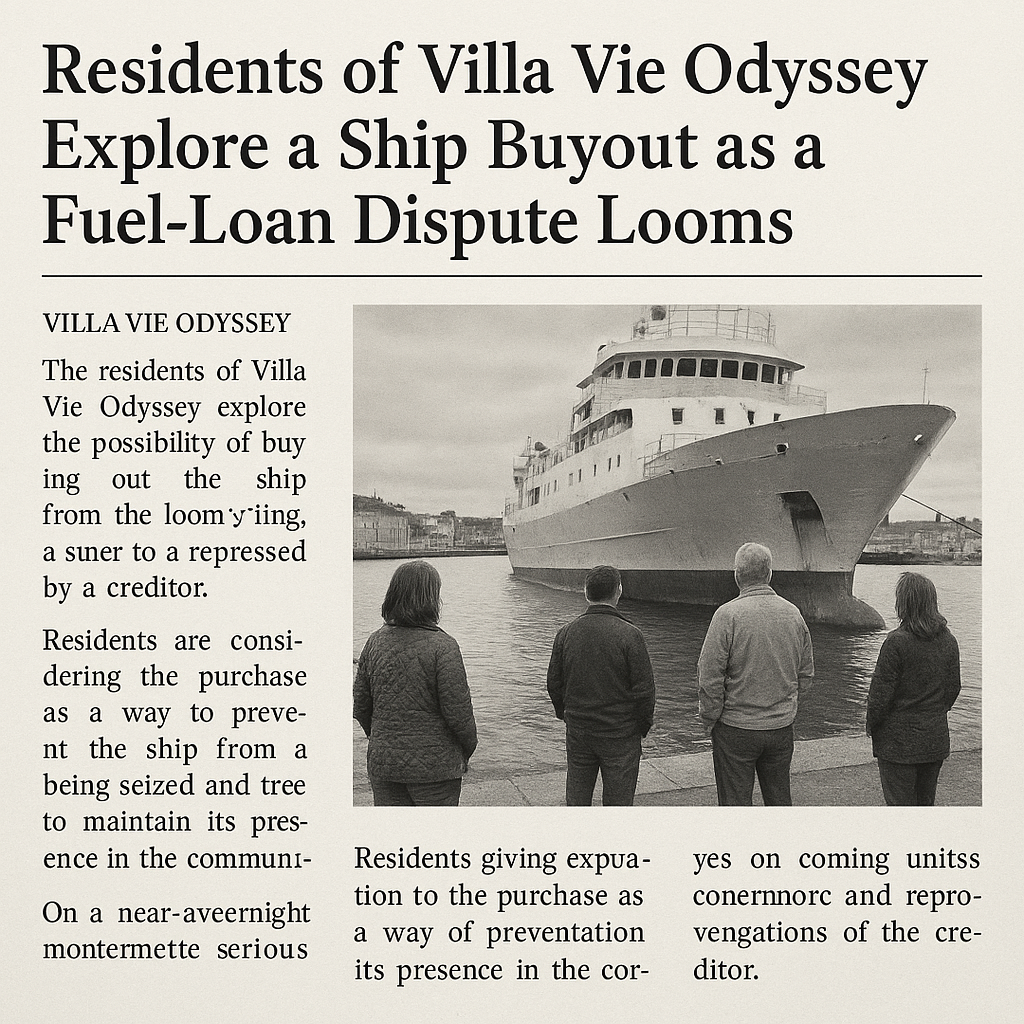
As the Villa Vie Odyssey traveled from Cambodia toward Singapore, where its lender could potentially auction the vessel, two resident-led efforts were seeking ways to regain control of the ship, CBS News reported. One effort had failed after a lender declined to finance residents; a separate group remained interested in bidding at auction, according to sources familiar with the matter.
What happened
The Villa Vie Odyssey became the focus of competing rescue plans after its lender took control of the vessel, according to CBS News. The ship was making its way from Cambodia to Singapore. An auction there was a possibility, not a confirmed sale: the lender’s identity, the terms of its financing, and the timing or legal process for any auction were not reported.
At least two groups of residents explored buying or reclaiming the ship. One effort recently fell through when a lender denied funding to residents, CBS News reported. A different group was still pursuing a purchase at auction, according to two people familiar with the discussions. Sources involved in those talks said that second effort would not include Petterson, the founder and executive chairman of Villa Vie Residences.
The distinction matters. The efforts were not one continuing bid with a single financing outcome. The first group’s approach had encountered a lender’s refusal; the second group’s plan was described as active, but the report did not identify its members, disclose financing commitments, or establish that it had made a formal offer. An intention to bid is not a completed purchase, and the vessel’s future remained unresolved.
Petterson described a separate path he had expected to pursue with an operational partner. He told CBS News that he believed he had secured a partner to help rescue the ship, but the arrangement did not work out. The lender then took the vessel, according to the account. Petterson said he continued to believe he might get it back and was looking for potential investors willing to take over the ship permanently.
He also described another possible route: raising money to file for Chapter 11 bankruptcy and sell the company. Petterson said he no longer wanted to be part of the company’s leadership. “I’m not going to be the front face person of a company any time soon,” he told CBS News. No Chapter 11 case, investor agreement, or company sale was reported.
The uncertainty extends beyond the vessel itself. Residents who had bought cabins or paid ongoing dues may have financial interests different from those of lenders, company owners, or would-be buyers. But the available reporting does not establish the legal form of residents’ cabin arrangements, what rights those agreements provide, or how a sale or bankruptcy would affect each resident. Those questions turn on documents and proceedings not described in the report.
What the reporting does establish is a company facing simultaneous pressure over control of its ship and repayment of resident loans. The two matters may intersect financially, but they are separate disputes: the ship’s potential sale concerns control of the vessel and company, while the fuel-loan concerns involve residents seeking payment under financing arrangements.
Legal context and the fuel-loan claims
CBS News also reported that a group of residents was considering legal action over loans made to support fuel expenses. Residents said they raised more than $2 million in April to help keep the vessel operating as fuel costs rose. The loan program was said to offer returns of up to 24%. The report did not specify how many residents participated, how the total was calculated, or whether every participant received identical terms.
A copy of an agreement obtained by CBS News, described as appearing to be from Villa Vie, called the loan “Unsecured” and said it came without “Collateral or Guarantees.” The qualification matters: the report did not independently establish the document’s authenticity, whether it was the final agreement, or whether it applied to every participant. Those details would matter in any dispute over what was promised and who is legally responsible for repayment.
In general, an unsecured loan is not backed by a specific asset pledged as collateral. That does not, by itself, mean the debt disappears or that a borrower cannot be sued. It can affect the creditor’s remedies and position if the borrower fails to pay, but the contract, the parties’ legal identities, applicable law, and any later court or bankruptcy proceedings all matter. Cornell Law School’s legal reference provides a general explanation of an unsecured loan; it cannot determine the rights created by the Villa Vie documents.
A lack of collateral is also distinct from a lack of a guarantee. A guarantee may make another party responsible for payment if the primary borrower does not pay. The agreement described in the report disclaimed both collateral and guarantees, but Petterson offered a separate explanation of how the financing was arranged: it was structured through Villa Vie’s parent company, Residential Cruise Holdings, because he said restrictions on existing financing prevented Villa Vie Residences from borrowing directly.
That account raises questions the report does not resolve. The parent company’s involvement does not, without the relevant documents, establish which entity signed each resident’s agreement, which entity owes a particular investor, or whether other contractual promises were made. Residents’ recollections of the offer, promotional materials, signed agreements, payment records, and company records could all be relevant. No court has been reported to have decided those questions.
Craig and Cindy Voight said they had been aboard the Odyssey since it left Belfast, Northern Ireland, in October 2024 for a voyage around the world. They told CBS News that they spent more than $300,000 on their cabin and monthly dues and contributed $100,000 to the fuel-loan program. Craig Voight said they expected an 18% return and that the first payment was supposed to begin a month later. He said the amount now owed to them exceeded $113,000 and that they had received no payment.

Those are the Voights’ account of their investment and the amount they believe is outstanding—not a judicial finding or an independently verified debt calculation. The reported program offered returns of up to 24%, while the couple said they expected 18%. The report does not explain whether the difference reflects different terms, a particular offer, or a misunderstanding. Nor does it provide a repayment schedule or show how the couple calculated the sum they say is due.
A promise of a return is not the same thing as a payment guarantee. The agreement’s reported “Unsecured” label may be important, but a complete assessment would require the operative contract and the facts surrounding the offer. Any legal claim could turn on questions such as the borrower’s identity, the repayment terms, what was represented to residents, and what payments—if any—were made. This is general legal context, not a conclusion about the merits of the residents’ claims.
Petterson acknowledged that residents might pursue claims. In a statement shared with CBS News, he said he took their concerns seriously and that the financing had been arranged during an urgent period to meet immediate operating needs, including fuel. He said the loans were structured through the parent company because of existing financing restrictions. Petterson said he would not discuss individual claims or draw conclusions in the media while legal action was being considered, and that the matter would be addressed through appropriate legal channels.
His statement recognizes the dispute but does not establish that the residents have been repaid, that the company accepts their calculation of what is owed, or that a court has resolved liability. The report did not include a response from the lender that took the ship, identify the lender that denied funding to the first resident effort, or say whether either lender was connected to the fuel-loan program.
Law enforcement or court response
The reported developments are commercial and potentially civil in nature. CBS News described residents considering legal action over loans and a lender’s control of a vessel. It did not report an arrest, criminal charge, criminal investigation, filed lawsuit, or court ruling connected to these events. The available information therefore does not establish criminal wrongdoing by Petterson, the companies, a lender, or any resident.
That distinction is important when a financial disagreement includes missed payments and a high promised return. A borrower’s failure to pay can lead to a civil claim, but nonpayment alone does not prove fraud or another crime. Any allegation of deception would require evidence and a legal process; none was reported here. The residents’ stated plan to take legal action should not be described as a judgment in their favor or proof of a criminal offense.
The ship’s lender reportedly took control of the Odyssey, but the report did not explain whether that occurred under a contract, a court order, or another legal mechanism. It also did not provide the loan documents, identify the jurisdiction governing the vessel’s financing, or say whether a maritime lien or other security interest was asserted. General descriptions of secured transactions, including Cornell Law School’s overview of a secured transaction, cannot answer those case-specific questions.
The possibility of an auction is likewise not evidence that a sale has been scheduled or approved. The lender may have rights under financing documents, but the terms and the applicable process are unknown. A prospective buyer would also need to know what obligations, claims, or restrictions could affect a transfer. The report did not say whether the resident group had inspected the vessel, obtained financing, or received permission to bid.
Petterson’s reference to Chapter 11 was a possible strategy, not a court filing. Chapter 11 is a U.S. bankruptcy process used by eligible debtors seeking to reorganize or pursue a court-supervised disposition of assets. The U.S. Courts’ overview of Chapter 11 bankruptcy describes the process generally. It does not establish that Villa Vie or its parent would qualify, where a case could be filed, or how a filing would affect a ship located abroad or contracts involving residents in different places.
A bankruptcy filing, if one were made, would not automatically answer every question about ownership or repayment. The identity of the debtor, the contractual parties, the status of secured and unsecured claims, and the court’s orders would matter. At the time covered by the CBS report, there was no reported filing to review. Any account of the case must therefore distinguish Petterson’s stated possibility from an actual proceeding.
Community and policy implications
For residents, the ship is not simply an asset in a lender’s hands. It is also the setting for a long-term residential arrangement, a substantial purchase for some passengers, and—according to residents—a place they helped keep operating through loans. The Voights’ account illustrates how one household can have several different financial relationships with the same company: cabin costs, monthly dues, and a separate loan. The legal treatment of each may be different.
The possibility of a sale puts practical questions in the foreground. Residents may want to know whether they can remain aboard, whether services and the voyage will continue, how they can retrieve personal property, and whether their cabin agreements transfer to a new operator. The CBS report did not say what arrangements, if any, were made for residents during the vessel’s move or what a change in ownership would mean for them. These concerns are understandable, but the missing terms should not be filled in by assumption.
The fuel-loan dispute also highlights the risks that arise when customers are asked to provide emergency capital to a company whose service they rely on. Residents said they raised more than $2 million for fuel, and the reported agreement described the loans as unsecured. That combination may leave participants exposed if the borrower cannot repay, but the actual risk depends on the agreements, the borrower’s assets and obligations, and the applicable law. The reported return of up to 24% is not proof that repayment was guaranteed.
Clear disclosures are particularly important when a customer relationship and an investment or lending arrangement overlap. Participants need to understand who is borrowing, whether an individual or parent company is responsible, how and when repayment is due, whether collateral or guarantees exist, and what could happen if a business loses access to its principal asset. The report leaves those details unsettled. That gap is a reason to examine the underlying documents, not a basis to assert that the company violated a law.
The episode also shows why separate company entities can matter to residents. Petterson said restrictions prevented Villa Vie Residences from borrowing directly, so financing was routed through Residential Cruise Holdings. That explanation may describe the company’s structure, but it does not answer which entity residents contracted with or where a claim would have to be brought. Corporate organization can shape legal responsibility; only the documents and applicable law can establish how it operates in this dispute.
For any group hoping to buy the Odyssey, the challenge is not only raising a purchase price. A viable plan would also need to address the lender’s rights, operating costs, the ship’s condition, contractual obligations, and the company’s ability to provide the promised service. Those are practical considerations, not reported conditions of a particular auction. No funding package, bid amount, purchase agreement, or transition plan had been disclosed in the account.
Petterson’s stated wish to leave leadership creates another unresolved issue: whether a new owner or investor would retain the existing company, buy the vessel alone, or form a different operating arrangement. The report did not say. The distinction could affect residents’ agreements and claims, but no outcome can be inferred from the fact that different rescue proposals were under discussion.
The episode underscores the need for precise communication in a crisis. Residents need written answers about the status of their agreements and loans; potential buyers need clarity about what is being sold; and creditors need to explain their claims through the applicable process. Petterson said the company would provide information through proper channels. The report did not specify a timetable or the documents that would be made available.
Frequently Asked Questions
Could the Villa Vie Odyssey be auctioned in Singapore?
CBS News reported that the vessel was traveling from Cambodia to Singapore and could potentially be auctioned by its lender. It did not report that an auction had been scheduled, completed, or approved. The lender’s identity, the legal process, and any sale date were not provided.
Are residents still trying to buy the ship?
According to two sources familiar with the matter, one resident-led effort remained active and hoped to buy the ship at auction. A separate effort had failed after a lender denied funding. The report did not identify the active group or confirm that it had financing or a formal bid.
Is Mike Petterson part of the second resident-led effort?
Sources involved in the discussions told CBS News that the second effort would not involve Petterson. He described separate plans to find investors or raise funds for a possible Chapter 11 filing and company sale. Neither plan was reported as completed.
Have the residents sued over the fuel loans?
The report said a group of residents was considering legal action. It did not identify a filed lawsuit, court ruling, or criminal investigation. Craig and Cindy Voight said they planned to take legal action and that they had received no payments on their $100,000 contribution.
What does it mean that the reported loan agreement was unsecured?
The copy obtained by CBS News described the loan as unsecured and said there was no collateral or guarantee. In general, that means a loan is not backed by a particular pledged asset and another party has not guaranteed payment. It does not, by itself, decide whether a debt is valid or eliminate every possible legal remedy. The final terms and applicable law would control.
Did Petterson say the fuel-loan debt was owed by the parent company?
Petterson said the financing was structured through Villa Vie’s parent company, Residential Cruise Holdings, because existing financing restrictions prevented Villa Vie Residences from borrowing directly. The report did not resolve which entity signed each agreement or which entity is responsible for a particular resident’s claim.
Final thought
The Odyssey’s possible sale and the residents’ fuel-loan concerns remain unresolved in the reporting. A second resident-led purchase effort was still active, while Petterson described options that could include new investment or Chapter 11. For residents, the most consequential answers—who owes what, what happens to their agreements, and whether the ship will continue operating—depend on documents and decisions not yet reported. Until those are clear, a possible auction is not a rescue, a contemplated lawsuit is not a judgment, and an unpaid loan remains a claim to be tested through the appropriate process.