A veteran was arrested after allegedly setting off fireworks and starting a fire in front of a Manhattan building that houses several federal offices...
Veteran Arrested After Fireworks Spark Fire Outside Manhattan Federal Offices, FBI Says
A veteran was arrested after allegedly setting off fireworks and starting a fire in front of a Manhattan building that houses several federal offices, including Immigration and Customs Enforcement, according to the FBI.
Key Takeaways
- Investigators say fireworks were set off outside a Manhattan federal office building before a fire broke out.
- The building reportedly houses multiple federal agencies, including ICE.
- The FBI is leading the case, and prosecutors may weigh arson, explosives, or other federal charges depending on the evidence.
- The incident raises concerns about security at dense federal office locations in New York City.
What happened
Federal authorities say the arrest stems from an incident outside a Manhattan building that contains offices used by multiple federal agencies. According to the FBI, a veteran allegedly set off fireworks and caused a fire in front of the building. The exact sequence of events, including whether the fire was accidental or intentionally set, will matter as investigators reconstruct what happened.
The scene is significant because the location is not a single-agency facility. Buildings with mixed federal tenants often serve as everyday workplaces for immigration officers, investigators, administrative staff, and other personnel. That makes even a relatively small fire a broader public-safety concern. 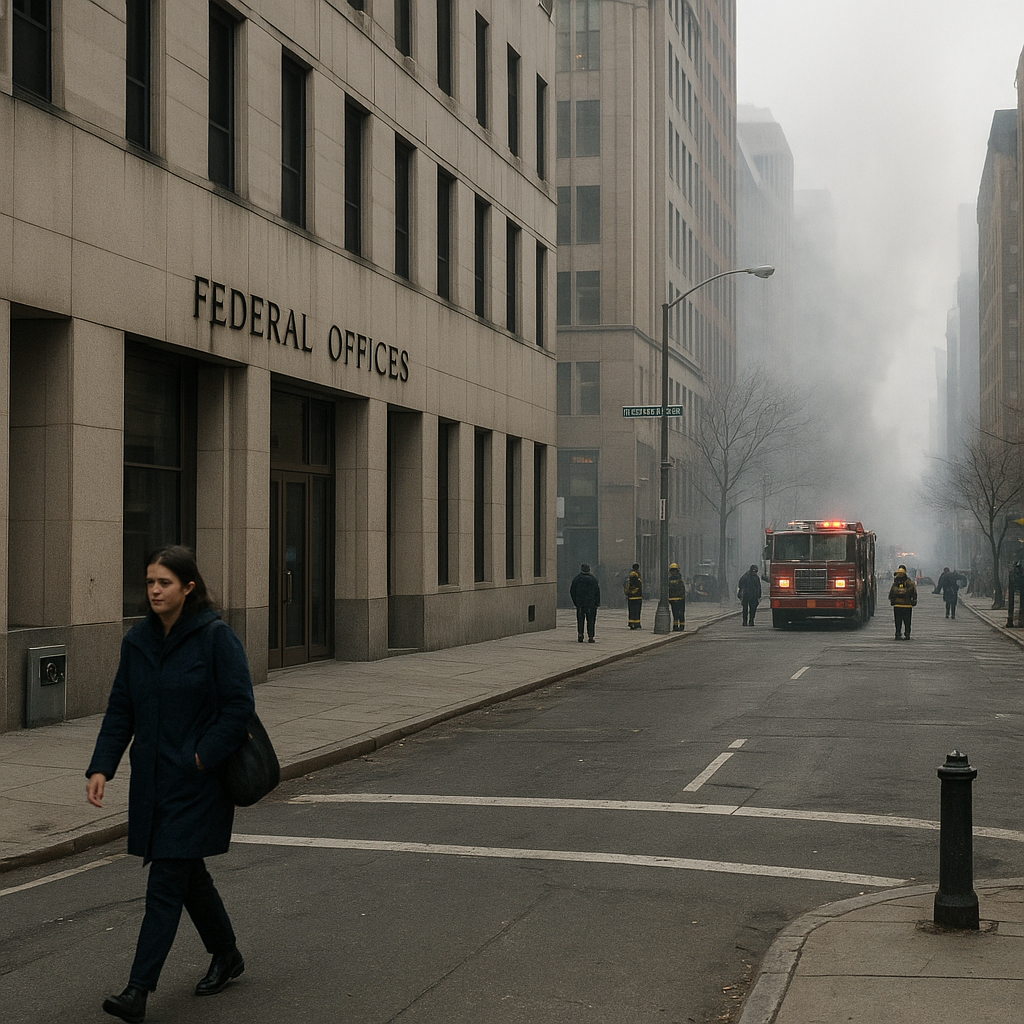
Fire in front of a federal office building can trigger an evacuation, disrupt operations, and place workers, visitors, and passersby at risk. Early reports identified the incident through the FBI, and CBS News correspondent Anna Schecter reported additional details.
Legal context and charges or proceedings
The precise charges have not been fully detailed in the public reporting available so far, but several federal statutes could come into play depending on the evidence. A fire set near a federal building can implicate arson-related offenses, destruction of property, reckless endangerment, and in some situations explosives or firework violations. The government may also assess whether the conduct interfered with federal operations or posed a risk to federal employees and facilities.
In federal cases, the charging decision often turns on intent. Did the suspect mean to ignite a fire? Did the fireworks cause an accidental blaze? Was there reckless disregard for the risk? Those distinctions can shape whether prosecutors file a misdemeanor, a state-level charge, a federal felony, or a combination of offenses.
If prosecutors pursue federal charges, the next steps could include a presentment before a magistrate judge, a detention hearing, and a probable-cause review. Defense lawyers would likely scrutinize the evidence chain, challenge the classification of the fireworks or fire source, and examine whether any statements were obtained properly. 
Federal arson statutes can carry substantial penalties, especially where property used in interstate commerce or by the federal government is involved. But a public statement of arrest does not equal conviction. Many early headlines reflect allegations, while the legal case later depends on laboratory results, witness accounts, and the defendant’s intent.
Law enforcement or court response
The FBI’s involvement indicates that federal officials saw enough at the outset to treat the matter as more than a local nuisance fire. Federal jurisdiction can attach when a crime affects federal property, federal personnel, or certain protected facilities. That often means the investigation is coordinated with the U.S. Attorney’s Office, the Bureau of Alcohol, Tobacco, Firearms and Explosives if explosives questions arise, and local fire or police authorities.
In incidents involving fireworks and fire, investigators typically focus on several questions. Where did the fireworks come from? Were they consumer-grade, professional-grade, or altered in some way? Was the fire started by a burning shell, discarded material, or another ignition source? Did weather, building materials, or debris contribute to the spread? These questions are not peripheral. They determine the legal theory and the seriousness of the case.
Courts will eventually be asked to sort through the evidence. If the suspect is charged in federal court, the early phase may move quickly. The government may seek detention if it believes the person poses a danger or a flight risk. The defense may argue for release, especially if the alleged conduct did not cause major injuries and the defendant has community ties or military service background.
That background can matter at sentencing, but it usually does not eliminate liability. Judges can consider a person’s history, mental health, trauma exposure, or service-related issues during bail and sentencing. Still, criminal courts focus first on public safety and the elements of the offense.
The case also highlights the role of first responders. Firefighters and building security personnel often serve as the first line of defense in incidents near government offices. Even when a fire appears small, the risk calculation changes in a dense urban environment. Manhattan’s federal buildings sit amid pedestrian traffic, transit access, and neighboring office towers. A fire in that setting can have consequences far beyond the immediate block.
Community and policy implications
This arrest raises questions that go beyond one defendant. Federal buildings are common targets for protest, disruption, and symbolic acts, and authorities must distinguish lawful expression from criminal conduct. Fireworks can be used in demonstrations, celebrations, and public events, but they become dangerous when deployed near occupied buildings or in a manner that causes fire or panic.
The presence of ICE offices in the building may also feed political reactions. Immigration enforcement offices have long been flashpoints in national debates over deportation, detention, and federal power. But political controversy does not change the legal standards. A fire outside a federal office building is first and foremost a safety matter and a law-enforcement matter. If investigators show it was deliberate, it becomes a criminal case with potential prison exposure.
For New Yorkers, the incident may also prompt a closer look at building security. Many federal office buildings are not isolated compounds. They sit in mixed-use areas, with employees, contractors, and visitors moving through public space. That raises practical questions: Are there enough barriers at entry points? Is surveillance adequate? How quickly can fire crews reach the scene? Are there clear protocols for suspicious activity outside the building?
At the policy level, cases like this often feed broader debates about the regulation of fireworks and incendiary devices. Local and state laws vary widely, and enforcement can be inconsistent. In a city as dense as Manhattan, even consumer fireworks can cause serious danger if used in the wrong place. Lawmakers may revisit whether penalties are adequate when fireworks lead to fires near critical facilities.
There is also the question of mental health and veteran support. The fact that the suspect is described as a veteran will prompt some to ask whether service-related trauma, substance use, or a crisis contributed to the incident. Those questions are appropriate, but they should be answered carefully and with evidence. Veterans are not more likely than other groups to commit arson as a class. Most are law-abiding. Yet individuals in distress sometimes come into contact with the justice system after behavior that alarms neighbors or authorities.
If charges are filed, the defendant may be eligible for treatment-oriented alternatives at some stage of the process, depending on the case facts, criminal history, and jurisdiction. But when a fire is set near federal offices, prosecutors generally treat deterrence and accountability as central concerns. The public wants to know that government buildings, workers, and nearby residents are protected.
Frequently Asked Questions
What happened in Manhattan?
Authorities say a veteran was arrested after allegedly setting off fireworks and starting a fire in front of a Manhattan building that houses several federal offices, including ICE.
Was anyone injured?
No injuries have been publicly reported in the available coverage, though the incident created a fire risk near an occupied federal office building.
What charges could be filed?
Potential charges could include arson, reckless endangerment, property destruction, or fireworks-related offenses, depending on the evidence and jurisdiction.
Why is the FBI involved?
The FBI may investigate when an incident involves federal property, federal employees, or a threat to a federal building.
Does being a veteran affect the case?
Not in terms of legal guilt. It may matter later in bail or sentencing discussions, but prosecutors still must prove the elements of the offense.
Final thought: The arrest underscores how quickly a fireworks incident can become a federal criminal case when it happens outside a government building and creates a fire. The coming days should clarify whether investigators believe the blaze was intentional, reckless, or the result of a dangerous mistake. Until then, the case sits at the intersection of public safety, federal security, and a justice system that will need to sort allegation from proof.