U.S. authorities in Japan acknowledged that a U.S. service member was in police custody and said they would fully cooperate with the investigation, a...
U.S. Service Member Held in Japan as Authorities Promise Full Cooperation in Investigation
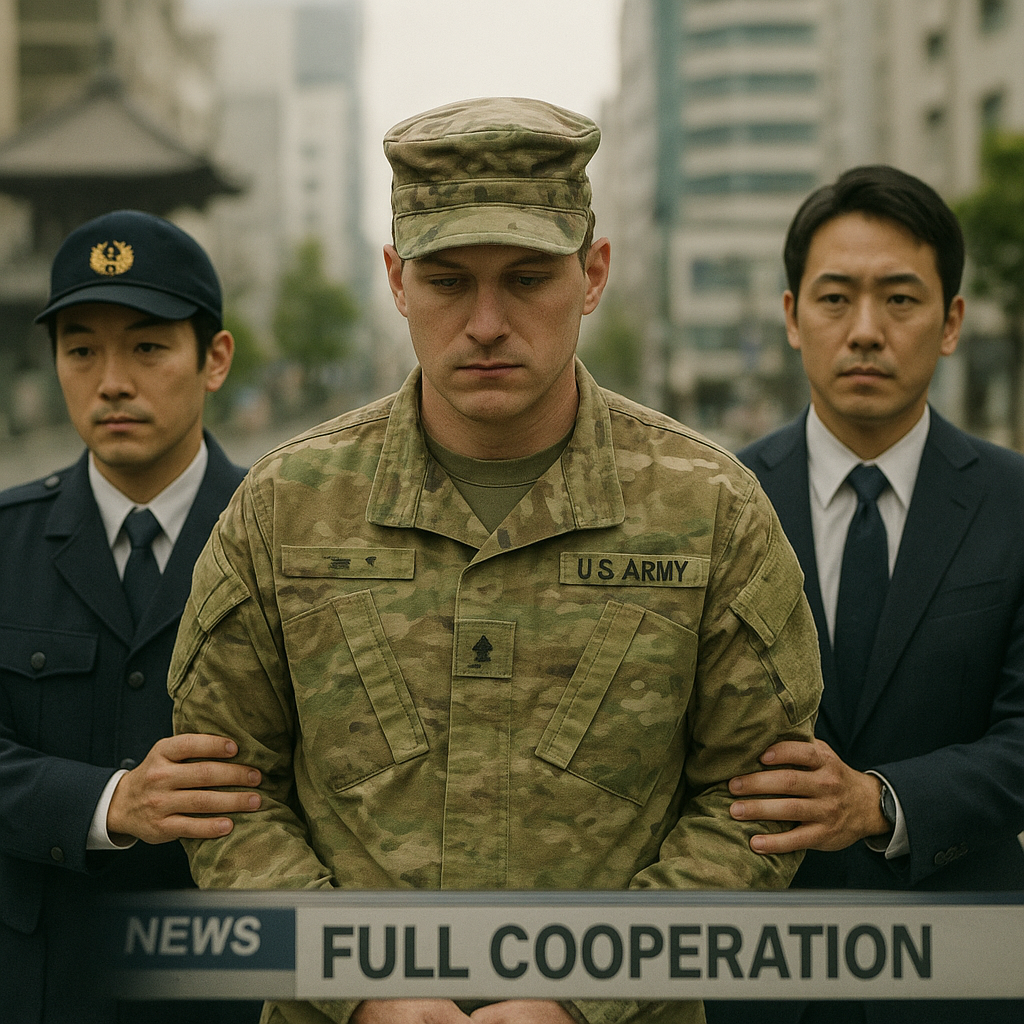
U.S. authorities in Japan acknowledged that a U.S. service member was in police custody and said they would fully cooperate with the investigation, a development that immediately raised questions about the facts of the case, the role of the host-nation justice system, and the status of the bilateral agreement that governs crimes involving American personnel overseas.
Key Takeaways:- A U.S. service member is in Japanese police custody.
- U.S. authorities say they will cooperate fully with the investigation.
- The case highlights the legal framework governing U.S. personnel stationed in Japan.
- Local officials, military authorities, and prosecutors may all have roles in the next steps.
What happened
Japanese authorities took a U.S. service member into custody in connection with an investigation that has not yet been fully detailed publicly. U.S. authorities in Japan confirmed the custody status and said they would assist investigators. That acknowledgment matters because it signals that the matter is being treated as a criminal investigation under Japanese jurisdiction, not merely a military disciplinary issue.
At this stage, the public record appears limited. Authorities have not released a complete account of the underlying allegations, the location of the reported incident, the timing of the arrest, or the service member’s branch of the military. That kind of restraint is common early in a case involving a foreign service member in Japan, particularly when investigators are still gathering statements and physical evidence.
Cases like this often begin with a local police response, followed by coordination between prefectural investigators, prosecutors, and U.S. military representatives. If there was an arrest, it likely stemmed from suspected conduct that Japanese law enforcement believed warranted detention while evidence was reviewed. Depending on the facts, that could involve assault, theft, traffic-related offenses, sexual misconduct allegations, or another offense under Japanese law.
For the public, the key issue is not only what happened, but which authorities will control the process. In Japan, criminal investigations are driven by local police and prosecutors. American military officials may cooperate, but they do not displace Japanese jurisdiction when the alleged crime falls under host-nation law. That point is often misunderstood in cases involving U.S. bases overseas.
The situation also reflects the practical tension that comes with a large American military presence in Japan. Tens of thousands of U.S. personnel are stationed there under a security alliance that has deep strategic significance. But when an allegation arises, it can quickly become a local public-safety concern, a diplomatic matter, and a test of how well the two governments manage accountability.
Similar episodes have shaped public debate before, especially in Okinawa and other areas with heavy U.S. military concentration. Residents and local leaders often demand transparency, while military officials emphasize cooperation and due process. The result is a case that can move well beyond the single defendant and into broader questions about trust and oversight.
For readers following related criminal justice and public accountability issues, this case fits alongside broader coverage of investigations involving government personnel and institutional response. See also recent reporting on police accountability and oversight, military justice and criminal investigations, and cross-border criminal cases.
Legal context and charges or proceedings
The legal framework for U.S. service members in Japan depends on the nature of the alleged conduct, the status of the accused, and the terms of the bilateral agreement that governs the presence of American forces. In general, Japanese authorities can exercise jurisdiction over crimes committed on Japanese soil, even when the accused is a U.S. service member. Military status does not erase local criminal law.
The U.S.-Japan Status of Forces Agreement, commonly called SOFA, sets out how criminal cases involving American personnel are handled. In broad terms, it divides jurisdiction between the two countries based on where the offense occurred and what kind of offense is alleged. The agreement also addresses custody, investigation, and the transfer of the accused when charges are pending.
That legal structure is one reason these cases attract attention. The public often asks whether a service member will be turned over immediately, detained by Japanese police, or processed first through military channels. Under SOFA, those answers depend on the circumstances. In many cases, Japanese authorities handle the investigation and any prosecution, especially if the alleged conduct occurred off-duty and outside a military installation.
If formal charges are filed, the case would proceed through Japan’s criminal justice system. That could include detention, questioning, prosecutorial review, and, if warranted, indictment. Japanese prosecutors are known for high conviction rates and a methodical approach to charging decisions. Defense lawyers often focus on the scope of questioning, evidence preservation, and access to the accused.
The U.S. military, meanwhile, may open a parallel administrative review. That process can affect the service member’s assignment, security clearance, and eventual discipline, even if the Japanese case is still in its early stages. A service member can face both civilian criminal exposure and military consequences.
Depending on the allegations, the case may also raise rights questions. Under Japanese procedure, prolonged detention and repeated questioning have drawn criticism from human rights groups and defense advocates. Those concerns do not determine guilt or innocence, but they shape how the case is viewed inside and outside Japan.
The broader issue is whether the process feels fair to all parties. Local residents want assurance that the law applies equally to U.S. personnel and Japanese nationals. The military wants to show cooperation without overstepping host-nation authority. The accused has the right to counsel, to contest the evidence, and to receive a decision grounded in law rather than politics.
Those tensions are not unique to military cases, but they are sharpened when a foreign service member is involved. The public often treats the matter as a test of sovereignty. Officials treat it as a legal case. Both are true.

Law enforcement or court response
The statement from U.S. authorities that they will fully cooperate with the investigation is significant because it suggests a coordinated response rather than a defensive one. When American officials move quickly to acknowledge a case, it can help prevent confusion and reduce the chance of inaccurate reporting. It also signals to Japanese authorities that the U.S. side is not seeking to obstruct the inquiry.
Japanese police and prosecutors, for their part, are likely to control the investigative timeline. If the accused remains in custody, investigators may continue questioning, reviewing evidence, and interviewing witnesses. The next public update could come from local police, a prefectural prosecutor’s office, or a U.S. military spokesman, depending on how the case develops.
In similar cases, the first official statements are often brief by design. That conservatism protects the integrity of the investigation and avoids prejudicing any potential prosecution. But the lack of detail can also create frustration, especially among residents living near bases and among observers who want to know whether the alleged conduct posed a broader public-safety risk.
Military police or command representatives may also be involved if the accused was on duty or if the incident has service-related implications. Even then, the Japanese criminal process remains central. This is one of the clearest differences between a domestic U.S. military case and a host-nation prosecution.
The response from the chain of command can matter just as much as the formal legal steps. Commanders may issue reminders about conduct expectations, curfews, alcohol rules, or local regulations. They may also coordinate with civilian authorities on base access, witness availability, and evidence sharing.
That said, public confidence often depends on more than a cooperative statement. Residents and civil society groups in Japan have repeatedly called for faster disclosure after incidents involving American personnel. They want to know whether the accused was previously the subject of complaints, whether preventive measures failed, and whether local authorities were informed promptly.
The larger military justice system also comes into view. If the service member is later returned to U.S. custody, commanders may initiate discipline, separation proceedings, or other administrative action. Those steps are separate from any Japanese prosecution. The U.S. system has its own standards, including the Uniform Code of Military Justice and command-based administrative tools.
In a broader law enforcement context, the case sits at the intersection of domestic public safety, international cooperation, and criminal procedure. That is why reporting on these incidents often draws from a wide set of sources and legal frameworks rather than a single court docket.
For background on how investigators coordinate across jurisdictions, readers may also want to review international law enforcement cooperation, criminal investigations involving public officials, and court processes in high-profile cases.
Community and policy implications
For communities near U.S. bases in Japan, an arrest like this is never just a single case file. It becomes part of an ongoing discussion about safety, accountability, and whether local concerns are being taken seriously. In places with a long military presence, residents often say trust is built or damaged one case at a time.
The reaction can be especially sharp if the alleged offense is serious or if the arrest follows a prior period of strained relations. Local governments may call for more information, stronger preventive measures, or tighter coordination with U.S. commanders. Community leaders sometimes argue that the real issue is not only punishment after an incident, but stopping harm before it happens.
That can translate into policy debate. Should there be more shared training between Japanese police and U.S. military officials? More transparency after arrests? Faster notification to local authorities? Better support for victims and witnesses? These questions tend to emerge when a case touches public sentiment and national sovereignty at the same time.
The matter also has implications for service members and their families. Most personnel stationed overseas obey the law and have no involvement in criminal cases. Still, a high-profile arrest can affect morale and remind troops that off-base conduct can carry serious legal consequences. Military leaders often respond by reinforcing rules on alcohol, driving, nightlife, and local laws.
There is also a civil rights and due process dimension. Host-nation prosecutions involving foreign personnel can invite scrutiny from advocates who worry about prolonged detention, language barriers, and access to counsel. Those concerns do not excuse misconduct, but they are relevant when discussing the fairness of the process.
A balanced public response should recognize all of those interests. Local residents deserve safety and accountability. Japanese authorities deserve the ability to enforce their laws. The U.S. military has an obligation to cooperate. And the accused retains the presumption of innocence unless and until a court determines otherwise.
In practical terms, the case may also influence future policy discussions in Washington and Tokyo. Lawmakers and defense officials periodically review how SOFA operates, especially after incidents that generate public frustration. Some want tighter reporting requirements. Others resist changes that could complicate allied defense cooperation.
Those debates are rarely settled by one case. But every arrest involving U.S. personnel abroad becomes part of the record that officials cite when they argue for reform, better training, or improved transparency.
The stakes are high because the alliance itself is high-stakes. Japan hosts a major U.S. military presence, and the partnership is central to regional security. That makes accountability even more important. A credible justice process helps preserve the public legitimacy of that arrangement.
Readers interested in the broader policy context may also find these related pieces useful: criminal justice policy reform, victim rights and reporting, and how prison and pretrial detention policies differ across systems.
Frequently Asked Questions
Q: Is the U.S. service member still in Japanese custody?
A: Based on the authorities’ acknowledgment, yes, the service member was in police custody at the time of the statement. Future custody status will depend on decisions by Japanese investigators and prosecutors.
Q: Does the U.S. military control the case?
A: Not if the alleged offense falls under Japanese jurisdiction. The Japanese criminal justice system typically controls the investigation and any prosecution, while U.S. military officials may cooperate.
Q: What charges could be filed?
A: Officials have not publicly detailed the allegations, so it is too early to say. Possible charges would depend entirely on the facts and on Japanese law.
Q: Can the service member also face military discipline?
A: Yes. A criminal case in Japan does not prevent the U.S. military from taking administrative or disciplinary action under military rules.
Q: Why do these cases attract so much attention?
A: They involve criminal allegations, foreign military presence, local public safety, and questions about transparency and jurisdiction. That mix makes them legally and politically sensitive.
Q: What happens next?
A: Investigators will continue gathering evidence, and prosecutors will decide whether to file charges. If charges are filed, the case will move deeper into Japan’s court system.
The immediate question is whether the investigation yields charges, but the larger question is whether the legal process will satisfy both public safety demands and the standards of fairness that matter in any criminal case. In a setting where military alliance, local sovereignty, and individual rights all intersect, even a short official statement can carry significant weight.
What happens next will depend on the evidence. But the response from both Japanese and U.S. authorities suggests the case will be handled under the law, not by silence.