A 49-year-old Sri Lankan man suspected of stabbing a woman to death in her home was arrested Friday after his scooter collided with a wild elephant as he tried...
Sri Lankan Man Arrested After Scooter Collides With Elephant During Escape From Fatal Stabbing
A 49-year-old Sri Lankan man suspected of stabbing a woman to death in her home was arrested Friday after his scooter collided with a wild elephant as he tried to flee, police said. The elephant emerged from jungle onto a nearby road; witnesses told police it appeared unharmed and returned to the jungle. The suspect was treated in hospital under armed guard, and police said they had recovered a suspected murder weapon.
What happened
The stabbing was reported in Anuradhapura district, in north-central Sri Lanka. A police official told AFP that the 49-year-old man was suspected of stabbing a woman inside her home. The account did not identify the woman or describe her relationship to the suspect. It also did not report a motive, the time of the stabbing or whether anyone else was present.
Police said the man tried to escape on a scooter. A short distance from the home, an elephant came out of the jungle and onto the road, where the scooter collided with it. The sequence is unusual, but the reported facts are limited: police described the man as attempting to flee, and witnesses later told police the elephant seemed to be unharmed and retreated into the jungle.
There is no report that the elephant charged the man, pursued him or was deliberately approached. Nor is there a reported veterinary examination confirming its condition. Witnesses’ impression that the animal appeared unhurt is the available account of its welfare after the collision. The incident should not be treated as evidence of an intentional encounter between the suspect and the elephant.
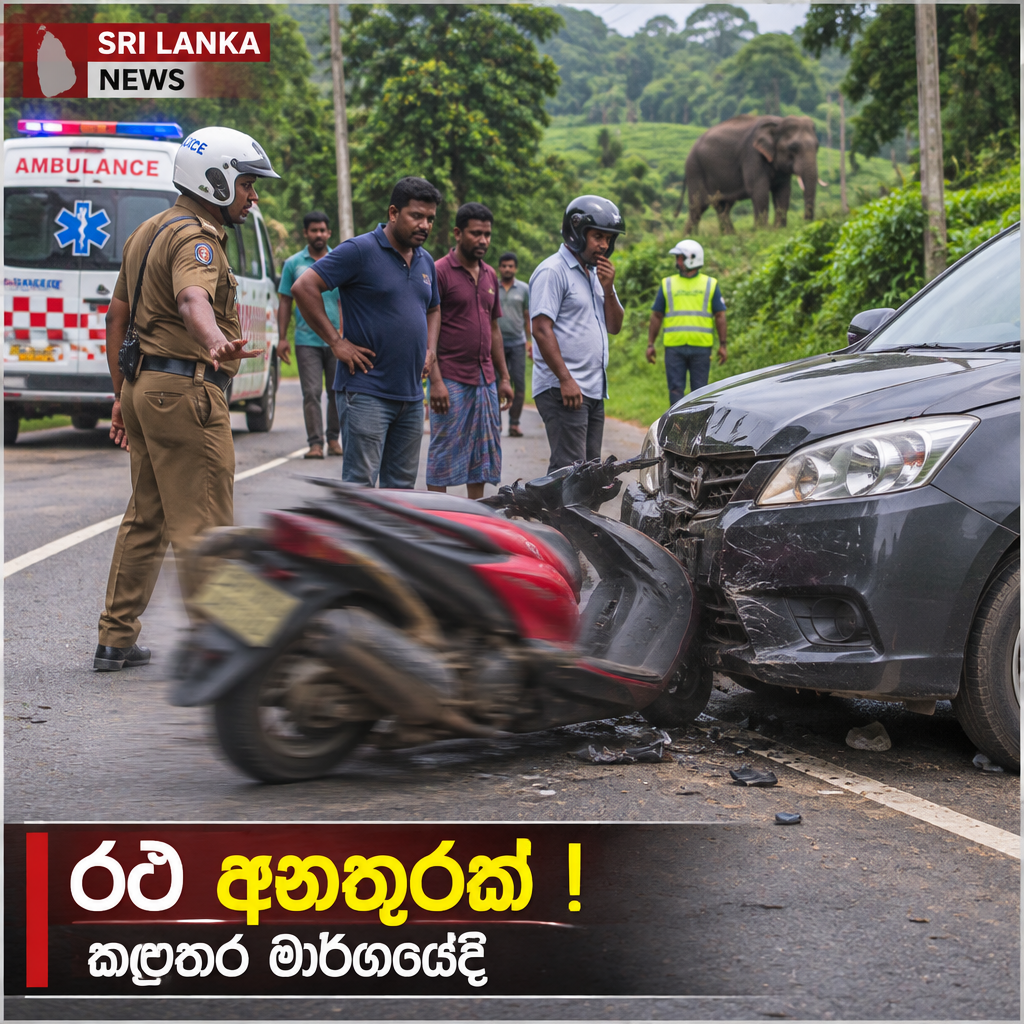
The suspect was arrested and taken to hospital for treatment of injuries that police did not specify. He remained there under armed guard, according to the report. Police also said they had recovered the suspected murder weapon. No description of the weapon, its location or any forensic examination was reported.
The crash and arrest do not establish guilt. The man is suspected of the killing, not convicted of it. The information reported by AFP did not say whether police had formally charged him, when he might leave hospital, or whether he had appeared before a court. The victim’s name and further details about the investigation were also not reported.
The elephant’s appearance on the road links the alleged flight to a broader reality in Sri Lanka: settlements, farms and roads can sit close to areas used by wild elephants. That context helps explain why people and elephants sometimes meet unexpectedly. It does not establish what caused this particular elephant to reach the road or whether the location is part of a known crossing route.
Legal context and charges or proceedings
The central criminal allegation is a fatal stabbing. Police described the man as suspected of killing the woman, but the information reported does not identify a formal charge or provide documents filed in court. That distinction matters. An arrest allows an investigation to proceed; it is not a judicial finding that the suspect committed the crime.
Investigators would ordinarily seek to establish what happened through evidence that can be tested, including witness accounts and physical evidence. Police reported recovering a suspected weapon, but no information was provided about whether it had been examined, whether it was linked to the victim, or whether investigators had gathered other evidence. Those questions remain open in the public account of the case.
The scooter collision may also be part of the chronology investigators need to verify. The reported sequence is that the man was trying to escape after the stabbing and then crashed into the elephant. The report does not say how police established that sequence, whether anyone saw the stabbing, or whether investigators had obtained other accounts or records. It would be premature to treat any unreported detail as established fact.
A suspect’s injuries and hospital treatment do not decide the homicide allegation. Police said the man was receiving treatment under armed guard, but did not specify the injuries, his medical condition or the reason for the particular security arrangements. Those details should not be inferred from the presence of officers at the hospital.
If a case proceeds, prosecutors would need to present admissible evidence and establish criminal responsibility in court. The suspect would have the opportunity to respond to the allegations. No court date, plea, bail decision or trial outcome was reported. Until a court reaches a decision, the presumption of innocence remains central to responsible reporting.
There is a separate legal context around the elephant, but no report suggests the animal was harmed intentionally or that the suspect faces a wildlife offense. Sri Lankan elephants are protected. WWF states that killing one carries the death penalty under Sri Lankan law. That protection is relevant to the national approach to wildlife, but it should not be confused with this case: witnesses said the elephant appeared unharmed, and police statements described the man’s suspected offense as the stabbing.
Sri Lanka’s Department of Wildlife Conservation is the public agency responsible for wildlife conservation and management. The agency’s role in a wildlife incident would be distinct from police work on the alleged homicide. No statement from wildlife officials about this collision was reported. It is therefore not known whether officials assessed the elephant or the road location after the crash.
Law enforcement or court response
The reported police response was to arrest the suspect, arrange for his treatment under guard and recover an object described as the suspected murder weapon. The key public account came from a police official speaking to AFP. No additional statement from prosecutors, a court or the wildlife authorities was reported.
A complete public account of the investigation would need to distinguish confirmed findings from allegations. For example, the official statement that police recovered a suspected weapon does not, by itself, establish that the object was used in the killing. Investigators would need to determine its relevance through evidence and, if charges are filed, present the case through the proper legal process. No results of laboratory testing or other forensic work have been made public in the information reported.
The same care applies to the collision. Witnesses reportedly told police that the elephant appeared unharmed and withdrew into the jungle. That is a meaningful observation, but it is not the same as a formal veterinary assessment. There is no reported confirmation of whether officials later searched for or examined the elephant, or whether the animal showed any injury after it left the road.
Police have not publicly described the suspect’s account of the alleged stabbing or the crash. There is no reported confession, interview transcript or statement from a lawyer. The absence of those details does not establish what happened; it simply means the public record described so far is limited. Further updates would be needed to clarify the charge, the evidence and the next court step.
Because the suspect was being treated in hospital, the timing of any further investigative or court action was not reported. Medical care and criminal procedure must proceed together: custody does not eliminate the need for appropriate treatment, and treatment does not settle the allegation. No information was reported about the suspect’s release, transfer or continued hospitalization.
Community and policy implications
The collision took place against a background of frequent human-elephant encounters in Sri Lanka. Expanding settlements and farms often overlap with elephant habitats, bringing people and animals into shared spaces. A road can become one of those meeting points, particularly where it passes close to jungle. The specific road in this case was not identified, so it is not possible to say whether it has a record of collisions or whether any local warning measures were in place.
Official figures cited in the report indicate that Sri Lanka recorded about 400 elephant deaths and 150 human deaths annually over the preceding five years. Those figures describe a serious public-safety and conservation problem, although the report did not break them down by cause, district or year. They should be understood as broad national totals, not as a measure of the danger at the road where this scooter crash occurred.
The country is home to an estimated 7,000 wild elephants, according to the information reported. Sri Lanka regards elephants as a national treasure and protects them by law. The scale of the population estimate and the high number of reported deaths underline a difficult policy balance: protecting people and livelihoods while preserving animals that are part of the country’s natural heritage.
For residents of remote villages, an elephant encounter can be more than a brief sighting. Elephants may damage crops, and the report notes that some residents attack animals that destroy their harvests. Crop losses can threaten household income and food security. A policy response that focuses only on wildlife protection, without addressing those costs and the safety concerns of residents, risks leaving communities to bear the burden of coexistence on their own.
At the same time, killing or injuring elephants can have severe legal consequences and can further weaken a population already exposed to conflict with people. WWF describes the Sri Lankan elephant as protected and says killing one carries the death penalty. The report contains no allegation that the suspect in this case harmed the animal. The point is broader: wildlife law and public-safety planning need to reduce the chance that an unexpected encounter turns into injury, retaliation or a criminal case.

Conservation and safety measures can include keeping movement routes between habitats intact, planning roads and new settlement with wildlife movement in mind, and using local warnings where elephants regularly cross. Where barriers are used, they need maintenance and placement that account for the routes animals actually take. These are policy options, not measures reported as present at the crash site. No information was provided about local fencing, signs or warnings.
Waste management is another part of the problem. Conservationists and veterinarians have previously warned that plastic waste at a landfill in eastern Sri Lanka was killing elephants in the region. Drone footage in 2020 showed more than a dozen hungry elephants searching for food there. When edible waste is accessible, it can draw wildlife into human-managed sites and expose animals to plastic and other hazards. Properly securing waste is one practical step that can reduce an avoidable source of contact, though it cannot address every cause of human-elephant conflict.
Railways pose a separate and deadly risk. A Sri Lankan express train killed an elephant and derailed in an incident reported in the source account. That crash occurred three months after seven elephants were fatally struck on the same route, described as the country’s worst wildlife railway accident. Wildlife officials said 139 elephants had been killed by trains over the 17 years since authorities began collecting that data. The figures show why transport planning and wildlife protection cannot be treated as separate concerns.
The scooter crash differs from a train strike: it involved a person suspected of a violent crime and an elephant that witnesses said appeared unharmed. Still, both kinds of incidents show how roads and transport routes can intersect with wildlife movement. Better information about crossing points, timely warnings and careful route planning may reduce risk. Any approach should be grounded in local evidence rather than assumptions about where animals travel.
The International Union for Conservation of Nature lists the Asian elephant as endangered at the species level. The Sri Lankan population is part of that wider conservation concern, while local residents face immediate questions of safety and livelihood. Public agencies therefore have to work across responsibilities: police investigate crimes, wildlife officials protect animals, and transport and land-use authorities shape the conditions in which encounters occur.
For the public, the clearest lesson from this case is not that an elephant prevented a crime or deliberately stopped a fleeing suspect. There is no evidence for either interpretation. Police described an alleged stabbing, an attempted escape, an accidental collision and an arrest. The elephant’s reported retreat without visible injury is a limited but important detail, while the suspect’s guilt and the full circumstances of the killing remain matters for investigation and, if charges follow, the courts.
Frequently Asked Questions
What is the 49-year-old man suspected of doing?
Police suspect him of stabbing a woman to death in her home in Anuradhapura district. The information reported did not identify a formal charge or a court finding.
How did the suspect get injured?
Police said his scooter collided with a wild elephant as he tried to flee. He was treated for unspecified injuries in hospital under armed guard.
Was the elephant hurt?
Witnesses told police the elephant appeared to be unharmed and retreated into the jungle. No veterinary examination was reported.
Has the suspect been charged or appeared in court?
No formal charge, court appearance, bail decision or court date was reported. An arrest is not a conviction.
Why are elephant encounters a concern in Sri Lanka?
Settlements and farms often overlap with elephant habitats. Reported deaths, crop damage, waste-related hazards and railway collisions all contribute to a wider challenge involving public safety and wildlife protection.
The case now turns on what investigators can establish about the fatal stabbing and what prosecutors, if any charge is filed, can prove in court. The elephant’s reported escape without visible injury offers no resolution to that criminal inquiry. It does, however, put the incident in the context of a wider obligation: protect people and wildlife in places where their paths cross, without treating an accidental encounter as proof of intent.