A South Carolina investigation that began with a body found in the road ended with detectives following a trail of physical and digital evidence — an oil...
South Carolina investigators trace fatal hit-and-run to suspect after oil leak, video and truck data
A South Carolina investigation that began with a body found in the road ended with detectives following a trail of physical and digital evidence — an oil leak, security video and data from a pickup truck’s onboard computer — to a man they say intentionally ran down a romantic rival.
Key Takeaways:- Investigators say a combination of surveillance footage, vehicle data and a fluid trail helped identify the suspect.
- The case is being treated as a deliberate act, not a routine traffic crash.
- Digital evidence from modern vehicles is increasingly central in homicide investigations.
- The allegation raises questions about domestic conflict, motive and the speed of police response.
What happened
Authorities in South Carolina say a deadly encounter that looked at first like a traffic crime quickly became something more serious. According to investigators, a man suspected of killing a romantic rival used a pickup truck to strike the victim, then fled the scene. What pulled the case together was not a single breakthrough but a sequence of them: first a visible oil leak, then security camera footage, and finally information pulled from the truck’s onboard computer.
This layered approach is now common in violent-crime probes. Investigators often start with the obvious — the location of the injury, skid marks, debris or witness statements — and then move into digital records. In this case, the physical trail allegedly left by the truck became a bridge to the electronic trail inside it. That combination can be decisive in cases where a suspect may have expected little more than a witness dispute or a fatal crash report.
South Carolina prosecutors have not described this as a random roadway tragedy. The case, as presented by investigators, centers on motive. They say the suspect was jealous and believed the victim had become a romantic rival. That detail matters because it can change how police and prosecutors classify the conduct. Instead of a fatal accident, the evidence may support an allegation of intentional violence.
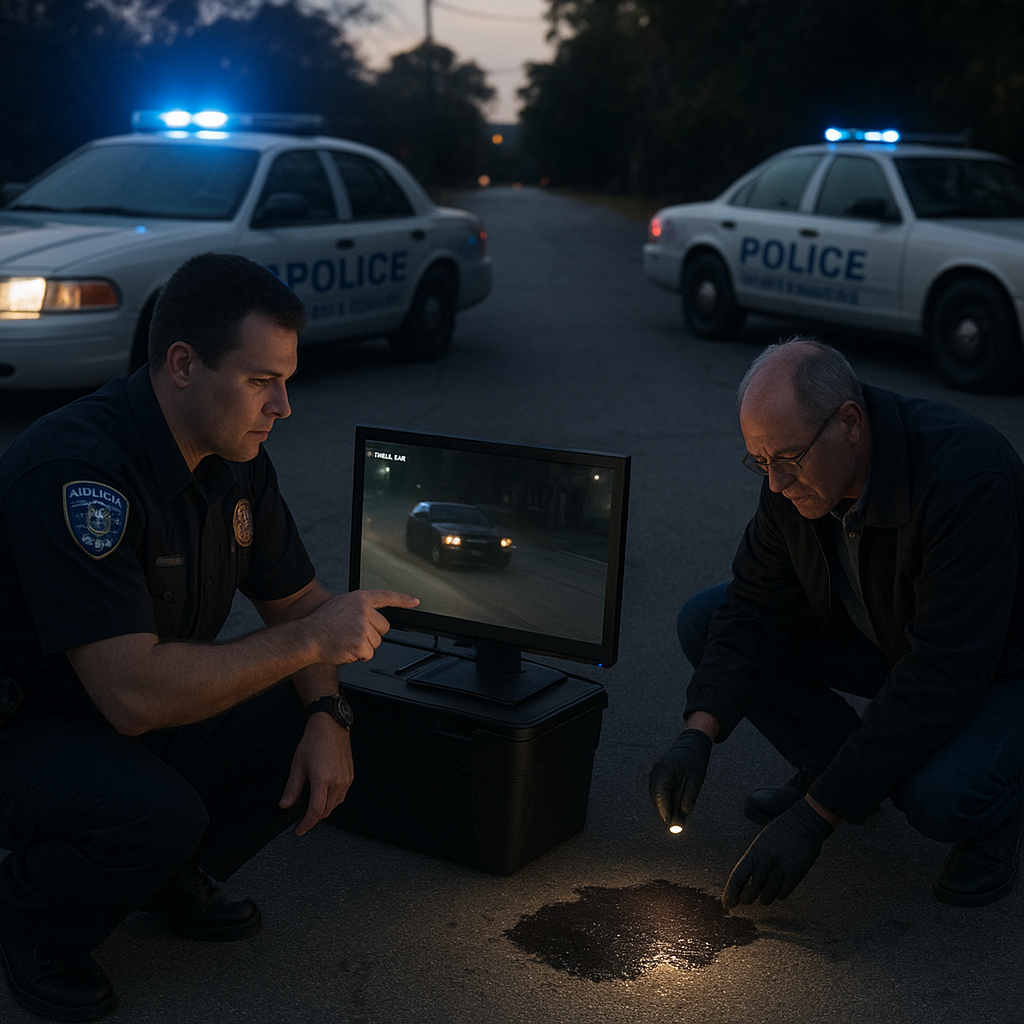
The investigation also illustrates how quickly local detectives now have to work across disciplines. A homicide investigator may rely on traditional scene work, while a digital forensics analyst can extract location or activity data from a vehicle module, and a property owner’s camera system may provide a timeline. None of those pieces alone may be enough. Together, they can tell a coherent story.
Cases like this often follow the same pattern. Police first confirm the victim’s identity and determine whether the death was caused by impact, assault or another force. They then map the suspect’s movement before and after the alleged crime. Vehicle telemetry, security camera clips and cellular records can place a suspect near the scene, show speed or braking patterns, and establish whether the person tried to clean up, disguise or abandon the vehicle.
That may be one reason investigators focused on the truck itself. Oil leaks are mundane, but they can create a traceable path. A leak can connect the scene to a parking lot, garage or residence. If surveillance footage captures the vehicle along that route, police can use the leak as a corroborating detail rather than an isolated clue. In a prosecution, corroboration matters; jurors tend to trust a case more when several independent forms of evidence point in the same direction.
The broader public-safety issue is that emotionally driven violence often evolves quickly and leaves little room for intervention. Romantic conflict can escalate into stalking, threats or assault before police are called. When a weapon is a vehicle, the danger is especially high because the act can unfold in seconds and be mischaracterized as an accident in its earliest stage.
Legal context and charges or proceedings
Depending on what prosecutors can prove, this kind of case may be charged as murder, attempted murder, assault and battery by mob if there are multiple participants, or vehicular homicide if the state believes the death resulted from reckless rather than intentional conduct. The distinction turns on evidence of intent. If investigators can show the suspect aimed the truck at the victim or acted with clear purpose, the case strengthens considerably.
South Carolina law, like the law in many states, allows prosecutors to use circumstantial evidence to prove intent. A defendant does not have to confess for the state to make its case. Surveillance video, vehicle data, prior threats, text messages and witness testimony can all support the theory that the collision was deliberate.
That is why modern homicide cases often become as much about analysis as about eyewitness accounts. Digital records may show time stamps, route history or driving behavior. A vehicle’s event data recorder — sometimes described as a car’s black box — can preserve information about speed, throttle use, braking and steering inputs. If those records show sudden acceleration toward the victim or an absence of braking, they may help prosecutors argue that the truck was used as a weapon.
The legal stakes are significant. A fatal case that begins as a possible traffic incident can later become a first-degree murder investigation if the evidence points to premeditation. The presence of jealousy as a motive may also allow prosecutors to argue planning, especially if the suspect had threatened the victim before the crash. Motive by itself is not proof, but it can make other evidence more persuasive.
This case also underscores the role of forensic preservation. Once police suspect a vehicle was used in a violent offense, they generally try to secure it quickly before it is repaired, washed or junked. The longer the delay, the greater the risk that key evidence will disappear. That is one reason investigators move fast to obtain search warrants for the vehicle, surrounding property and any phones associated with the suspect.
For readers following how these cases proceed in court, related developments often appear under the broader categories of courts and criminal proceedings, law enforcement investigations and public-safety policy. Each stage can alter the direction of the case. A grand jury indictment, a preliminary hearing or a suppression motion over digital evidence may become central long before a trial begins.
The admissibility of truck data may also be contested. Defense lawyers commonly challenge whether investigators properly obtained the data, whether the extraction was complete, and whether analysts can reliably interpret the results. If the search warrant was too broad or the chain of custody was weak, a judge could limit part of the evidence. Those disputes are often invisible to the public but crucial in determining whether a prosecution holds up.
There is also the question of classification. If prosecutors file the case as murder, they will need to show more than a deadly collision. If they charge manslaughter or a similar offense, they may be signaling that proof of intent is still developing. In high-conflict domestic or relationship-based cases, prosecutors sometimes begin conservatively and add counts later as forensic evidence solidifies.

Law enforcement or court response
Investigators in cases like this typically coordinate among local police, state agents and prosecutors. Scene technicians document tire marks, body position and debris. Detectives canvass nearby homes and businesses for cameras. Digital examiners extract data from the vehicle and compare it with the timeline from video and witness statements.
The response is painstaking, and it is often visible only in fragments. A security camera that captures a truck leaving a location may not show the impact itself. A data download may show the truck’s speed but not the driver’s intent. An oil trail may confirm the route but not the motive. The work lies in assembling those fragments into something a jury can understand.
In this South Carolina case, investigators say that is exactly what happened. The oil leak apparently helped link the vehicle to the scene. Security footage helped place the truck in motion. Onboard data then strengthened the identification of the vehicle and, by extension, the suspect. The result was a probable cause package that could support charges and an arrest.
When a suspect is accused of using a vehicle to kill, courts usually treat the matter with the same seriousness as any other violent felony. Bail, if available at all, can be sharply contested. Prosecutors may argue that the defendant poses a danger to the public or to witnesses. Defense counsel, meanwhile, may press for release conditions, especially if the state’s evidence is circumstantial.
The courtroom response can also include protective orders, no-contact provisions and limits on communication. Those tools are common when the alleged victim and suspect were entangled in a romantic or domestic dispute. If there are children, shared property or ongoing custody issues, the case can spill into family court as well.
For law enforcement, the larger significance is investigative. Modern vehicles increasingly contain the equivalent of a digital memory. That creates opportunities for police, but it also raises evidentiary burdens. Agencies must train personnel to collect data properly, preserve metadata and explain technical findings in plain language.
This matters beyond one case. In many jurisdictions, investigators now rely on vehicle modules, phone location records, doorbell video and business cameras to bridge gaps that traditional witness testimony cannot fill. That shift can improve clearance rates in violent crime, but it also demands strong oversight. Courts will continue to decide where the limits are.
For more background on how agencies handle these cases, see related coverage on investigative methods, digital evidence in court and criminal justice policy. Those topics shape not only one prosecution, but the way future cases are built.
Community and policy implications
The facts of this case point to a broader concern: the use of a vehicle as a weapon in a personal dispute. That is not just a criminal-law issue. It is a public-safety problem, a prevention problem and, in some settings, a domestic-violence problem. When jealousy and anger escalate, the warning signs may be visible before the fatal act occurs.
Communities often ask what could have been done differently. In some cases, prior threats are documented but not fully acted on. In others, victims do not feel safe enough to report. Even when police respond, they may not have enough evidence to intervene before a confrontation turns deadly. That gap is familiar to advocates who work in domestic-violence prevention and victim services.
Policy discussions around cases like this tend to focus on three areas. First is technology: law enforcement agencies need access to tools that can lawfully capture and interpret vehicle data. Second is training: officers and prosecutors need to understand how to connect a physical clue, like an oil leak, to a digital record. Third is accountability: any use of digital evidence must comply with warrant requirements and privacy rules.
There is also a civil-liberties dimension. The same tools that help solve violent crimes can be overused if agencies do not impose limits. Surveillance cameras, vehicle telematics and cell-site records can reveal a person’s movements with great precision. Courts have increasingly been asked to decide how much access police should have and what safeguards are required. Readers interested in those questions can follow broader discussions in civil rights reporting and policy coverage.
From a community standpoint, the case may also reinforce how quickly a personal conflict can become a public danger. A roadway that should have been ordinary became a crime scene. A vehicle that should have been transportation became alleged evidence. That transformation is hard to ignore.
Public officials often emphasize prevention after cases like this, but prevention can be difficult to define. It may mean better response to domestic threats, more rapid reporting of dangerous behavior, or closer coordination between police and victim advocates. It can also mean education: reminding people that threats and stalking are not private matters when violence is foreseeable.
As prosecutors move forward, the case will likely become a test of how well a digital-and-physical evidence package can support a serious violent-crime charge. That is increasingly common in modern criminal justice. Juries may hear less about a single dramatic eyewitness and more about timelines, metadata, footage and forensic reconstruction.
Frequently Asked Questions
How did investigators identify the suspect?
They say they used a combination of evidence: an oil leak traced across the scene, security video and data pulled from the pickup truck’s onboard computer.
Why is the vehicle data important?
Modern vehicles can record information about speed, braking and movement. That data can help investigators show where a vehicle was and how it was driven.
What charges could be filed in a case like this?
Depending on the evidence, prosecutors could pursue murder, manslaughter, vehicular homicide or related assault charges. The key issue is whether the act was intentional or reckless.
Can circumstantial evidence support a murder case?
Yes. Courts allow prosecutors to prove intent through circumstantial evidence, including video, digital records, witness statements and prior threats.
Why does this case matter beyond one arrest?
It shows how digital evidence is reshaping violent-crime investigations and how relationship-driven conflict can escalate into deadly public violence.
The central lesson from this South Carolina case is that modern investigations increasingly depend on layered evidence. A leak on the pavement, a camera on a building and a record inside a truck can together do what one witness alone cannot. That is powerful for detectives and prosecutors, but it also places a premium on careful warrant work, precise forensic analysis and measured charging decisions.
If the allegations are proved in court, this case will stand as another example of how quickly jealousy can turn lethal and how thoroughly investigators can now reconstruct the path to a crime. If the evidence is challenged, the courtroom will determine how much of that reconstruction can survive scrutiny. Either way, the case reflects a criminal-justice system that now runs on both old-fashioned detective work and increasingly sophisticated data.