Seattle police are searching for a third suspect in connection with a deadly shooting at a food festival near the Space Needle, a case that has shaken a...
Seattle Police Hunt Third Suspect After Deadly Shooting at Food Festival Near Space Needle
Seattle police are searching for a third suspect in connection with a deadly shooting at a food festival near the Space Needle, a case that has shaken a crowded public event area and raised questions about witness cooperation, video evidence, and how quickly investigators can identify people involved in gun violence.
Key Takeaways:- Police say a third suspect is being sought after a fatal shooting near one of Seattle’s most recognizable landmarks.
- The case involves a public festival setting, which can complicate witness statements, video review, and suspect identification.
- Investigators are likely relying on surveillance, cellphone footage, and tips as they work to piece together what happened.
- The shooting adds to broader concerns about public safety at large outdoor events and how local agencies respond when violence erupts in crowded spaces.
What happened
According to Seattle police, the shooting took place at or near a food festival in the area surrounding the Space Needle, a major tourist and event corridor where thousands of people can gather on a busy day. One person died in the shooting, and investigators have described the case as involving at least three suspects. Police are actively hunting for the third person they believe was involved.
At this stage, the basic sequence appears to be that a confrontation or rapid exchange escalated into gunfire in a public setting. In cases like this, the first hours matter. Detectives work to secure the scene, identify victims and witnesses, and determine whether the shooting was targeted, retaliatory, or the result of a dispute that spilled into a crowd.
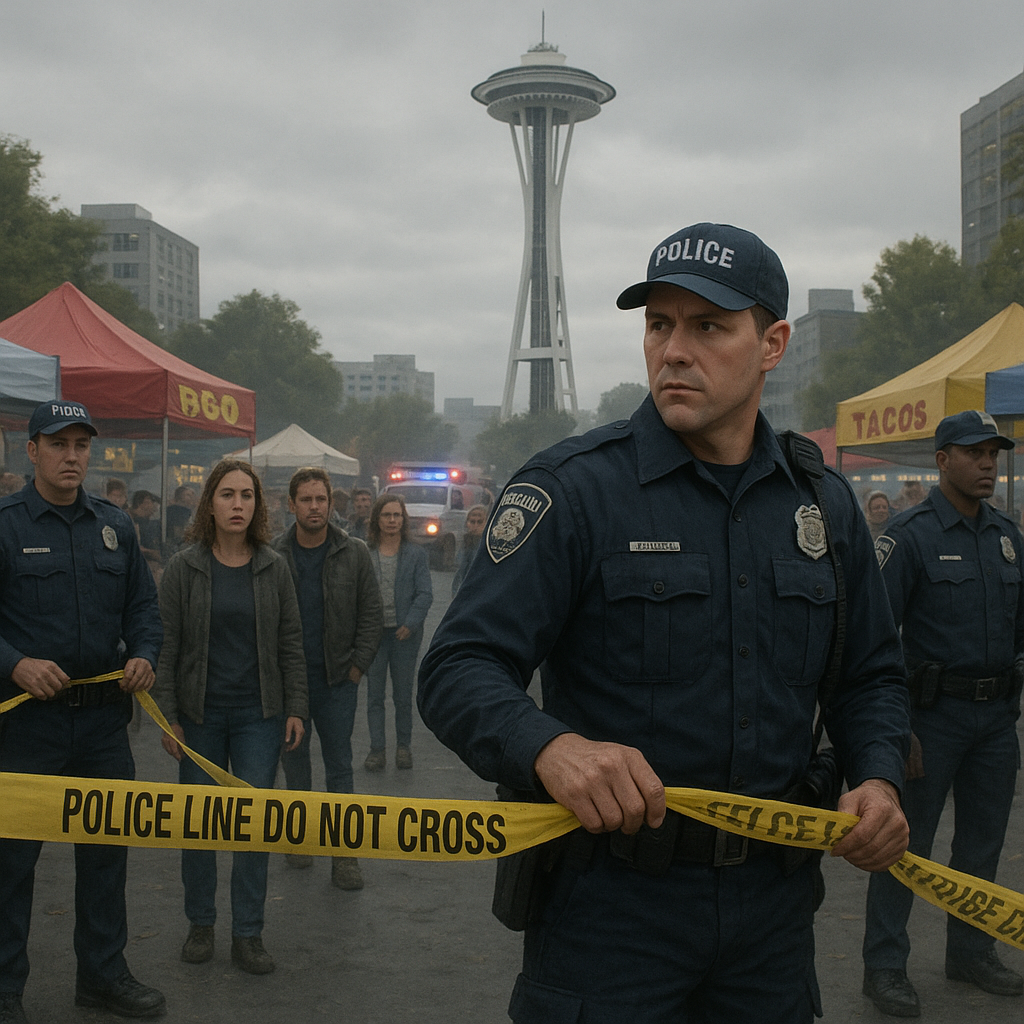
The festival setting makes the inquiry more difficult. Large public events generate a mix of noise, movement, and competing accounts. People may see only a fragment of what occurred. Others may leave before police arrive. Some may be reluctant to come forward if they fear retaliation or if they are unsure what they witnessed. That means investigators often lean on surveillance video, license plate readers, cellphone videos, and social media posts to reconstruct the timeline.
The fact that police are looking for a third suspect suggests investigators believe more than one person may have had a role in the shooting, whether as a shooter, accomplice, lookout, or getaway driver. In violent felony cases, identifying each participant matters because prosecutors may later rely on theories of accomplice liability or conspiracy if the facts support those charges.
Crowd shootings also create a larger public-safety ripple effect. A festival is not just a crime scene; it is a place where families, tourists, vendors, and workers expect a basic level of security. When a homicide occurs there, the impact extends well beyond the immediate victim and suspects. It can affect attendance, vendor revenue, nearby businesses, and public confidence in the city’s ability to keep major events safe.
For local residents, the case is likely to be remembered not only as a homicide but also as an example of how quickly violence can disrupt a heavily traveled civic space. For Seattle police, it is another test of whether investigators can identify all responsible parties before evidence disappears and memories fade.
Legal context and charges or proceedings
At the moment, the case appears to be in its investigation phase, which means police are still gathering facts before prosecutors decide what charges to file, if any additional arrests are made, or whether the case proceeds against suspects already in custody. In a homicide investigation, that often includes forensic work, witness interviews, ballistics analysis, and reviewing every available video angle.
If prosecutors determine there is probable cause, the most serious charge would likely be murder, though the exact degree would depend on intent, planning, and the underlying facts. Washington law also allows for a range of related charges such as manslaughter, unlawful possession of a firearm in some circumstances, or charges tied to attempted murder or assault if others were endangered or injured.
When multiple suspects are involved, legal questions can become more complicated. A person does not necessarily have to fire the weapon to face serious charges. Under accomplice liability, someone who knowingly aids or encourages the crime can be treated as a principal offender. That is why police often emphasize that they are searching for all involved parties, not just the person believed to have pulled the trigger.
This distinction matters in the charging process. Prosecutors want to know who brought the gun, who planned the confrontation, who drove the vehicle, and who may have left the scene after the shooting. They also need to determine whether the evidence supports a coherent story that can hold up in court. A case built on shaky identifications or partial witness accounts may be vulnerable to defense challenges.
Defense attorneys, if and when suspects are charged, will likely scrutinize how police identified the third suspect and whether officers relied too heavily on uncertain eyewitness accounts. They may also challenge the reliability of video enhancement, the chain of custody for physical evidence, and whether statements were obtained lawfully. Those are routine issues in homicide prosecutions, but they often matter most when a case begins with a chaotic event in a crowded public place.
If you are following how prosecutors build homicide cases, related coverage in courts reporting often shows the early decisions that shape later courtroom battles, including bail, charging, and pretrial motions. Cases involving public violence can also overlap with investigative reporting on how quickly police identify suspects using digital evidence. And when a shooting affects people gathered for a civic event, it can raise policy questions about event security and city preparedness.
Another legal issue is whether the crime scene and surrounding area are covered by cameras from nearby businesses, traffic infrastructure, or event vendors. In many urban investigations, those recordings become central to the case. They can corroborate witness statements or contradict them. They can also reveal whether the suspects arrived together, separated before the shooting, or fled in different directions.
Because this case involves a death, the prosecution process can move differently from less serious offenses. Homicide reviews often involve senior detectives and prosecutorial supervisors. Charging decisions may take time as investigators wait for laboratory results or seek additional witnesses. That can frustrate the public, but it is also part of building a case that can survive pretrial scrutiny and, if necessary, a jury trial.
In Washington, as in many states, prosecutors must prove the elements of the offense beyond a reasonable doubt. If there were multiple suspects, the state will also need to sort out individual roles. The law does not permit a broad assumption that everyone at the scene shares equal blame. It requires evidence tying each person to the crime.
Law enforcement or court response
Seattle police have publicly acknowledged the search for a third suspect, which signals that detectives believe there is still an active risk of unresolved accountability in the case. In practice, that means the investigation is not just about solving one killing. It is about making sure all participants are identified, arrested if possible, and presented to prosecutors with enough evidence for formal charges.
Police responses to public shootings typically begin with scene containment. Officers secure the perimeter, provide aid to the injured, preserve evidence, and separate witnesses. In a crowded festival area, that can be a fast-moving operation. Officers may also coordinate with fire, emergency medical personnel, and event organizers. The goal is to prevent contamination of evidence while also protecting the public from any continuing threat.
Once the scene is stabilized, detectives usually begin canvassing the area for cameras and witnesses. They may review body-worn camera footage, dispatch logs, and 911 calls to determine the order of events. If firearms are recovered, forensic testing can link shell casings or bullets to a particular weapon. If no gun is found, investigators may depend more heavily on video and witness testimony.

In this case, the statement that police are searching for a third suspect implies investigators have already developed some degree of confidence about who they are looking for. That confidence may come from surveillance images, a witness naming the person, cellphone data, or other leads that have not yet been made public. Police often withhold details to preserve the integrity of an arrest or to avoid alerting a suspect before they are taken into custody.
If arrests are made, the next step could include a probable cause hearing, bail review, or arraignment in Seattle’s criminal courts. In a homicide case, judges will pay close attention to public safety concerns, flight risk, and the strength of the evidence presented by the state.
Court proceedings in a case like this can become a test of how well the justice system manages violent crime in dense urban settings. Prosecutors may ask for no-contact orders, firearms restrictions, and conditions tied to electronic monitoring if any defendants are released pending trial. The defense will likely argue for the least restrictive terms available under state law.
There is also the question of whether the case will be charged in superior court as a high-level felony with enhancements or aggravating circumstances. That depends on the evidence. If the shooting was carried out in a public place with children or families nearby, if a firearm was unlawfully possessed, or if there is proof of premeditation, prosecutors may consider whether the facts support additional allegations.
The response from law enforcement will also be measured by transparency. In high-profile cases, the public wants to know why the shooting happened, whether the suspects were known to police before the event, and whether the city could have done more to prevent the violence. Police are often limited in what they can say early in an investigation, but the absence of details can fuel speculation.
For a broader look at how investigators handle fast-moving violent crime, law enforcement coverage often focuses on the tactics used to identify suspects through digital evidence and witness interviews. The Seattle case appears to be following a similar pattern: preserve the scene, collect the video, identify the people involved, and build the case carefully before publicizing every detail.
Community and policy implications
A shooting at a food festival near the Space Needle affects more than the people directly involved. It touches vendors, workers, event planners, nearby residents, and visitors who assume a major public gathering will be safe. When violence erupts in that setting, the community is left with practical questions: How many officers were there? Was the event screened adequately? Were disputes already brewing before shots were fired? Could anyone have intervened sooner?
Public events are difficult to secure perfectly. They are open, fluid, and often designed to be accessible. That creates tension between safety and openness. Too much security can change the character of an event; too little can leave gaps that criminals exploit. Cities often have to decide how to balance those competing demands, especially in popular tourist districts.
The Seattle case may prompt renewed discussion about event safety planning, including camera coverage, private security staffing, bag checks, emergency exits, and coordination with police. It may also raise questions about how authorities communicate risk before and after a major event. If threats are known, what is the threshold for a stronger police presence? If there are no known threats, how do organizers prepare for violence that emerges without warning?
There is also a civil-rights dimension to any large public safety response. Residents generally want robust policing around crowded events, but they also expect that officers will enforce the law fairly and avoid heavy-handed tactics that can intimidate law-abiding attendees. That balance matters in a city that has debated policing practices and public trust. Coverage of civil rights issues often shows that communities are most willing to support visible security when they trust the response is lawful, proportionate, and transparent.
Policy makers may also look at whether surveillance expansion is the right answer. More cameras can help solve crimes, but they also raise privacy concerns. More plainclothes police can improve deterrence, but they may not stop sudden violence and can affect how people experience public events. These debates are not abstract. They show up after incidents like this one, when officials search for practical fixes.
Another concern is the toll on witnesses. In many homicide cases, the investigation depends on people who were present but did not want to be. Cities and prosecutors sometimes have to work hard to reassure witnesses that speaking with police will not expose them to unnecessary danger. Without cooperation, cases can stall. That is especially true when suspects are believed to be part of a local social network or when the victim and suspects knew each other.
The case may also influence how the city talks about violence prevention. Some advocates argue that short-term enforcement should be paired with longer-term interventions, including conflict mediation, youth outreach, and rapid response to escalating disputes. Others focus on gun access, arguing that repeated shootings in public spaces reflect broader problems in firearm availability and illegal carrying. Both points can be true at once. A homicide scene is where policy arguments become concrete.
In corrections and prison policy terms, if the case leads to convictions, it may eventually add to the city and state’s population of people serving long terms for violent offenses. That raises its own set of questions about rehabilitation, incapacitation, and the pressure violent crime places on the criminal justice system. For now, though, the immediate issue is public safety and whether police can bring in the remaining suspect before the case grows colder.
A major public event shooting also affects how people use urban space. Tourists may think twice about attending future festivals. Parents may change plans. Vendors may lose revenue. Even after police make arrests, there can be a lasting perception problem. Restoring confidence requires more than a single press conference. It requires visible investigative work, honest communication, and, eventually, courtroom accountability.
Frequently Asked Questions
Was this a random shooting?
Police have not publicly described the attack that way. At this stage, investigators appear to be working to determine the motive and whether the victim was targeted or whether the violence grew out of a dispute.
Why is police searching for a third suspect?
Investigators believe more than one person may have participated in the crime. The third suspect could be tied to planning, helping the shooter, or leaving the scene with the others.
What charges could be filed?
Depending on the evidence, prosecutors could pursue murder charges or related felonies such as manslaughter, assault, or firearm offenses. The exact charges will depend on intent, role, and available proof.
How do police identify suspects so quickly in public shootings?
Investigators usually rely on surveillance video, witness interviews, cellphone footage, forensic evidence, and digital records. Public events often provide more potential evidence than isolated crimes, but the scene can also be chaotic.
Could the suspects face court proceedings soon?
If police make arrests and prosecutors file charges, the case could move quickly into initial court hearings. Homicide cases typically involve early review of probable cause, bail, and detention issues.
Why do festival shootings get so much attention?
Because they happen in public spaces where people expect safety. A homicide at a crowded event raises concerns about the crime itself, event security, policing, and public trust.
The central question in this case is whether Seattle police can identify and arrest the third suspect before important evidence goes stale or witness memories weaken. That is often the defining challenge in violent crime investigations: not just proving what happened, but proving who did it, how each person was involved, and whether the case can be carried through court. For the city, the outcome will shape more than a single prosecution. It will also influence how residents and visitors think about safety at major public gatherings near one of Seattle’s best-known landmarks.