Maduro and Flores Reportedly Set for U.S. Court Return as New Torture Indictment Emerges
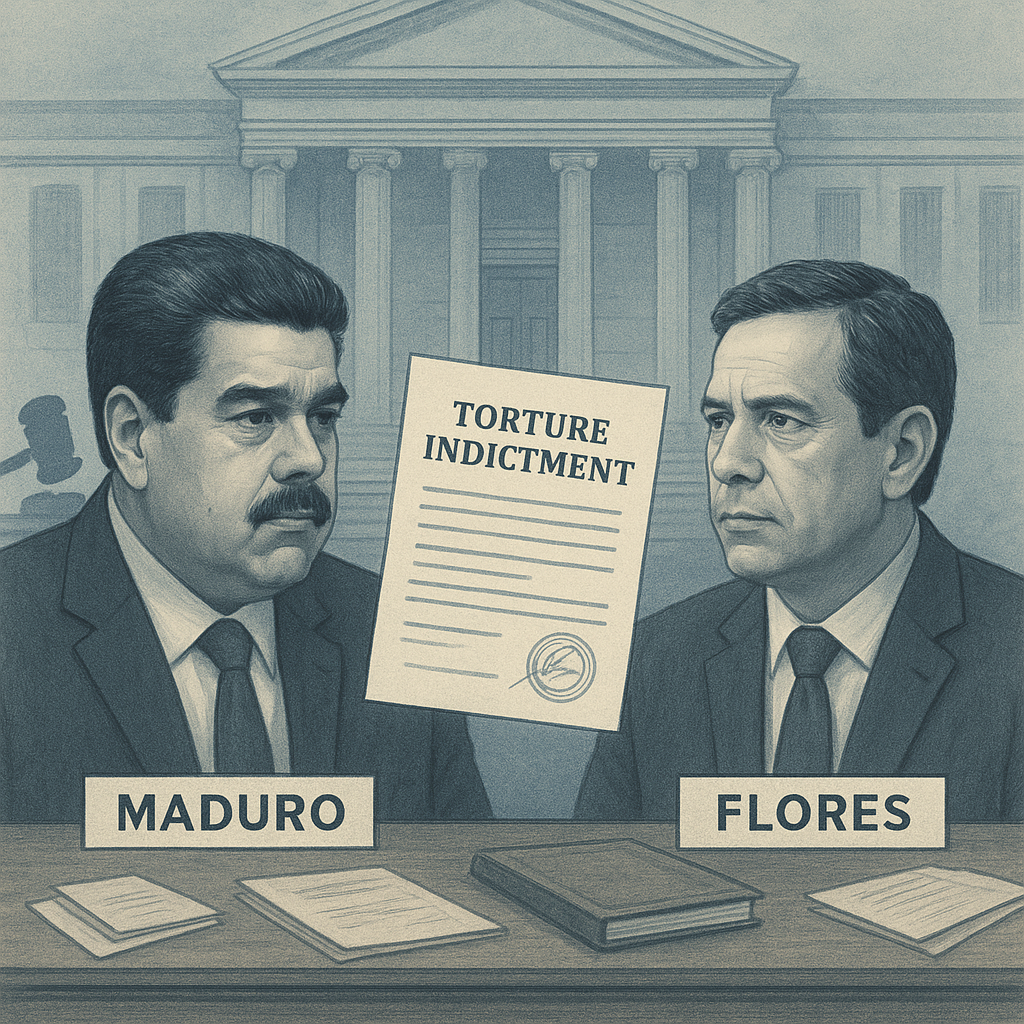
Former Venezuelan President Nicolás Maduro and his wife, Cilia Flores, are expected to return to a U.S. court amid a new torture indictment, according to the CBS News report supplied for this article. The report identifies Katrina Kaufman as its correspondent, but the brief does not specify the court, hearing date, counts in the indictment, alleged victims, or the conduct prosecutors say supports the charges. Those details matter: an indictment is an accusation, not a finding of guilt, and the precise wording will determine the legal questions the case raises.
What happened
The immediate news is limited but consequential: CBS News reports that Maduro and Flores are slated to appear again in a U.S. court amid a new torture indictment. The supplied item does not say when or where the hearing will take place, what the indictment alleges, or whether the defendants have entered pleas. It also does not identify the alleged victims or describe the acts prosecutors say constituted torture.
Those omissions are not minor. The details in an indictment shape the entire legal case. They identify the offenses charged, the conduct alleged, the time period and location involved, and, in many cases, the government’s theory of how each defendant participated. Until the charging document or a fuller reliable report is available, it is not possible to say whether prosecutors allege direct acts, ordering or aiding conduct, conspiracy, or some other form of involvement. Nor is it responsible to treat the phrase “torture indictment” as a complete description of the charges.
Maduro is described in the report as Venezuela’s former president. Flores is his wife and a political figure in her own right. Their relationship does not by itself establish criminal responsibility. Prosecutors must tie each defendant individually to the elements of each charged offense, and the evidence must be tested through the ordinary procedures of a criminal case.
A return to court is a procedural event, not a verdict. Depending on the stage of the case, a hearing could address matters such as arraignment, scheduling, motions, access to evidence, or other pretrial issues. The information provided does not identify the purpose of this particular appearance, so it should not be described as a trial or as a decision on guilt.
The report also refers to a “new” indictment. Without the document, it is unclear whether that means a newly filed case, a superseding indictment that adds or revises charges in an existing case, or another charging development. Those possibilities have different procedural consequences. A superseding indictment, for example, can alter the charges while a case is pending, but it does not establish that the new allegations are true.
Legal context and charges or proceedings
The word “torture” has a specific legal meaning. It is not enough, for a criminal conviction, that conduct is described in public discussion as cruel, abusive, or politically repressive. Prosecutors must identify an applicable criminal statute and prove its elements beyond a reasonable doubt. The indictment should make clear which law is invoked and what conduct is alleged to satisfy it.
One relevant U.S. law is 18 U.S.C. § 2340A, which criminalizes torture outside the United States in defined circumstances. The statute sets out a legal definition and limits when U.S. courts may exercise jurisdiction. Among the jurisdictional conditions, the law addresses cases in which an alleged offender is a U.S. national or is present in the United States, as well as certain cases involving U.S. nationals as victims. The statute and its jurisdictional provisions can be read at the U.S. Code.
That statute is background, not proof that it is the statute charged here. The supplied report does not identify the code section. It would therefore be premature to state that prosecutors have charged Maduro or Flores under § 2340A, or to predict how a court would resolve any jurisdictional challenge. Other legal theories may be possible, and the actual indictment is the controlling source for the charge names and alleged elements.
The international definition of torture is also relevant context. The United Nations Convention Against Torture describes torture in terms that include the intentional infliction of severe physical or mental pain or suffering for specified purposes, when carried out by, at the instigation of, or with the consent or acquiescence of a public official. The treaty text is available from the U.N. Office of the High Commissioner for Human Rights. A treaty definition may inform legal and policy discussion, but it does not replace the criminal statute and proof required in a U.S. prosecution.
The distinction between state responsibility and individual criminal responsibility is important. International bodies may examine whether a government tolerated abuse or failed to prevent it. A criminal court, by contrast, must decide whether the particular defendants before it committed, ordered, aided, or otherwise legally participated in specific offenses under the law charged. A person’s official position, family relationship, or political prominence cannot substitute for proof of the elements of a crime.
The case may also raise questions about immunity, but no answer can be assumed from the report alone. Claims of immunity can depend on a person’s status, the nature of the alleged conduct, the legal basis for the prosecution, and the circumstances in which a court is asked to act. The fact that the report calls Maduro a former president is relevant context, but it does not by itself resolve whether any immunity applies. The court would need to consider arguments presented by the parties and the applicable law.
If the defendants contest the charges, the process could include motions challenging the indictment, the court’s jurisdiction, the admissibility of evidence, or the legal sufficiency of particular counts. If the prosecution proceeds, it must disclose evidence under applicable rules and establish guilt beyond a reasonable doubt at trial unless the case is resolved by a lawful plea. The defendants have the right to counsel and to challenge the government’s evidence.
It is also important to separate an indictment from an arrest warrant, an extradition ruling, or a judgment. An indictment is a charging document approved through the applicable grand-jury process. It sets out allegations; it does not decide them. The supplied report does not explain how the defendants came before the U.S. court or describe any prior proceedings, so no account of custody, transfer, or earlier rulings can safely be added here.
Law enforcement or court response
The report says the two defendants are slated to return to court, but it does not identify the judge, prosecutor, defense counsel, court, or scheduled date. It likewise does not quote a statement from the Justice Department, the court, Maduro, or Flores. Those details should be taken from the docket, the indictment, or attributed reporting rather than filled in by assumption.
The court’s role is to manage the case and ensure that the prosecution follows legal procedure. At an early appearance, a judge may address scheduling, representation, detention, or other preliminary matters, depending on the case’s posture. A judge does not determine guilt simply because a defendant appears in court or because an indictment has been filed. Any contested legal issue must be decided under the relevant standards, with the parties given an opportunity to present their arguments.
Prosecutors, for their part, must make their allegations in formal filings and support them with admissible evidence. If the case relies on testimony from people who say they were tortured or witnessed abuse, the defense may challenge the reliability, credibility, and context of that evidence. Documentary records, expert evidence, and proof about the defendants’ alleged roles may also become significant, if they form part of the government’s case. None of those evidentiary categories should be treated as confirmed in this matter without access to the filings.
A credible account of the next court appearance should report what the judge actually does, not just that the defendants were present. It should distinguish between a prosecutor’s allegation, a defense argument, a judicial ruling, and an established fact. If the court releases an indictment or a written order, those primary documents can clarify the case more reliably than short summaries of the proceedings.
The U.S. Justice Department previously announced separate criminal charges against Maduro and other Venezuelan officials in 2020. That earlier announcement is available in the department’s press release on the 2020 charges. It provides historical context, but it does not establish what is alleged in the new torture indictment described by CBS News. The charges, legal theories, and procedural posture of one matter should not be conflated with another.

Community and policy implications
The allegations described in the report carry implications beyond the courtroom. Any prosecution involving alleged torture by officials raises questions about accountability, the protection of victims and witnesses, and the capacity of courts to assess conduct that may have occurred in a foreign political system. Those questions deserve attention, but they do not change the government’s burden of proof or the defendants’ rights.
For Venezuelans who say they or their relatives suffered abuse, a criminal case can offer a public forum in which evidence is presented and claims are examined. The process can also be difficult. Witnesses may face safety concerns, trauma, language barriers, or fear of retaliation. Courts and prosecutors must consider those risks while preserving the defendant’s ability to examine evidence and challenge testimony. The report supplied here does not identify any victims or witnesses, so their experiences should not be presumed or described without reliable sourcing.
There is a wider policy question about how countries respond to alleged human-rights abuses when the accused are powerful officials or former officials. Criminal proceedings may signal that official status does not automatically place a person beyond scrutiny. At the same time, prosecutions that cross borders can generate disputes over jurisdiction, due process, diplomatic relations, and the perceived neutrality of the forum. These are matters for careful legal analysis, not conclusions that can be drawn from a headline.
The public record is especially important when a case is politically charged. Clear distinctions between allegation and proof help protect the integrity of proceedings and public understanding. Reporting should avoid presenting charges as established facts, and government statements should be attributed as claims unless a court has made findings. The same standards apply to defense arguments: a denial or challenge is not a judicial ruling, but it is part of the process that must be reported accurately.
The United States has long used criminal law to address some conduct with an international dimension. The existence of a statute, however, does not automatically mean it applies to every alleged act abroad. Courts must examine statutory language, jurisdictional prerequisites, the facts alleged, and any constitutional or immunity questions properly raised. If the indictment is made public, its specific provisions will show which of those issues are actually in play.
For the moment, the most useful public questions are concrete. What court is hearing the matter? What are the exact counts? Does the indictment identify an applicable torture statute or another offense? What conduct is alleged against each defendant? What does the court schedule next? Answers to those questions will provide a firmer account than speculation about the case’s likely outcome.
The case may also test the public’s ability to follow a complex proceeding without reducing it to a political contest. A fair account must recognize both the gravity of torture allegations and the central principle that criminal liability must be proved individually. Neither the seriousness of an accusation nor the prominence of the accused is a substitute for evidence.
Frequently Asked Questions
What does the report say about Maduro and Cilia Flores?
The CBS News item supplied for this article says that former Venezuelan President Nicolás Maduro and his wife, Cilia Flores, are slated to return to a U.S. court amid a new torture indictment. It does not provide a hearing date, court location, case number, or the indictment’s specific allegations.
Have Maduro and Flores been found guilty?
The supplied report describes an indictment and an expected court appearance, not a conviction. An indictment is an accusation. The prosecution must prove each charge beyond a reasonable doubt, and defendants are presumed innocent unless and until guilt is established in court.
What law is the alleged torture indictment based on?
The supplied news brief does not identify the statute. U.S. law includes 18 U.S.C. § 2340A, which addresses torture outside the United States under specified conditions, but it cannot be assumed that this is the law charged in this case. The indictment would provide the definitive answer.
When and where will the next court appearance take place?
The provided report does not state a date or identify the court. The schedule should be confirmed through the court docket or a fuller, reliable news report.
What happens at a return court appearance?
The purpose depends on the stage of the case. A hearing may address scheduling, representation, detention, or pretrial motions. The report does not say what matters are scheduled in this instance, and an appearance alone is not a determination of guilt.
Final thought
The reported return to court is a significant procedural development, but the underlying facts remain incomplete in the information available here. The indictment, court record, and statements from both sides will be essential to understanding what prosecutors allege and what the defendants contest. Until those materials are available, the careful account is also the simplest one: a news report says a new torture indictment is involved and that Maduro and Flores are expected in court; the charges remain allegations, and the court process must determine what the evidence proves.