Lindsay Clancy’s murder trial reached an impasse on Tuesday when jurors told the judge they were deadlocked after four days of deliberations, leaving the...
Jury Deadlocked in Lindsay Clancy Murder Trial After Four Days of Deliberations
Lindsay Clancy’s murder trial reached an impasse on Tuesday when jurors told the judge they were deadlocked after four days of deliberations, leaving the high-profile Massachusetts case unresolved for now.
Key Takeaways:- Jurors informed the court they could not reach a unanimous verdict after four days.
- The case centers on the deaths of three children and a contested mental health defense.
- The judge now must decide how to respond, including whether to give additional instructions or declare a mistrial.
- The outcome could shape how future juries weigh severe psychiatric evidence in homicide cases.
What happened
The deadlock marks a significant procedural turn in one of the most closely watched murder trials in Massachusetts in recent years. Clancy, a former labor and delivery nurse from Duxbury, is charged in connection with the deaths of her three children in January 2023. The case has drawn intense public attention because of the circumstances surrounding the killings, the defendant’s mental health history, and the competing narratives presented by prosecutors and the defense.
According to the report from CBS News, jurors told the judge they had exhausted their discussions without reaching consensus. In most criminal cases, a unanimous verdict is required. When a jury cannot agree, the trial judge typically faces a narrow set of options: issue a supplemental instruction encouraging further deliberation, ask the jury whether more time might help, or declare a mistrial if the deadlock appears final.
Deadlock does not equal acquittal. It means only that, at least at this stage, the jury has not reached the unanimous decision required to convict or acquit on the charges submitted to it. In a case as emotionally charged as Clancy’s, even a single holdout juror can halt a verdict.
The reported deadlock came after four days of deliberations, a period that suggests jurors gave the evidence significant consideration. That evidence included testimony about Clancy’s mental health, expert assessments, and the Commonwealth’s effort to prove criminal responsibility beyond a reasonable doubt. The defense, meanwhile, has argued that Clancy’s mental state at the time of the killings should weigh heavily in the case.
The proceedings have tested not only the facts of the case but also how jurors process psychiatric evidence in a homicide trial. Criminal cases involving severe mental illness often create a difficult tension: jurors must determine both what happened and whether the defendant had the legal capacity required for criminal liability.
Legal context and charges or proceedings
The Clancy case sits at the intersection of homicide law, mental health evidence, and jury decision-making. Prosecutors allege that Clancy killed her children and then attempted to die by suicide. The defense has said that her actions occurred in the grip of profound mental illness, including postpartum psychiatric conditions. That distinction matters because criminal law does not punish illness itself; it examines whether the defendant possessed the mens rea, or guilty mind, necessary for the charged offense.
In cases like this, the defense may pursue one of several legal theories. Depending on the jurisdiction and the evidence, those theories can include insanity, lack of criminal responsibility, or mitigation based on mental disease or defect. The legal standards are strict. A defendant must show more than stress, depression, or emotional collapse. The question becomes whether mental illness so impaired the defendant that she could not understand the nature or wrongfulness of her conduct, or otherwise could not form the required intent.
Massachusetts law has its own framework for evaluating such claims, and jurors are asked to apply that framework to often conflicting expert testimony. That can be difficult. Psychiatrists may agree on diagnosis while disagreeing sharply about legal consequences. One expert may say the defendant was acutely psychotic; another may testify that, despite severe symptoms, she retained enough awareness to satisfy the law’s intent standard.
The jury’s deadlock also reflects the burdens that govern criminal trials. Prosecutors must prove guilt beyond a reasonable doubt. That standard is intentionally high. It protects against wrongful conviction, especially in cases where the evidence includes emotional testimony, complex medical records, and expert opinions that do not point in exactly the same direction.
Readers interested in the broader legal architecture around these issues may also look to coverage of criminal responsibility standards, mental health evidence in homicide prosecutions, and how courts handle juror deadlock in serious felony cases. Those questions recur frequently in courts across the country, even though the facts differ from case to case.
Law enforcement or court response
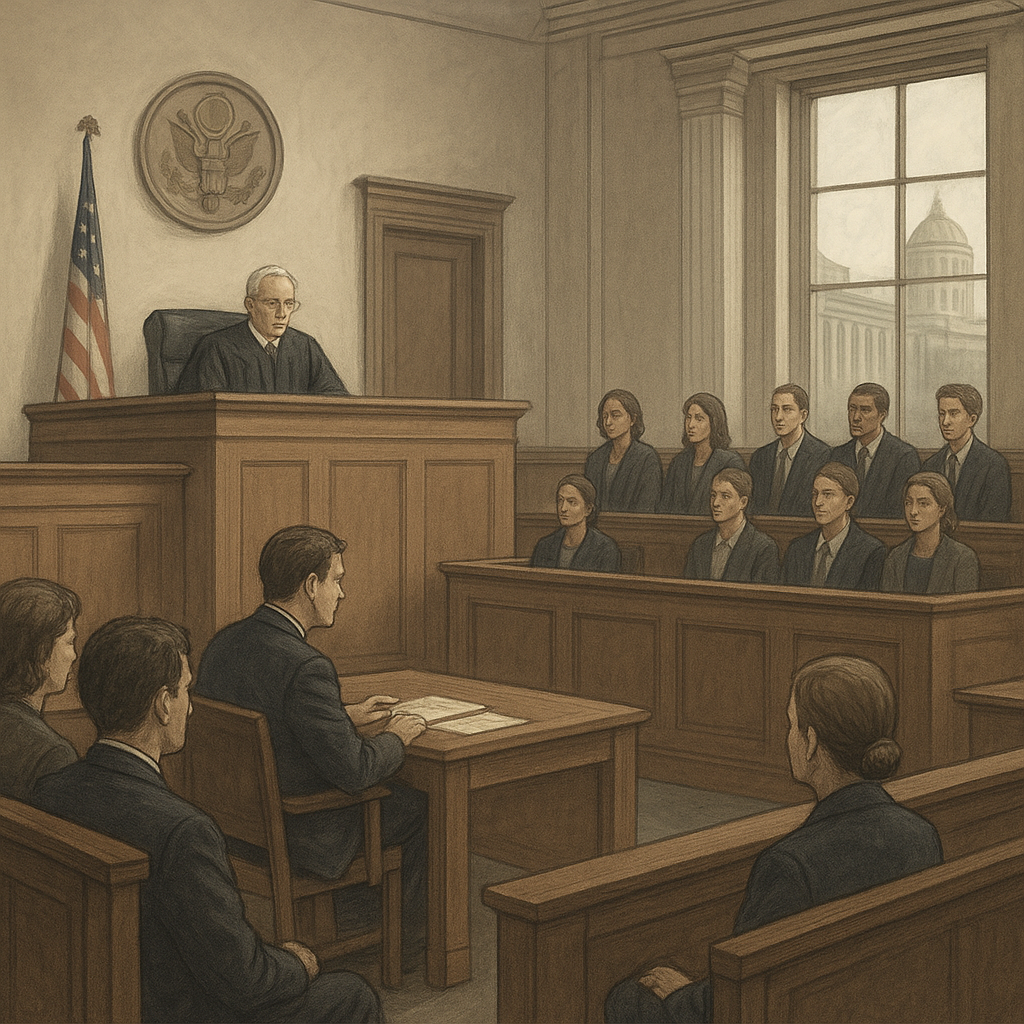
Once a jury reports that it is deadlocked, the focus shifts from the evidence to the procedure. The trial judge has discretion in how to proceed, but that discretion is not unlimited. Judges often ask jurors whether more deliberation might be useful or whether a clarifying instruction could help. In some cases, courts give what is commonly known as an Allen charge or similar supplemental instruction, which reminds jurors of the importance of reaching a verdict while also making clear that no juror should surrender an honest conviction simply to end the case.
If the judge believes further deliberation would be futile, a mistrial may be declared. A mistrial because of a hung jury is not unusual in serious criminal cases. It is, however, a major event in a case with national attention because it leaves the prosecution free, at least in many circumstances, to consider retrying the charges.
Any decision to retry a case like Clancy’s would depend on a mix of legal, evidentiary, and practical factors. Prosecutors would have to assess whether a second trial would likely produce a different result, whether witnesses are available and reliable, and how the defense would reshape its case. Public sentiment, though not legally determinative, often exerts pressure on both sides in a case that has already produced extensive media coverage.
Courtroom dynamics in this trial also underscore how judges manage emotionally difficult proceedings. In cases involving child deaths, mental illness, and a defendant who has herself been portrayed in sharply conflicting ways, a court must maintain order while protecting due process. That includes shielding jurors from outside influence and ensuring that deliberations remain confidential.
The defense and prosecution will likely read the deadlock differently. Prosecutors may view it as evidence that some jurors were not persuaded by the psychiatric defense. The defense may see it as proof that the jury was unable to reach the unanimous certainty required to convict on the most serious charges. Neither interpretation is definitive. A hung jury can signal anything from deep division over intent to uncertainty about expert testimony or sympathy for the defendant’s condition.
For broader context on how juries are instructed in serious criminal cases, readers may want to compare this trial with other deadlocked deliberations in homicide or manslaughter prosecutions. In those cases, the final result often turns less on the public narrative and more on how jurors apply a legal standard they have only recently encountered for the first time.
Community and policy implications
The Clancy case has resonated well beyond the courthouse. It has prompted public discussion about postpartum mental health, the limits of criminal law, and the way the justice system responds when a defendant’s alleged conduct is intertwined with psychiatric crisis. Those questions are not simple, and they often divide the public long after the criminal case itself ends.
One reason the case has drawn such intense attention is that it sits at the boundary between punishment and treatment. Families of victims understandably focus on accountability. Mental health advocates, by contrast, stress that severe psychiatric episodes can distort reality and may call for earlier intervention, better access to care, and stronger hospital-to-community support systems. The criminal court cannot solve those broader systemic problems, but cases like this expose them.
The policy implications are significant. If a jury cannot agree on guilt where a mental illness defense is central, lawmakers and court administrators may look again at whether jurors receive enough guidance on psychiatric evidence, whether mental health evaluations are accessible early enough in the process, and whether current treatment systems reduce the risk of catastrophic outcomes. Those are hard questions, but they are central to justice policy.
There are also civil rights dimensions. The law must balance two truths at once: the state’s obligation to prosecute violent crime and the defendant’s right to a fair process when mental illness may have affected conduct or capacity. That balance becomes especially delicate when a case is heavily publicized. Pretrial publicity can influence expectations, even if jurors are instructed to decide only on the evidence presented in court.
Cases like this also shape how the public understands mental health and violence. That understanding can easily become distorted. Most people with mental illness are not violent, and the presence of a psychiatric defense in a murder case should never be treated as proof of a broader social pattern. But the legal system still has to evaluate individual responsibility, and it must do so carefully.
The case may also renew discussion about the adequacy of crisis intervention in the weeks and months before violence occurs. In high-profile tragedies involving family members, investigators and advocates often ask whether warning signs were missed, whether records or communications showed escalation, and whether there were opportunities for intervention. Those inquiries can be important, but they must be handled responsibly and without speculation.
For readers interested in related justice-policy coverage, reporting on mental health diversion, competency restoration, and homicide trials involving psychiatric testimony can provide helpful context. Those topics often intersect, even when the facts differ dramatically from one case to the next.
As the court considers its next step, the case remains both a criminal proceeding and a broader public reckoning with how the legal system handles severe mental illness in violent-crime prosecutions. That tension is unlikely to disappear, whether this trial ends in a mistrial, a verdict, or another round before a new jury.

Frequently Asked Questions
What does it mean when a jury is deadlocked?
A deadlocked jury means the jurors could not reach the unanimous verdict required in a criminal case. It does not mean the defendant was found guilty or innocent. It means the jury could not agree after deliberating.
What happens after a deadlocked jury tells the judge it cannot agree?
The judge can ask jurors to continue deliberating, give supplemental instructions, or declare a mistrial if further discussion appears unlikely to produce a verdict.
Can the prosecution retry the case if there is a mistrial?
Often, yes. A mistrial caused by a hung jury usually leaves the prosecution free to decide whether to retry the charges, though that decision depends on the evidence, the court record, and broader case considerations.
Why is mental health such a central issue in this trial?
Because the defense has argued that Clancy’s mental state played a major role in the events at issue. In homicide cases, mental health evidence can affect whether the defendant had the intent or legal responsibility required for conviction.
Does a deadlocked jury mean the defense won?
Not necessarily. A deadlock is not a legal victory for either side. It simply means the case ended, for now, without the unanimous result needed for a verdict.
What does this case tell us about the criminal justice system?
It shows how difficult it can be for jurors to apply criminal law when the facts involve both alleged violence and serious psychiatric evidence. It also highlights how courts handle some of the hardest questions in homicide prosecution.
The trial’s deadlock does not end the public discussion around the case. It does, however, underscore how difficult it can be for a jury to sort through severe mental health claims, tragic facts, and the law’s demand for certainty before someone can be convicted of the most serious crimes.