Jordon Hudson’s civil lawsuit in Massachusetts alleges that Airbnb hosts shared doorbell-camera footage of her then-boyfriend, Bill Belichick, without their...
Jordon Hudson Alleges Airbnb Hosts Shared Ring Video of Bill Belichick in Privacy Lawsuit
Jordon Hudson’s civil lawsuit in Massachusetts alleges that Airbnb hosts shared doorbell-camera footage of her then-boyfriend, Bill Belichick, without their permission, helping expose a relationship the pair had tried to keep private. The complaint says the video showed Belichick shirtless outside a Winthrop rental home in summer 2023. It also alleges that one host later acknowledged sending the clip to friends. The lawsuit names hosts Elise McDevitt and Craig Nolan; Airbnb, Ring and Belichick are not defendants. The precise legal claims, the damages Hudson seeks and the route by which the video reached social media are not reported.
Key Takeaways
- Hudson’s complaint alleges that footage recorded outside a short-term rental was shared without her or Belichick’s knowledge or authorization.
- The complaint says McDevitt agreed to delete the video, then later acknowledged sending it to friends; it does not establish who posted it online.
- The action is a civil privacy lawsuit, not a reported criminal case. The complaint’s specific causes of action and requested damages are not reported.
- A Boston attorney questioned whether Hudson could show a legally recognizable injury, while the court has not made findings on the allegations.
What happened
Hudson’s complaint describes a four-night stay at a home at 27 Brewster Ave. in Winthrop, Massachusetts, during the summer of 2023. At the time, Hudson was 25 and Belichick was 74, according to the account of the lawsuit. The couple wanted to keep their relationship out of public view. Their stated wish for privacy matters to the dispute, but by itself it does not establish what legal protection applied to a recording made outside a residence.
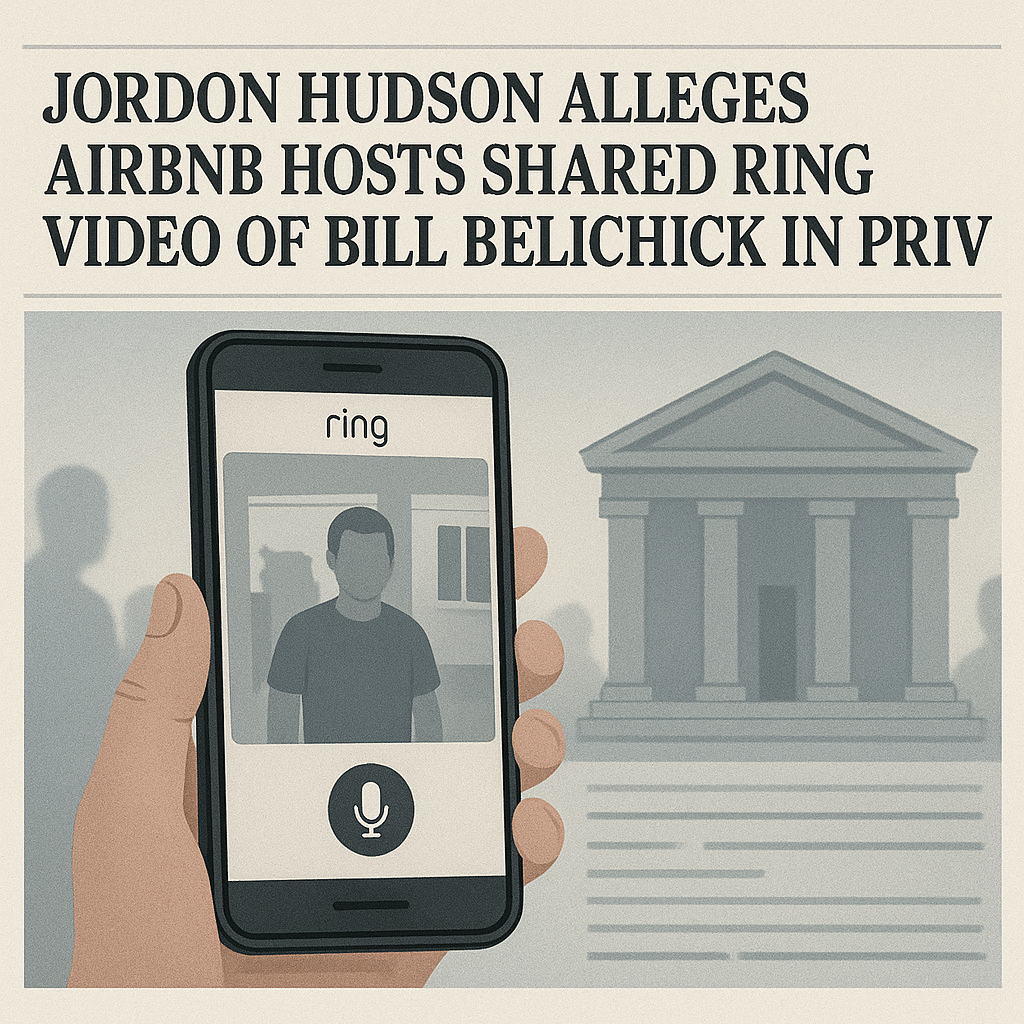
On the last night of the stay, McDevitt allegedly texted Hudson about where the couple had parked. The message asked her not to park in front of a neighbor’s home. According to the complaint, the text also included a link to Ring doorbell footage of Belichick walking to and from the rental while shirtless. Hudson alleges neither she nor Belichick knew about or authorized the recording and saving of that video.
The complaint says McDevitt agreed to delete the footage after Hudson raised the issue. It does not describe the full exchange or establish what copies existed after that conversation. A video stored on a camera may be different from a copy sent by text, downloaded to a phone or shared with another person. Those details could matter to a court’s assessment of what happened, but they are not set out in the reporting available here.
The footage later appeared on social media, according to the lawsuit, and Hudson says its circulation made the relationship public. The complaint connects the hosts’ conduct to that disclosure. But the reported account does not establish who uploaded the video to social media, whether a recipient forwarded it, or how it moved from the camera or an initial message to a public post. McDevitt allegedly told Hudson that the hosts had sent it to a few people while trying to determine whether the man in it was Belichick, and added that she did not know what happened after that.
In May 2025, the complaint says, McDevitt contacted Hudson unexpectedly and acknowledged sharing the footage with friends. The message quoted in the lawsuit reads: “We had sent it to a few people initially wondering is this him [Mr. Belichick], isn’t it him and I don’t know what happened from there, but we did delete it from the camera, as I assured you.” That is an alleged message reproduced in a civil pleading, not testimony tested in court. Its wording acknowledges sending the clip to some people, while leaving the later circulation unexplained.
Hudson’s lawsuit says the defendants “exhibited no remorse or regard for these” actions. That characterization is the plaintiff’s allegation. McDevitt and Nolan had not provided a response in the reported account. NBC News said it could not immediately reach them through publicly listed phone numbers and email addresses. Representatives for Belichick, Ring and Airbnb also could not immediately be reached for comment. None of those three is named as a defendant.
The distinction between the person shown and the person claiming harm is central. The footage described in the complaint shows Belichick, but Hudson alleges that its circulation exposed her relationship. The reported material does not say whether Hudson appears in the video, whether the footage captured conversations, or whether it revealed anything beyond Belichick’s movements outside the home. Those unanswered details may affect how the dispute is understood, and should not be filled in by assumption.
The complaint does not identify a dollar amount Hudson is seeking. The reported account also does not give a case number, name the court division, specify the causes of action, or describe any hearing schedule. Those omissions leave important questions about the lawsuit’s legal theory and progress unanswered. They do not, however, erase the central allegation: that footage recorded during a private rental stay was shared beyond the people who were captured or involved.
Legal context and the allegations
The case is a civil action, not a criminal prosecution. No arrest, criminal charge or law-enforcement investigation related to the footage is reported. In a civil lawsuit, a plaintiff asks a court for a remedy and must support the claims under the applicable law. Filing a complaint starts a dispute; it does not prove that the defendants did what the complaint alleges. The hosts would have an opportunity to contest the allegations through the court process, but a response or ruling is not reported.
Massachusetts has a statutory right to protection from “unreasonable, substantial or serious interference” with privacy. The language appears in Massachusetts General Laws, chapter 214, section 1B. The statute provides a legal framework for privacy claims, but it does not make every recording or disclosure unlawful. Whether a particular act crosses the legal threshold depends on the facts and the claims actually brought. The reported account does not identify which specific legal theories Hudson has pleaded, so it would be premature to say exactly how the statute applies here.
The Massachusetts Supreme Judicial Court has considered the state’s privacy law in cases such as Hill v. NCAA. That case is not about a short-term rental or a doorbell camera. It is relevant only as part of the broader legal background: privacy disputes turn on the circumstances, the nature of the information and the conduct at issue. The court in Hudson’s case would need to apply the governing law to the complaint and evidence actually presented, not to a general claim that every recording is either private or public.
The location of a camera is likely to be an important part of the debate. A recording of a walkway or entrance visible from outside a home may raise different expectations from a recording inside a bedroom or bathroom. But “outside” does not automatically settle the question. The rental was a residence for the duration of the stay, and the camera’s placement, angle, notice, purpose, retention and sharing could all be relevant. The lawsuit’s account does not establish whether the device was disclosed in the listing or exactly where it was mounted.
There is also a difference between making a recording for security and distributing it to other people. A host might install a camera to monitor an entrance, but that purpose does not by itself answer whether a particular clip was properly collected, stored or shared. Conversely, the claim that a video was shared does not, on its own, prove a privacy violation. The court would need to consider the conduct alleged, the applicable legal standard and any evidence or defenses the parties present.
The injury question may be contested. Hudson says the clip’s circulation exposed her relationship with Belichick, but the reported complaint does not quantify any financial loss or explain other specific consequences she claims. A privacy injury need not always take the form of a lost paycheck, yet a plaintiff still has to connect the alleged conduct to a legally cognizable harm under the claim being pursued. The law and the complaint’s actual counts—not speculation about embarrassment or publicity—will determine what must be shown.
Boston civil attorney Michael Coyne questioned whether Hudson could establish a claim for damages. He argued that she and Belichick had no expectation of privacy while outside the home and asked how she had been injured by the relationship becoming known. “If anything, her profile was elevated by it. So where’s the damage?” Coyne said. That is an outside attorney’s assessment, not a judicial finding. The reported account does not say that Coyne represents any party in this case.
Coyne’s argument raises two distinct issues: whether the conduct amounted to an actionable privacy interference and whether it caused an injury for which a court could award relief. Those questions should not be collapsed. A judge could find a particular act unreasonable without accepting every claimed consequence, or could reject a claim if a required element is missing. Because the specific causes of action are not reported, it is not possible to state which elements Hudson must prove or what defenses the hosts might raise.
Nor does a person’s public profile automatically dispose of a privacy dispute. Belichick is widely known, but the complaint concerns what private hosts allegedly did with a recording from a rental stay, not merely whether news organizations may report on a public figure. At the same time, a wish to keep a relationship confidential is not necessarily enough to make every recording of an outdoor space legally protected. The legal question lies in the details and the applicable cause of action.
Law enforcement and court response
No police response or criminal investigation is reported. The dispute described is being pursued through a civil lawsuit in Massachusetts. That distinction matters: a civil complaint is not evidence that a crime occurred, and it does not mean prosecutors have brought charges. The allegations concern recording, sharing and the claimed consequences of disclosure; the available account does not say that any law-enforcement agency has investigated the hosts or the online posting.
The filing has not produced a reported ruling on the merits. No judge has been reported to have decided whether the recording violated Massachusetts law, whether the hosts shared it in a legally actionable way, or whether Hudson suffered compensable harm. The available account also does not report a hearing date, a response from the defendants, or a request for an injunction. A court may address procedural issues before any trial, but no particular motion or ruling is reported in this case.
That gap is important because a complaint is one side’s account. It states allegations and asks for relief; it does not establish the truth of those allegations. The defendants may admit, deny or dispute different parts of the account, and evidence may differ from what either side initially says. As the case proceeds, the parties may submit documents, messages, camera records or other evidence, subject to the court’s rules. None of those materials is described in the reported account beyond the message quoted in the complaint.
The named defendants are McDevitt and Nolan. Airbnb and Ring are not named parties, despite their connection to the rental platform and camera system, and Belichick is not a plaintiff in the reported filing. Their absence from the case means the lawsuit, as described, does not ask the court to decide their liability. It also means no conclusion should be drawn about whether either company’s policies were followed or whether either company had a role in the alleged sharing.
McDevitt and Nolan could not immediately be reached by NBC News on Monday using publicly listed contact details. The report did not include a comment from them. Representatives for Belichick, Ring and Airbnb likewise could not immediately be reached. The absence of comment is not an admission and should not be treated as evidence for either side. Their positions, if any, remain unreported.
The court’s eventual role will be narrower than the public debate around the relationship. It will address the legal claims and evidence presented by the parties, not decide every question about celebrity, online attention or rental-platform practices. If the case is resolved privately or dismissed before trial, the public record may never establish all of the facts that readers want answered. Until there is a ruling or verified evidence, the allegations should remain attributed to the complaint.

Community and policy implications
Short-term rentals can put ordinary residential settings into a commercial relationship: a guest rents a home, while the owner or host may maintain devices for security or property management. That arrangement depends on clear expectations. Guests need accurate information about monitoring; hosts need to limit access to footage and use it only for legitimate purposes. A disclosure that a camera exists is important, but it does not necessarily answer every question about what happens to a recording after it is made.
Airbnb’s current camera and recording-device policy describes rules for recording devices in listings, including requirements concerning disclosure and restrictions on cameras inside a listing. The policy in force today may not be identical to the rules that applied during the 2023 stay, and the complaint’s account does not say whether the camera was disclosed. The current policy therefore provides background, not proof that the hosts complied with or violated the terms that applied at the time.
The dispute also shows why camera access and retention practices matter. A device can create a record that is easy to share beyond its original purpose. Property owners and rental managers can reduce that risk by limiting who can view footage, setting appropriate retention periods, securing accounts and avoiding casual distribution. These are practical safeguards, not findings about what happened in Winthrop. The complaint’s account leaves open how many people received the clip and whether any copies remain.
For guests, the case is a reminder to read listing disclosures and ask questions about recording devices before booking. But responsibility should not be placed only on travelers. A guest may not know how a device is configured or whether recordings are saved, and may have little control over the host’s account. Clear, prominent disclosures and consistent rules can help guests make informed choices and give hosts a workable standard. They cannot, by themselves, resolve whether a particular later disclosure was appropriate.
There is a separate public-interest question about sharing footage involving a famous person. Curiosity about Belichick may help explain why the clip attracted attention, but popularity does not establish that the sharing was lawful or harmless. Nor does the complaint prove that the hosts intended to expose Hudson’s relationship. The alleged message says the hosts initially sent the video to a few people to ask whether it showed Belichick; it also says McDevitt did not know what happened after that. The distinction between initial sharing and later online publication remains unresolved.
The consequences of disclosure can vary. A person may object to the loss of control over a private relationship even when the resulting publicity brings attention or opportunities. A court, however, must evaluate legally relevant injury rather than assume that any unwanted exposure caused compensable harm. Coyne’s public criticism puts that issue plainly. Hudson’s account and any evidence she presents may frame it differently. Without the complaint’s full legal theories and evidence, neither view should be treated as the court’s answer.
The case may also encourage hosts and platforms to clarify what “security footage” is for. A recording used to respond to a safety incident is different from a clip circulated for speculation or entertainment, even if the same camera captured both. Policies can address disclosure, access and sharing, while courts determine legal responsibility in individual cases. No policy change by Airbnb or Ring in response to this lawsuit is reported, and neither company is a party to the action described.
Hudson and Belichick are no longer dating, according to multiple news outlets, and Belichick recently declined to refute those reports. That later relationship status does not answer whether the earlier recording was authorized, how it spread or whether Hudson can prove a legal injury. The claim concerns the alleged handling of a clip during a particular stay and the effect its circulation had at that time. Keeping the timeline clear is essential to separating the lawsuit’s facts from later coverage of the couple.
Frequently Asked Questions
What does Jordon Hudson’s lawsuit allege?
The complaint alleges that Airbnb hosts Elise McDevitt and Craig Nolan were responsible for sharing or allowing the circulation of Ring doorbell footage of Bill Belichick outside a Winthrop rental in summer 2023. It says Hudson and Belichick did not know about or authorize the recording, and that the video later appeared on social media and exposed their relationship. These are allegations, not findings by a court.
Did a host admit to sharing the video?
The complaint says McDevitt contacted Hudson in May 2025 and wrote that the hosts had sent the video to a few people while trying to identify Belichick. The message also says McDevitt did not know what happened after that and that the video had been deleted from the camera. The reported account does not establish who posted the clip to social media or how it reached the public.
Are Airbnb, Ring or Bill Belichick defendants?
No. The reported lawsuit names McDevitt and Nolan. Airbnb, Ring and Belichick are not named parties. Representatives for each could not immediately be reached for comment in the reported account. Their absence as defendants does not establish whether any company policy applied or whether anyone else had a role in the video’s circulation.
Is this a criminal case?
No criminal case, arrest or charge is reported. The filing is a civil privacy lawsuit. A civil complaint asks a court for relief and contains allegations that must be addressed through the civil process. It does not, by itself, establish that a crime occurred or that the defendants are liable.
How much money is Hudson seeking?
The reported account does not state a dollar amount, and it does not describe the full relief requested. Coyne questioned whether Hudson could show that she had been injured by the disclosure. That is his assessment, not a court decision. Any damages or other relief would depend on the claims pleaded, the evidence and the court’s application of Massachusetts law.
Has a judge ruled on the lawsuit?
No ruling on the allegations is reported. The available account does not provide a hearing date, a response from the defendants or a court decision on whether the recording or sharing violated privacy law. Until a court makes findings or the parties otherwise resolve the case, the complaint’s assertions remain allegations.
The central dispute is not simply whether a doorbell camera captured a public-facing walkway. It is what the hosts allegedly did with the footage, what the video revealed about people who had rented the home, and whether that conduct caused a legally recognized injury. Those questions are unresolved. For now, the complaint supplies one account, the defendants’ response is not reported, and no court has decided the case.