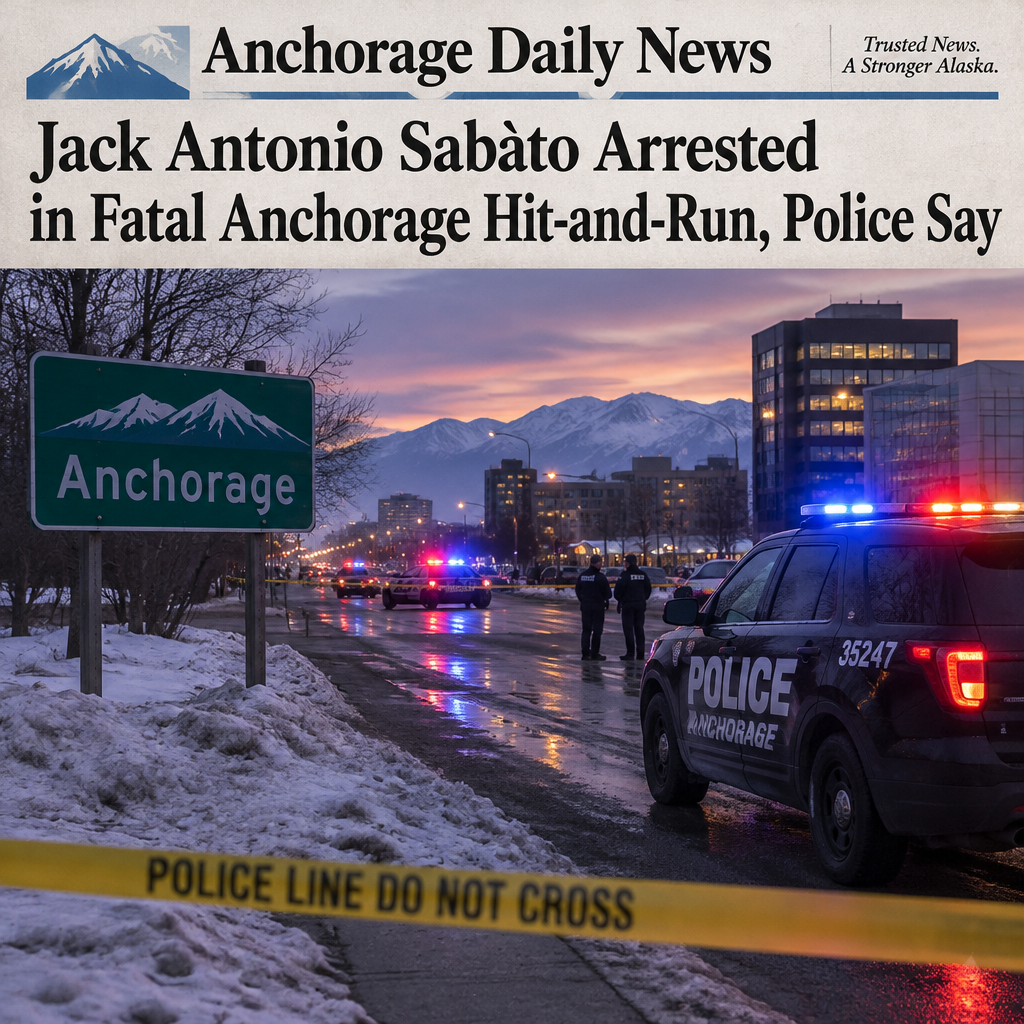
Jack Antonio Sabàto Arrested in Fatal Anchorage Hit-and-Run, Police Say
Jack Antonio Sabàto, 32, was arrested in connection with a fatal hit-and-run in Anchorage after a pedestrian was struck and killed early Monday, police said. Jail records show Sabàto was booked into the Anchorage Correctional Complex on suspicion of leaving the scene of a deadly accident and failing to assist. The arrest is an allegation, not a finding of guilt.
What happened
Anchorage officers and medical responders went to the intersection of Airport Heights Drive and Debarr Road shortly before 5:48 a.m. local time Monday. Police said they found an “unresponsive adult male” who had been struck by a vehicle. The driver, according to the department, left the scene. The pedestrian, identified as 42-year-old Carl Simmonds, was pronounced dead there.
Police identified Sabàto later that day as the driver allegedly behind the wheel of a Chevrolet Tahoe. Officials have not publicly described in the reported account how they connected him to the vehicle, how long the investigation took, or whether anyone else was in the Tahoe. Nor does the account explain the vehicle’s direction of travel, the pedestrian’s movements, or the sequence immediately before impact.
Those details matter. A report that a vehicle struck a pedestrian and left establishes the basic allegation, but it does not by itself describe the crash mechanics or explain what the driver knew at each point. Investigators may need to establish both who was driving and what happened after the collision. The available information does not say what evidence was collected or what conclusions investigators have reached beyond identifying Sabàto as the alleged driver.
The arrest report says Sabàto was booked on suspicion of leaving the scene of a deadly accident and failing to assist. Those terms describe the suspected conduct reported at booking; the account does not identify a charging document or specify the statutory counts, if any, filed by prosecutors. It also does not report a plea, bail decision, or court date.
Sabàto is the son of actress Virginia Madsen and actor Antonio Sabàto Jr. That family connection has drawn attention to the arrest, but it does not bear on the evidence or the legal standard. The relevant questions are what investigators can establish about the crash and whether prosecutors can prove any filed charge in court.
The report places the crash at an intersection and gives an early-morning time, but does not provide the calendar date, weather, visibility, street-lighting conditions, traffic controls, speed, or the location of any crosswalk. A clock time alone cannot establish whether it was dark or what a driver or pedestrian could see. Those facts should not be assumed while the investigation’s public record remains limited.
Legal context and charges or proceedings
Alaska law sets duties for a driver involved in a collision that causes injury or death. Alaska Statute 28.35.050, concerning accidents involving death or personal injury, addresses stopping at the scene and rendering reasonable assistance, among other responsibilities. The statute is available through the Alaska Legislature’s official statutes. The exact legal counts in this case cannot be determined from a booking description alone.
That distinction is important. An arrest means police took a person into custody based on an allegation and the applicable arrest standard. It is not the same as a prosecutor filing a charge, a judge finding probable cause, or a jury finding guilt. The reported booking language does not establish that a formal complaint or indictment has been filed. It also does not state which provisions prosecutors might rely on or whether the suspected conduct will ultimately be charged.
If charges are filed, prosecutors must prove the elements of each offense beyond a reasonable doubt. That would require evidence connecting the accused to the alleged conduct and establishing the facts required by the particular statute. The state’s case could be tested through pretrial motions, examination of witnesses, and challenges to the reliability or interpretation of evidence. The defense may dispute identification, the reconstruction of the collision, or other issues; none of those positions has been reported here.
The cause of a collision and a driver’s conduct after it are related but distinct factual questions. Investigators may examine what caused the impact and separately consider whether the driver stopped, remained at the scene, or provided assistance. The reported allegations concern leaving and failing to assist; they do not establish that Sabàto caused the collision, acted intentionally, was impaired, or knew a person had been struck. No such details have been reported.
Court records show that Sabàto is represented by a public defender. That fact identifies his reported legal representation; it does not indicate a plea, a court ruling, or the likely outcome. A defense lawyer’s role is to advise the client, review the evidence, and protect the client’s legal rights. The public defender’s office and representatives for Sabàto’s parents could not immediately be reached for comment on Wednesday, according to the account of the arrest.
The Alaska Court System’s case-search service is one public route for checking court records. But a case-search listing, if one appears, would not itself prove the underlying allegations. Court records may show procedural steps—such as filed counts, hearings, or rulings—while the evidence and legal arguments are addressed through the court process. The reported information does not give a docket number or say that an initial hearing has taken place.
Until a court reaches a decision, the presumption of innocence applies. That principle is not a prediction about the evidence; it is the rule that the government bears the burden of proving criminal charges. Precise reporting should therefore distinguish an arrest on suspicion from a formal charge, and both from a conviction.
Law enforcement or court response
Anchorage police said officers and medics responded shortly before 5:48 a.m. Monday, and the department later identified Sabàto as the alleged driver. The account provides no fuller police briefing, investigative report, or explanation of the identification process. It does not say whether police have asked witnesses to come forward or whether they have announced that the investigation is complete. The Anchorage Police Department’s public information page provides an official reference point for department information.
In a fatal vehicle investigation, investigators may use several kinds of evidence. Examples include witness accounts, nearby business or traffic-camera footage, physical damage to a vehicle, debris and marks at the scene, roadway measurements, and vehicle data. Depending on the circumstances, they may also consider phone records, medical findings, or other records. These are examples of potential investigative tools, not a description of what police used in this case; the reported account does not say.
Such evidence can address different questions. A camera image or witness could help identify a vehicle or establish its movements. A vehicle examination might be compared with physical evidence from the roadway. Measurements and photographs can assist a reconstruction of where impact occurred and how the vehicles and pedestrian moved. Other evidence may bear on the timing of the collision or what happened afterward. None of these possibilities should be treated as a confirmed investigative step without a statement or court filing that supports it.
Investigators also need to preserve the difference between identifying a vehicle and establishing who was driving it. A registered owner, a person found in or near a vehicle, and the driver at the moment of impact are not automatically the same person. The police statement, as described in the report, identifies Sabàto as the alleged driver, but does not explain the basis for that conclusion. Evidence and any challenges to it would be assessed through the criminal process.
The public record reported so far is narrow: police described the fatal collision, named Simmonds, identified the alleged vehicle and driver, and said Sabàto was arrested. No account of a reconstruction, toxicology findings, impairment allegation, vehicle inspection, or witness statement was provided. The absence of those details in the report does not show that investigators did or did not examine them. It means their status has not been reported.
The next public developments, if a case proceeds, could include a charging document, a court appearance, or a statement from law enforcement or counsel. Those steps would clarify the formal allegations and procedural posture; they would not, on their own, resolve whether the allegations are true. The Alaska Court System makes case information available, subject to the court’s rules and the records actually filed.
Community and policy implications
A pedestrian’s death at a named Anchorage intersection raises immediate questions for people who live, walk, and drive nearby. Yet the available facts do not establish whether the intersection’s design contributed to the crash. A meaningful safety review would need information about the crossing, traffic signals, lighting, sightlines, road surface, vehicle speeds, traffic volume, and the history of crashes at the location. None of those conditions has been described in the account.
The early hour is relevant to the timeline, but it cannot stand in for evidence about visibility. Anchorage’s daylight varies substantially across the year, and the calendar date is not given here. Weather, artificial lighting, vehicle headlights, and the positions of the people involved would also matter. Without those facts, declaring that darkness, road design, or a particular behavior caused the crash would go beyond what is known.
If local officials review the intersection, they could consider whether the available data support changes such as improved lighting, clearer crossings, signal adjustments, traffic-calming measures, or other design work. Those are potential tools for a safety assessment, not recommendations based on a finding about this particular location. Any decision should draw on engineering analysis, crash history, community experience, and the circumstances established by investigators.
The case also illustrates why leaving the scene after a serious collision is treated as a matter of public safety. Prompt assistance can connect an injured person with emergency care, while remaining at the scene can help responders and investigators understand what occurred. Alaska law addresses those responsibilities. Whether the law was violated in this instance is a question for evidence and, if charges are filed, the courts—not an assumption based solely on an arrest report.
Public attention can be heightened when an arrested person has well-known relatives. That attention should not displace the person who died or the limits of the known facts. Simmonds has been identified by name and age; the report provides no further information about his family, work, or life. A careful account avoids filling those gaps with guesses and avoids treating a family connection as evidence of wrongdoing or a reason to presume guilt.
The case also calls for restraint in discussing unverified claims online. The available report does not establish impairment, intent, a motive for leaving, or the precise circumstances of the impact. Sharing those assertions as fact could mislead the public and harm people connected to the case. Verified police statements, court filings, and attributed comments offer a firmer basis for updates than speculation.
Federal road-safety resources, including NHTSA’s pedestrian-safety guidance, discuss broader ways to reduce risk for people on foot. General guidance can inform community conversations, but it cannot substitute for facts about this intersection or this collision. Local safety decisions should be based on local evidence, while the criminal case—if one is filed—should be decided on the evidence admitted in court.
Frequently Asked Questions
Who was killed in the Anchorage crash?
Police identified the pedestrian as Carl Simmonds, 42. He was pronounced dead at the scene after being struck by a vehicle at Airport Heights Drive and Debarr Road, according to the police account.
What is Jack Antonio Sabàto accused of?
Jail records show he was booked on suspicion of leaving the scene of a deadly accident and failing to assist. Police said he was identified as the alleged driver of a Chevrolet Tahoe involved in the crash. The report does not specify formal charges.
Has Sabàto been convicted or entered a plea?
No conviction, plea, or court finding is reported. An arrest is an allegation and does not establish guilt. Sabàto is reported to be represented by a public defender.
What does Alaska law require after a crash involving injury or death?
Alaska Statute 28.35.050 addresses a driver’s duties, including stopping at the scene and rendering reasonable assistance. Which legal provisions apply to this case, and whether any violation can be proved, depend on the formal charges and evidence.
What is known about how the crash happened?
Police said Simmonds was struck by a vehicle that left the scene and later identified Sabàto as the alleged driver. The report does not describe the collision’s sequence, road or weather conditions, evidence collected, or the basis for the identification.
The established facts remain limited but serious: Simmonds died after being struck by a vehicle that police say left the scene, and Sabàto was arrested on suspicion of related offenses. Formal charges, evidence presented in court, and any judicial findings will determine what can be said next. Until then, the allegations should be reported as allegations and the victim should remain central to the story.