Investigators in the disappearance of Nancy Guthrie released two ransom notes, including one that appears to contradict what the Arizona sheriff overseeing the...
Investigators release two ransom notes in Nancy Guthrie disappearance as sheriff’s account is questioned
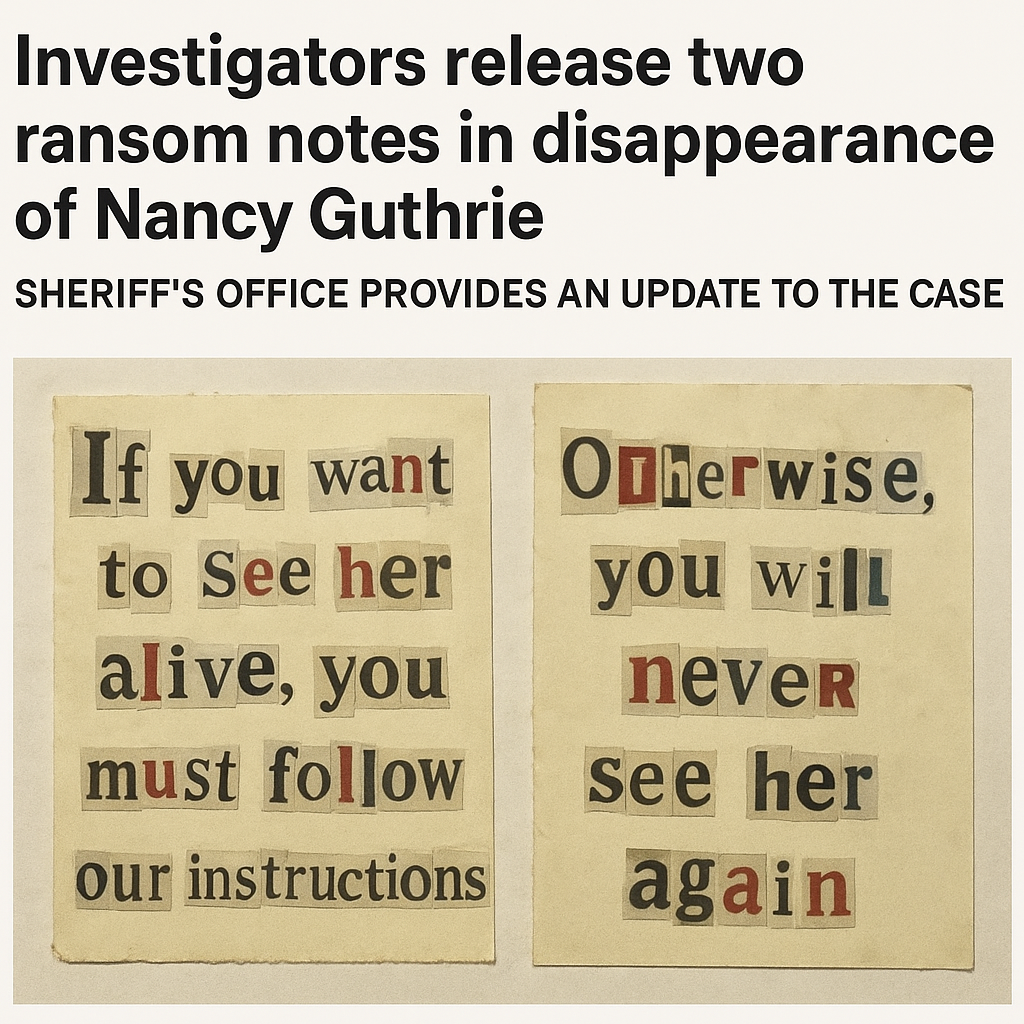
Investigators in the disappearance of Nancy Guthrie released two ransom notes, including one that appears to contradict what the Arizona sheriff overseeing the case told CBS News. The notes add a new layer of uncertainty to an already troubling investigation, raising questions about who wrote them, when they were created, and what they reveal about the timeline of the disappearance.
Key Takeaways:- Investigators have now made two ransom notes public in the Nancy Guthrie case.
- One note appears to conflict with the account given by the Arizona sheriff in a CBS News interview.
- The discrepancy raises questions about the chronology of the disappearance and the handling of the investigation.
- Public release of the notes may help investigators test statements against documentary evidence.
- The case remains an active investigation, with no public resolution reported.
What happened
Investigators working the disappearance of Nancy Guthrie released two ransom notes as part of the continuing effort to piece together what happened. In any missing-person case, documents like these are more than paper. They can offer a clock, a voice, or a clue about whether an abduction occurred, whether the family was being targeted, or whether someone was trying to stage a crime scene.
The most significant detail is that one of the notes appears to contradict what the Arizona sheriff overseeing the case told CBS News. That matters because public statements from a lead investigator can shape how the case is understood by the family, the media, and potential witnesses. If a released note conflicts with an official account, the discrepancy can point to one of several possibilities: mistaken recollection, incomplete information at the time of the interview, or a deeper inconsistency in how the case has been described.
At this stage, the notes are evidence, not answers. Investigators typically release such materials when they believe public scrutiny may surface new information or when they want to confirm details already obtained through the case file. In missing-person investigations, especially those with suspected foul play, even small contradictions can matter. A note that does not fit the stated timeline can alter the order in which investigators evaluate sightings, phone records, call logs, or vehicle movements.
It is also possible the public release serves a strategic purpose. Prosecutors and detectives sometimes disclose limited evidence to prompt new tips or to pressure someone who knows more than they have said publicly. That can be especially important if the case has stalled or if law enforcement believes the person responsible may be watching coverage closely.
Missing-person cases are often marked by a tension between public disclosure and investigative secrecy. Release too little, and the public may assume nothing is happening. Release too much, and investigators risk exposing case strategy. The decision to publish ransom notes suggests investigators think the material is significant enough to justify that risk.
Legal context and charges or proceedings
A ransom note can carry legal significance in several ways. It may become part of a kidnapping or extortion case if evidence shows the note was used to demand money or direct a family’s actions. It may also be used in a homicide investigation if the note appears to be staged after a killing. In some cases, the note is central to determining whether a crime was committed at all, or whether a disappearance was made to look like one.
If the notes are authenticated, investigators may compare handwriting, language patterns, paper stock, ink, and any physical or digital trace that links them to a suspect. Those details can matter later in court. A note alone rarely proves a crime, but it can support other evidence: cell-site data, surveillance video, witness testimony, forensic results, or admissions.
The contradiction reported between the note and the sheriff’s public account also has legal implications for testimony. Law enforcement officers who speak publicly must be careful not to overstate what they know. In a future hearing, trial, or deposition, any inconsistency between public statements and the documentary evidence can be used to challenge credibility. Defense attorneys often look for those gaps, especially if the case becomes a prosecution.
That does not mean the sheriff was wrong; it means the investigation needs to be measured against the actual records. In high-profile cases, investigators may summarize evidence in broad terms to preserve confidentiality. But once evidence becomes public, those summaries can be tested. That is one reason documents matter so much in criminal investigations: they freeze a moment in time.
The case also sits within the broader legal framework for missing persons and possible abductions. In the United States, there is no single national missing-person statute that governs every case. Local law enforcement usually leads the initial response, with state and federal agencies stepping in if there is evidence of interstate movement, kidnapping, organized criminal activity, or potential civil-rights concerns. Arizona case handling may also involve coordination with prosecutors if the facts suggest charges could be filed later.
Related coverage of law-enforcement accountability and evidence handling often turns on the same issue at play here: whether officials are working from verified facts or public assumptions. For readers following similar cases, our reporting on investigation procedures and missing persons evidence standards can help explain how detectives build a record and why early statements can later become important.
Law enforcement or court response
The release of the notes signals that investigators are trying to control the narrative with evidence rather than speculation. That is usually the correct move. In a missing-person or suspected kidnapping case, rumor can spread faster than facts. Publicly released documents can narrow the field.
The sheriff’s office has not, based on the information provided, publicly resolved the contradiction. That leaves several questions open: Did the sheriff describe the notes inaccurately? Were there multiple versions? Was the CBS News account based on a partial briefing? Or does the note itself contain language that investigators now interpret differently?
Those distinctions may seem small, but they affect how a case is pursued. If detectives believe the notes were staged, they may focus on forensic linkage and deception indicators. If they believe the notes reflect a genuine abduction, the investigative emphasis shifts toward the route, timing, and likely custody of the missing person. Each theory calls for different warrants, interviews, and expert analysis.
Law enforcement often faces a credibility test in the early stages of a major case. Families want certainty. The public wants clarity. Journalists want records. But police work is usually messy, and investigators sometimes have to correct themselves as new evidence arrives. When that happens, transparency can help if it is accompanied by specifics. Vague assurances do not.
Courts may eventually become involved if there are search warrants, grand jury proceedings, or criminal charges. If that happens, the ransom notes could be scrutinized under evidentiary rules governing authentication and relevance. The defense could argue the notes were unreliable, improperly handled, or taken out of context. Prosecutors, by contrast, would likely present them as one part of a larger evidentiary picture.
For readers interested in how police statements and later evidence are assessed, our related analysis on law enforcement public statements and evidence in criminal cases shows how these disputes are handled in practice.
Community and policy implications
Cases like Guthrie’s reach beyond a single investigation. They affect how the public views missing-person response, the speed of police communication, and the standards for releasing sensitive evidence.
Families often push for rapid disclosure because they believe public attention can generate tips. Law enforcement often resists that urge because premature release can compromise witness interviews, tip triage, or surveillance work. The release of the ransom notes suggests investigators judged that the benefits of disclosure outweighed the risks. Whether that calculation proves correct will depend on whether the release produces new leads.
There is also a broader policy issue: how agencies handle communications when their statements are later questioned. A contradiction between a released note and a sheriff’s public account may seem like a narrow issue, but public confidence in missing-person investigations depends on accuracy. When official statements and documentary evidence do not line up, people begin to wonder what else may be missing from the file.
That skepticism can be especially pronounced in smaller jurisdictions that do not have the staffing or forensic resources of large metropolitan agencies. Rural and suburban offices often rely on a limited number of detectives, outside labs, and assistance from state agencies. If the Guthrie case is one of those investigations, the public may reasonably ask whether the office has enough support to work the matter thoroughly.
The policy implications extend to evidence disclosure practices. Agencies need clear standards for when to release documents, how to summarize them, and what to do if later analysis changes the meaning of an earlier statement. That is not just about public relations. It is about preserving trust in the investigative process.
Missing-person coverage also intersects with civil-rights concerns when families argue that cases involving women, Indigenous people, people of color, or people from less influential communities do not receive the same urgency as others. National reporting has repeatedly shown that disappearance cases can move unevenly depending on resources, geography, and media attention. Even when those issues are not the central focus, they shape how the public receives a case like this one.
For further context on justice-policy questions that often arise in active investigations, see our coverage of missing persons policy, victim-family communication, and investigative transparency.

Frequently Asked Questions
Why are the ransom notes important?
They may help investigators determine whether a kidnapping occurred, who authored the notes, and whether the documents fit the known timeline of the disappearance.
What does it mean that one note contradicts the sheriff’s account?
It means there is a discrepancy between the public statement and the documentary evidence. That could reflect a misunderstanding, incomplete information, or a more serious inconsistency that investigators need to resolve.
Could the notes be used in court?
Yes, if the case leads to charges. The notes could be introduced as evidence, but they would still need to be authenticated and supported by other proof.
Does the release of the notes mean there is an arrest imminent?
Not necessarily. Investigators sometimes release evidence to generate tips or clarify the record long before any charges are filed.
Why would police release evidence in an active case?
To test statements, identify inconsistencies, prompt witnesses to come forward, and increase the chance of breaking a stalled investigation.
The release of these ransom notes suggests investigators believe the public can help, but it also shows how fragile early narratives can be in a disappearance case. One document can strengthen an investigation; another can expose a contradiction that forces officials to re-check everything. For Nancy Guthrie’s family, and for the public following the case, the notes are a reminder that the most important facts are often the ones still waiting to be verified.