Gisèle Pelicot Says She Will Take Legal Action Over Intimate Images Used to Promote Book
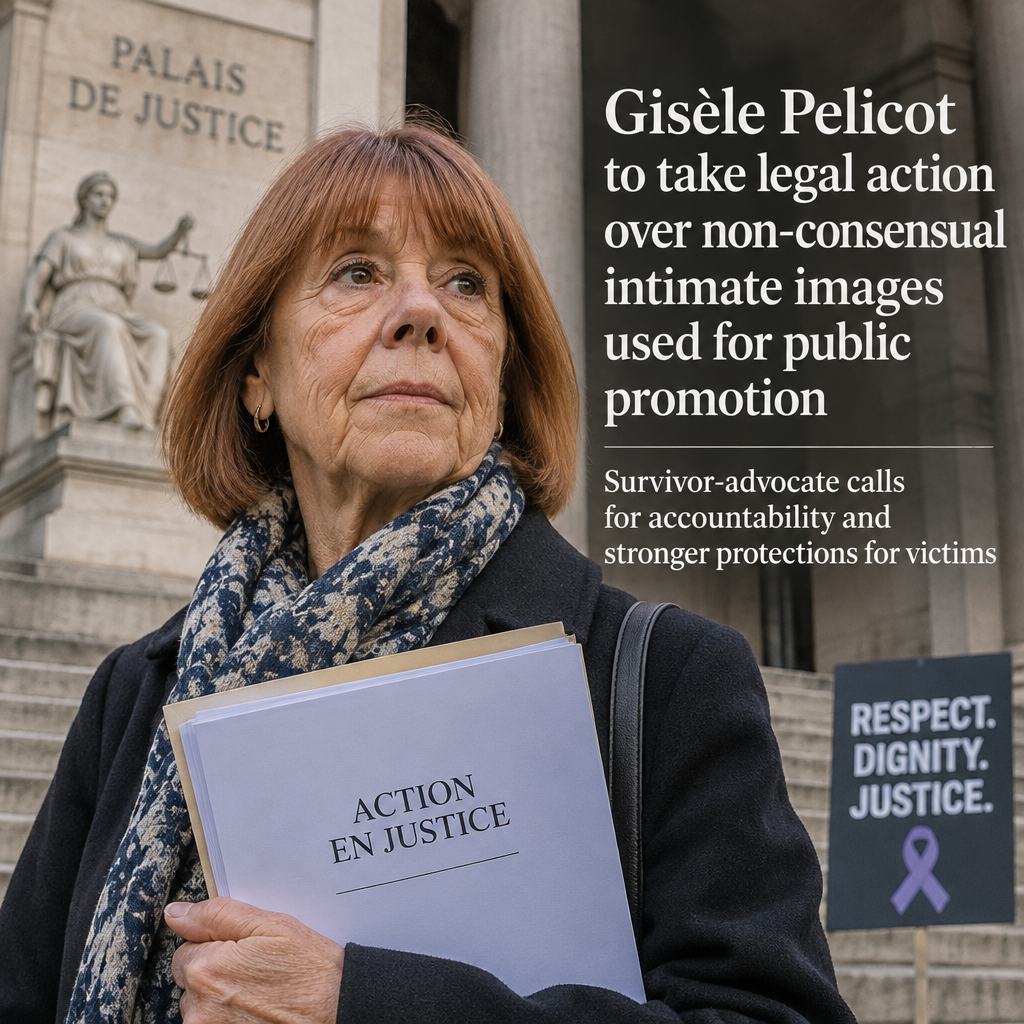
Gisèle Pelicot said Monday she will take legal action against a publisher and a book’s author after intimate images of her were sent to media outlets as part of a promotional campaign. Pelicot, whose former husband was convicted of drugging and raping her and arranging for other men to rape her, said the images and the book’s treatment of her experience had left her feeling exposed and humiliated again.
What happened
Pelicot, 73, told France’s BFMTV that she was deeply shocked that images connected with her intimate life had been circulated for commercial purposes. She said she would not accept what she described as an effort to rewrite her story by suggesting she was complicit in what she endured. Her message was not only about the photographs: she also objected to a book that, as described in reporting about its arguments, questions her status as a victim.
The photographs and videos were reportedly sent to media outlets to publicize a book by French psychoanalyst Sabine Prokhoris, published by Tinard. The reporting does not establish who obtained or transmitted the images, whether the publisher or author selected them, or what permissions—if any—were sought. Those details matter. A publisher’s role in commissioning publicity, an author’s involvement in the campaign, and the circumstances in which images were made or shared are separate questions that may require evidence to resolve.
The publisher said on its website that it offered Pelicot its “sincerest apologies.” It also said no images of rape or pornographic videos had been leaked to the press. That statement distinguishes the material at issue from recordings of sexual assaults, but it does not settle whether the images described as intimate or nude were distributed with Pelicot’s consent. Nor does it explain how the material reached the people who sent it to journalists.
Tinard said it would not print more copies after the 280 already produced have been sold. That is a decision about future printing, not, on the information reported, a recall of existing copies or a judicial order stopping publication. The publisher has not been reported to have announced that the remaining copies were withdrawn from sale.
Prokhoris told Agence France-Presse that she had given the publisher full responsibility for the promotional campaign. Her statement addresses who handled publicity, but does not itself establish what the author knew about the images, when she knew it, or whether she approved their use. Those questions remain unanswered in the public account.
The book’s back-cover description invites readers to “think freely” about coercive control. It characterizes the concept as a cornerstone of what it calls “#MeToo orthodoxy,” describes it as fundamentally ambiguous, and says it involves both parties in an “equally responsible, though not symmetrical” way. Reporting about the book says it challenges the concept and questions whether Pelicot was a victim, suggesting she might have been complicit despite her account that she was secretly drugged for years.
Pelicot has rejected that implication. She told BFMTV that she would not allow her experience to be rewritten in a way that made her responsible for what was done to her. In a statement to the broadcaster, she said she had fought to regain her dignity and freedom and would not let others take them away. Her description of being humiliated again links the publicity dispute to the intense public exposure she experienced during the criminal trial.
The source of the images has not been confirmed. Pelicot did not challenge their authenticity in her statements to French media, but neither did she confirm or deny a report by the French weekly Le Canard Enchaîné that they were among images taken by her former husband and presented as evidence at trial. The distinction is important: a report about possible provenance is not confirmation, and the public record described so far does not identify the person who sent the images to media outlets.
Legal context and proceedings
Pelicot said she would take legal action against both Tinard and Prokhoris. Her lawyer, Christophe Bigot, described two concerns to BFMTV: first, the nonconsensual sending of intimate images in a commercial context; second, a book that calls into question her status as a victim. Bigot said Pelicot considered the image distribution a clear violation of the law and did not intend to leave it unchallenged.
That announcement should not be mistaken for a report that a lawsuit has already been filed, that authorities have opened an investigation, or that a court has ruled. The public reporting does not specify the legal claims she intends to bring, the court in which she might file, or whether she has made a formal complaint. It also does not report a response from police or prosecutors about a new investigation. The legal route and any eventual findings remain unresolved.
French law includes protections for private life, including the broad protection set out in Article 9 of the Civil Code. Other legal provisions may be relevant depending on how images were created, obtained, retained, and shared. The applicable analysis can turn on facts such as consent, the setting in which an image was taken, the purpose of its use, and the conduct of each person involved. The public account does not supply enough detail to determine which provisions, if any, a court would apply in this dispute. The official texts are available through Legifrance’s Civil Code and Penal Code.
The promotional use of a private image can raise questions distinct from the merits of a book’s argument. A dispute over whether a publication accurately describes a criminal case is not the same as a claim that a person’s image was shared without permission. Conversely, a publisher’s apology or decision not to reprint a book does not, by itself, resolve a legal claim about image use. A court assessing any claim would need evidence about the images, their provenance, the communications among the people involved, and the steps taken to circulate them.
The book’s discussion also raises a separate issue: how public debate about coercive control should be handled when a specific survivor’s experience is discussed. The phrase generally refers to a pattern of conduct used to dominate, restrict, or undermine another person’s autonomy, rather than a single isolated act. But the report does not establish that the book offers a detailed account of the evidence in Pelicot’s trial or that a court was asked to decide a legal claim about coercive control as a separate offence. The trial concerned criminal charges and evidence against the defendants; the book advances a broader argument about a concept.
Whatever position a writer takes in that debate, disagreement over terminology does not reverse a criminal verdict. Dominique Pelicot was convicted and sentenced to 20 years in prison for his abuse of his wife and for arranging for 50 other men to join him in raping her while she was incapacitated. The verdict established criminal responsibility in the case. A later book can criticize concepts used in public discussion, but such criticism should be distinguished from the findings reached by the court and from an unsupported suggestion that the victim shared responsibility for the crimes.
Law enforcement and court response
The criminal trial that made Pelicot widely known took place in 2024. She waived her right to anonymity, choosing to be identified publicly. She said she wanted shame to change sides—from victims to perpetrators. Her decision placed her name and image before a large audience, but it did not amount to permission for any later use of private photographs. Choosing to speak publicly about a crime is not the same as consenting to the distribution of intimate material.

Dominique Pelicot’s 20-year sentence followed a case in which prosecutors presented evidence that he had drugged his wife repeatedly over roughly a decade and invited other men to rape her while she was incapacitated. In a February interview with CBS News, Pelicot described how difficult it was for her to imagine that her husband was drugging her. She said she had been manipulated for about ten years and saw him as a kind and caring man while he knew what he was doing to her.
That history helps explain why she objects to portrayals that cast doubt on her victim status. It does not answer the current questions about who supplied the images, but it provides essential context for her response. The trial involved intimate evidence about serious sexual crimes; the publicity dispute concerns whether images tied to that private experience were later sent to journalists for a commercial campaign.
No new court ruling or law-enforcement action in response to the book promotion has been reported. The known responses are Pelicot’s announced intention to take legal action, her lawyer’s account of the issues she wants addressed, the publisher’s apology and no-reprint statement, and the author’s statement about the campaign. If a case is filed or an investigation begins, those developments could clarify the legal theory and the evidence. Until then, the parties’ statements are not findings by a judge.
That distinction matters in coverage of an active dispute. It would be inaccurate to report that a court has found Tinard or Prokhoris liable, or that a criminal offence has been established in connection with the images. It would also be inaccurate to treat the publisher’s apology as proof that the images were shared unlawfully. The legal process, if initiated, will determine what was done, by whom, and whether the conduct violated applicable law.
The earlier trial and the current dispute should likewise not be collapsed into one proceeding. The convictions concerned the assaults and related conduct proved in the criminal case. A potential civil or criminal claim over image distribution would have its own legal questions, evidence, and procedural history. The available reporting does not say that a new claim has been joined to the old case or that the original trial court has been asked to revisit its verdict.
Community and policy implications
The case highlights a basic limit on how the public record can be used. Evidence may be examined in court under judicial rules and for a defined legal purpose; its appearance in a trial does not automatically make every image appropriate for later circulation. Journalists and publishers face decisions about whether a private image is necessary to report a story, whether the person depicted has consented to its use, and whether publication serves a legitimate public interest. A promotional campaign has a different purpose from courtroom evidence or public-interest reporting.
There is also a distinction between public identification and public access to every detail of a person’s private life. Pelicot’s decision to waive anonymity helped her communicate directly about the trial and challenge the expectation that victims should carry the shame. It did not surrender her right to set limits on how intimate images are used. Respecting that distinction is central to meaningful consent: permission to speak about one part of an experience does not imply permission for unrelated disclosures.
The episode may prompt questions about safeguards in publishing. News organizations and publishers can set procedures for reviewing images before using them, including checking provenance, confirming consent, documenting who authorized a campaign, and considering whether the material is necessary at all. Such checks are especially important when images come from a criminal case, a private archive, or a person who has not agreed to participate in publicity. A review process cannot decide every legal question, but it can reduce the risk of harm and make responsibility clearer when a problem arises.
The dispute also shows why the person depicted should not have to prove that an image is authentic before raising concerns about its use. Pelicot did not question the photographs’ authenticity, but the source remains unclear. Any legal examination would have to distinguish authenticity from authorization: an image may be genuine and still have been circulated without consent. It would also need to distinguish between the transmission of intimate photographs and the distribution of recordings of sexual assaults, which the publisher says did not occur.
For media outlets, receiving an image is not the same as having a reason to publish it. Editors can ask who provided it, whether the person shown consented, whether the image contributes information that cannot be conveyed in words, and what harm its display could cause. Even when a news organization ultimately declines to publish an image, decisions about whether to describe it, retain it, or use it to promote coverage deserve scrutiny. Reporting the existence of intimate material does not require reproducing it.
The book’s argument about coercive control invites a separate public conversation about how to describe patterns of abuse and how concepts associated with feminist movements are used. People can debate definitions, evidentiary standards, and policy consequences. But that debate is more responsible when it is precise about what a concept claims, what a court has actually found, and what facts are established in an individual case. Broad skepticism should not be used as a substitute for examining the record or as a reason to assign blame to a person whose account was tested in court.
The phrase in the book’s blurb that both parties are responsible, though not symmetrically, is especially consequential when read alongside the reported suggestion that Pelicot may have been complicit. The author’s full argument and the context of that passage are not reproduced in the available reporting, so readers should avoid treating a short description as a complete account of the book. Still, the wording helps explain why Pelicot says the publication undermines her experience. A careful debate should distinguish criticism of an idea from claims about a named person’s conduct.
The publisher’s apology and its decision not to print additional copies are relevant responses, but they do not erase the effects Pelicot says the campaign caused or answer the legal questions. Nor should a commercial decision be confused with an adjudication. If Pelicot proceeds, the court process may test whether the sharing violated her rights and what remedy is available. If she does not, the public may never learn more about the image chain than has been reported so far.
For survivors, the concern reaches beyond one book or one media campaign. Intimate images can become a means of renewed exposure when they are copied, transmitted, or repurposed without permission. That risk can persist even after a criminal case has ended and even when the person has chosen to speak openly about the crime. Institutions that handle sensitive evidence, along with publishers and newsrooms that receive it, have reason to treat control over access and reuse as an ongoing responsibility.
Frequently Asked Questions
What legal action has Gisèle Pelicot announced?
Pelicot said she intends to take legal action against publisher Tinard and author Sabine Prokhoris. Her lawyer identified the nonconsensual transmission of intimate images for commercial promotion and the book’s challenge to her victim status as concerns. A specific filing, claim, or court ruling has not been reported.
Are the images confirmed to be trial evidence?
No. Le Canard Enchaîné reportedly said the images were among material taken by Pelicot’s former husband and presented during his trial. Pelicot did not confirm or deny that account. The public reporting does not establish where the images came from or who sent them to media outlets.
Did the publisher say rape recordings were leaked?
No. Tinard said no images of rape or pornographic videos had been leaked to the press. The dispute concerns intimate images reportedly used in the book’s promotional campaign. The publisher’s statement does not, by itself, establish whether those images were shared with Pelicot’s consent.
What happened to Dominique Pelicot in the 2024 trial?
He was convicted and sentenced to 20 years in prison for his abuse of his wife and for arranging for 50 other men to rape her while she was incapacitated. Pelicot waived her anonymity during the trial and said she wanted shame to shift from victims to perpetrators.
What does the book say about coercive control?
The book’s back-cover description calls the concept fundamentally ambiguous and invites readers to question it. Reporting says the book challenges the idea and questions Pelicot’s status as a victim. The full argument is not set out in the available account, and the book’s position is not a court finding.
Pelicot’s dispute is now about more than a publisher’s publicity decision. It concerns who controls the circulation of intimate images, how the public record is used after a trial, and whether debate about abuse can remain rigorous without turning a survivor’s exposure into another instrument of harm. Her announced legal action may clarify some of those questions; until a filing or ruling is reported, the provenance of the images and the legal consequences of their distribution remain unresolved.