Last year, CBS Saturday Morning featured Elite Events and Tickets in a segment about how the company bought and resold access to live events. This week, the...
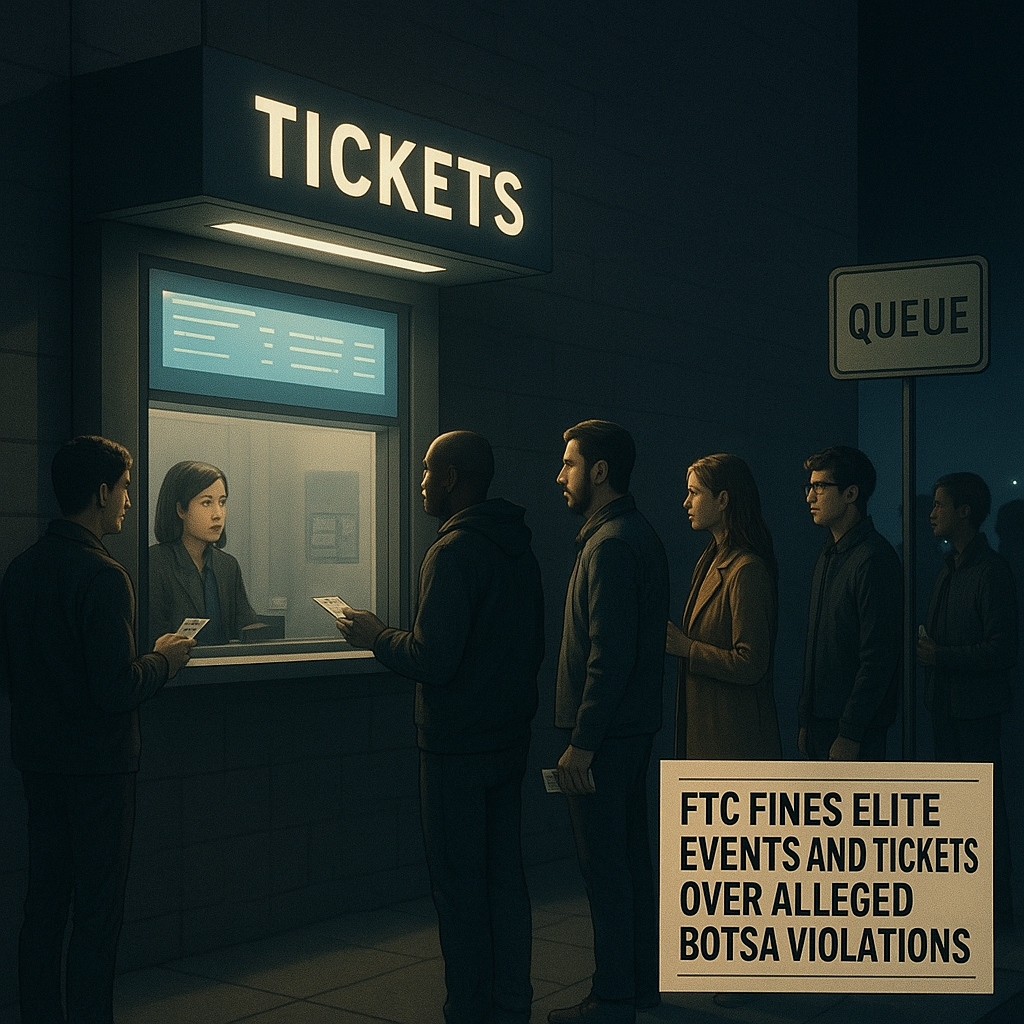
FTC Fines Elite Events and Tickets Over Alleged BOTSA Violations
Last year, CBS Saturday Morning featured Elite Events and Tickets in a segment about how the company bought and resold access to live events. This week, the Federal Trade Commission said the ticket reselling business violated the Better Online Ticket Sales Act, and it imposed a financial penalty. The company did not admit or deny the agency’s allegations.
Key Takeaways- The FTC says Elite Events and Tickets violated the Better Online Ticket Sales Act, a federal law aimed at curbing ticket speculation and online circumvention of purchase limits.
- The company neither admitted nor denied the allegations, a common feature of civil regulatory settlements.
- The case highlights how ticket reselling sits at the intersection of consumer protection, event access, and online enforcement.
- The settlement could influence how regulators scrutinize automated or deceptive ticket-buying practices in the future.
What happened
The Federal Trade Commission’s action against Elite Events and Tickets marks a significant federal move against a ticket reseller whose methods had already drawn public attention. The company was the subject of a CBS Saturday Morning segment last year, where its business practices and approach to acquiring event tickets were discussed. That earlier coverage put a spotlight on a trade that often sits in a gray area for consumers: the resale of tickets that were originally purchased through primary sellers and then offered back to the public at higher prices.
According to the FTC, the company crossed a legal line. The agency said the business violated the Better Online Ticket Sales Act, commonly known as BOTSA, a federal law designed to stop the circumvention of ticket-purchase limits and to protect consumers from unfair ticket acquisition practices. The FTC has not described the case as a criminal prosecution. Rather, it appears to be a civil enforcement matter, the kind of action federal regulators use when they believe a company has engaged in unlawful conduct affecting the marketplace.
That distinction matters. Civil enforcement cases generally focus on penalties, injunctions, and changes to business conduct, not jail time. Still, they can have substantial consequences. A fine can hit a company’s bottom line. An order can limit how it does business. And the public finding itself may shape how vendors, platforms, and consumers view the company going forward.
Ticket resale is a familiar flashpoint in consumer protection. Fans often complain that popular events sell out too quickly, that resale prices are far above face value, and that bots or coordinated purchasing schemes give certain buyers an advantage. At the same time, reselling is a real market, and some consumers rely on secondary sellers when primary tickets are gone. That tension is at the center of many disputes over how the live-events market should work and who gets access to scarce seats.

The FTC’s action against Elite Events and Tickets fits into that larger debate. Regulators have long been under pressure to confront ticket-buying methods that they believe undermine fair access. The fact that the company was previously featured in a broadcast profile adds another layer: public scrutiny of the business model came before formal regulatory punishment.
For readers following broader criminal justice or regulatory enforcement coverage, the case also shows how agencies use consumer-protection laws to police conduct that is not always prosecuted in criminal court. It is not a murder case, a fraud indictment, or a street crime investigation. But it is an enforcement action with real penalties, and it raises the same core public-interest questions: who was harmed, what rules were broken, and what does accountability look like?
Legal context and charges or proceedings
The Better Online Ticket Sales Act was enacted to prevent unfair ticket-buying tactics that use technology to evade purchase limits. The law is often associated with bots or other automated tools that can rapidly buy tickets in bulk, beating ordinary consumers to the checkout line. It also targets efforts to bypass controls put in place by ticket issuers.
The statute is part of a broader federal effort to regulate deceptive or exploitative conduct in the ticket market. It sits alongside other consumer-protection tools used by the FTC and related agencies, including actions against unfair or deceptive practices. In practical terms, BOTSA matters because it gives the government a basis to act when resellers do more than simply operate a secondary market. If they evade ticket controls or use prohibited methods to grab inventory, the conduct may move from aggressive business to unlawful behavior.
In this case, the FTC said Elite Events and Tickets violated that law. The company’s decision to neither admit nor deny the allegations is also worth explaining. That language is common in civil settlements and consent orders. It allows the matter to resolve without a formal trial and without the defendant making a factual admission that could be used elsewhere. From the agency’s perspective, the priority is usually forward-looking compliance and monetary relief. From the company’s perspective, settling can reduce uncertainty and limit the cost of continued litigation.
Unlike a criminal charge, a civil regulatory enforcement action does not require prosecutors to prove guilt beyond a reasonable doubt. The agency typically needs to show that the conduct fell within the statute’s prohibited scope and that remedies are justified. The result can still be serious. Federal fines, compliance obligations, monitoring, and bans on future conduct can all follow.
To understand the context, it helps to compare this matter with other legal and public-safety cases involving consumer deception and market manipulation. The justice system does not treat all wrongdoing the same. Some cases go through criminal courts. Others, like this one, are handled through administrative or civil enforcement. Both can involve investigations, evidence gathering, and negotiated resolutions.
That makes the case relevant to readers who track not just crime, but enforcement. For a broader perspective, see related reporting on consumer fraud enforcement, court-linked business accountability, and federal agency investigations. Even when an agency action does not end in a courtroom trial, it can still reshape conduct across an industry.
The timing is notable too. Live-event demand remains high, and ticket scarcity is often magnified by digital sales systems that can be exploited quickly. That is one reason regulators keep returning to this area. If a reseller is using prohibited methods to secure inventory, consumers may never get a fair chance at face-value purchase. In the FTC’s view, that is exactly the kind of distortion BOTSA was meant to prevent.
There is also a reputational component to the legal process. A company placed under an FTC order may be required to change its practices, retain records, or submit to compliance oversight. Even without a criminal conviction, that kind of action can alter a business model. It can also signal to competitors that the government is watching closely.
The allegations against Elite Events and Tickets are especially important because they concern an industry where the line between sharp dealing and illegal conduct can be thin. Some ticket resellers use legitimate sourcing. Others, according to regulators, use methods that amount to digital corner-cutting. The law is intended to separate the two.
Law enforcement or court response
Although this matter comes from the FTC rather than a police department or prosecutor’s office, it still represents government enforcement in action. The agency’s role is to investigate, evaluate evidence, and decide whether a company’s conduct violated federal law. That process often involves subpoenaed records, interviews, online evidence, and negotiations over settlement terms.
The FTC’s public announcement serves several functions. It punishes alleged misconduct, warns the market, and signals to consumers that the government is paying attention. It also lets other businesses know that compliance failures in the ticketing space may bring consequences. In enforcement terms, the announcement is not just a press release. It is part of the deterrent effect.
A civil settlement also reduces the chance that the issue will proceed through a prolonged court battle. The company’s choice not to admit or deny the allegations suggests that both sides wanted a resolution without a finding of liability after trial. That does not mean the case lacked substance. It means the parties reached a practical endpoint that allows the agency to collect a penalty and the company to move on under whatever restrictions the order imposes.
The FTC has increasingly used enforcement to address digital market abuses, and ticket resale is a natural target. The internet has made it easier for buyers to act quickly and at scale. It has also made it easier for regulators to trace suspicious patterns. When tickets vanish in seconds, investigators can look for signs of automation, coordinated purchases, or conduct designed to bypass posted limits.
For readers interested in how government enforcement works outside traditional courtroom drama, the contrast is instructive. A criminal case often centers on a named defendant, charges, arraignment, plea negotiations, and trial. A civil regulatory matter may never reach a jury. Yet it can still involve a detailed factual investigation and a binding legal resolution.
That distinction is important in coverage of businesses that operate in heavily regulated spaces. Ticket sellers, event platforms, and resale brokers may not think of themselves as subjects of law enforcement. But when a federal agency acts, the practical effect can be similar: subpoenas, lawyers, records, and public consequences. If you are following the broader criminal justice and enforcement beat, this kind of case belongs in the same conversation as FTC consumer protection actions, market conduct oversight, and federal civil enforcement.
There is also a broader public trust issue. Live entertainment depends on the idea that ordinary people have some chance to buy tickets fairly. When consumers believe the process is rigged, they lose confidence not just in one company, but in the market itself. Regulators know that legitimacy matters. A system that appears stacked toward professional resellers can fuel resentment and undermine compliance with purchase rules.
The FTC’s response to Elite Events and Tickets may not be the last such action. As ticketing becomes more digital and more competitive, enforcement pressure is likely to remain high. Agencies can pursue companies that exploit loopholes, and courts may be asked to interpret how old laws apply to new methods. That is a familiar pattern in consumer-protection work: technology changes, the conduct evolves, and regulators try to catch up.
Community and policy implications
Ticket resale may sound far removed from traditional criminal justice, but the policy questions are familiar. Who benefits from a market rule? Who pays when it is broken? How much enforcement is enough? Those questions show up in policing, prisons, consumer protection, and fraud cases alike.
For fans, the immediate impact of suspected BOTSA violations is straightforward: fewer fair chances to buy tickets at face value. If resellers use prohibited tactics to scoop up inventory, consumers are pushed into the secondary market sooner and often at higher prices. That can hit families, students, and lower-income buyers hardest. In that sense, the issue has equity dimensions, even if it is not framed as a civil-rights case.
For legitimate resellers, the case also matters because it can separate lawful secondary-market activity from conduct that regulators believe crosses a line. Not every resale is illegal. But if a business uses methods to bypass limits set by ticket issuers, the FTC may see it as more than routine arbitrage. The challenge for policymakers is drawing a workable boundary that allows lawful resale while stopping manipulation.
That’s why this case should be read alongside broader policy debates over online marketplaces and consumer fairness. Federal agencies have been asked to police everything from deceptive fees to dark-pattern interfaces to anti-competitive conduct. Ticketing has become one of the most visible examples because the harm is easy for consumers to understand. A seat at a concert or playoff game is not an abstract benefit; it is a lost opportunity when the sale process is manipulated.
The episode also reflects how regulatory enforcement can shape industry behavior without a new law from Congress. Even when lawmakers do not act, agencies can use existing statutes to test boundaries and make examples of conduct they consider unlawful. That can prompt businesses to tighten internal controls, limit automation, and document compliance more carefully.
There is a practical lesson here for companies operating in online marketplaces. If a business depends on access to scarce inventory, regulators may ask how that inventory was obtained. The legal risk rises when methods appear designed to evade established controls. The FTC’s action against Elite Events and Tickets suggests that ticket resellers should expect scrutiny not only of pricing, but of acquisition practices.
Public reaction is likely to be mixed. Some consumers will applaud the fine and see it as overdue accountability. Others may note that high ticket prices are driven by demand, artist policies, venue economics, and platform fees—not just reseller behavior. Both views can be true at once. Enforcement against one company will not fix every part of the ticket market. But it can make clear that the government is willing to act when rules are allegedly broken.
That is one reason cases like this matter in a broader policy context. They are not simply about a single business. They are about how the law responds to new tactics in a digital economy. The same pattern appears in other areas of regulation, including online fraud, platform accountability, and automated purchasing schemes. The question is not whether markets should exist, but what conduct the law will tolerate.
For consumers and advocates, the result may encourage more attention to how tickets are sold in the first place. The FTC’s action could strengthen calls for better safeguards, clearer disclosure, and stronger anti-bot measures. It may also feed into calls for Congress to revisit ticketing laws if agencies continue to find enforcement gaps.
The overlap with justice policy is clear. When the public sees laws as hard to enforce, trust erodes. That is true in policing and prosecutions, but it is also true in consumer-protection regimes. A rule without credible enforcement is only a suggestion. This case is one example of a federal agency trying to make the rule real.
Frequently Asked Questions
What is the Better Online Ticket Sales Act?
It is a federal law designed to stop circumvention of ticket purchase limits, especially through automated or deceptive methods used to buy tickets in bulk.
Did Elite Events and Tickets admit wrongdoing?
No. The company neither admitted nor denied the FTC’s allegations, which is typical in many civil settlements.
Is this a criminal case?
No. Based on the FTC’s action, this appears to be a civil regulatory enforcement matter, not a criminal prosecution.
Why does the case matter to consumers?
It concerns whether tickets were obtained in a way that unfairly reduced access for ordinary buyers and pushed more people into the resale market.
Could this affect other ticket resellers?
Yes. FTC enforcement can influence how other companies structure their buying practices, compliance systems, and anti-bot controls.
Does the FTC often act in cases like this?
The agency regularly brings consumer-protection actions, especially where it believes businesses used unfair or deceptive methods in digital markets.
The FTC’s action against Elite Events and Tickets is a reminder that consumer markets are policed in more ways than one. Not every enforcement case is a criminal indictment, but civil penalties can still carry real weight. In a ticketing world shaped by speed, scarcity, and automation, regulators are signaling that purchase limits and platform rules are not optional. For companies built around resale, that message is hard to ignore.