The FBI said Wednesday that some ransom notes connected to the disappearance of Nancy Guthrie have been "deemed to be extortion attempts without legitimacy,"...
FBI Says Some Ransom Notes in Nancy Guthrie Disappearance Are Fake Extortion Attempts, Others Still Under Investigation
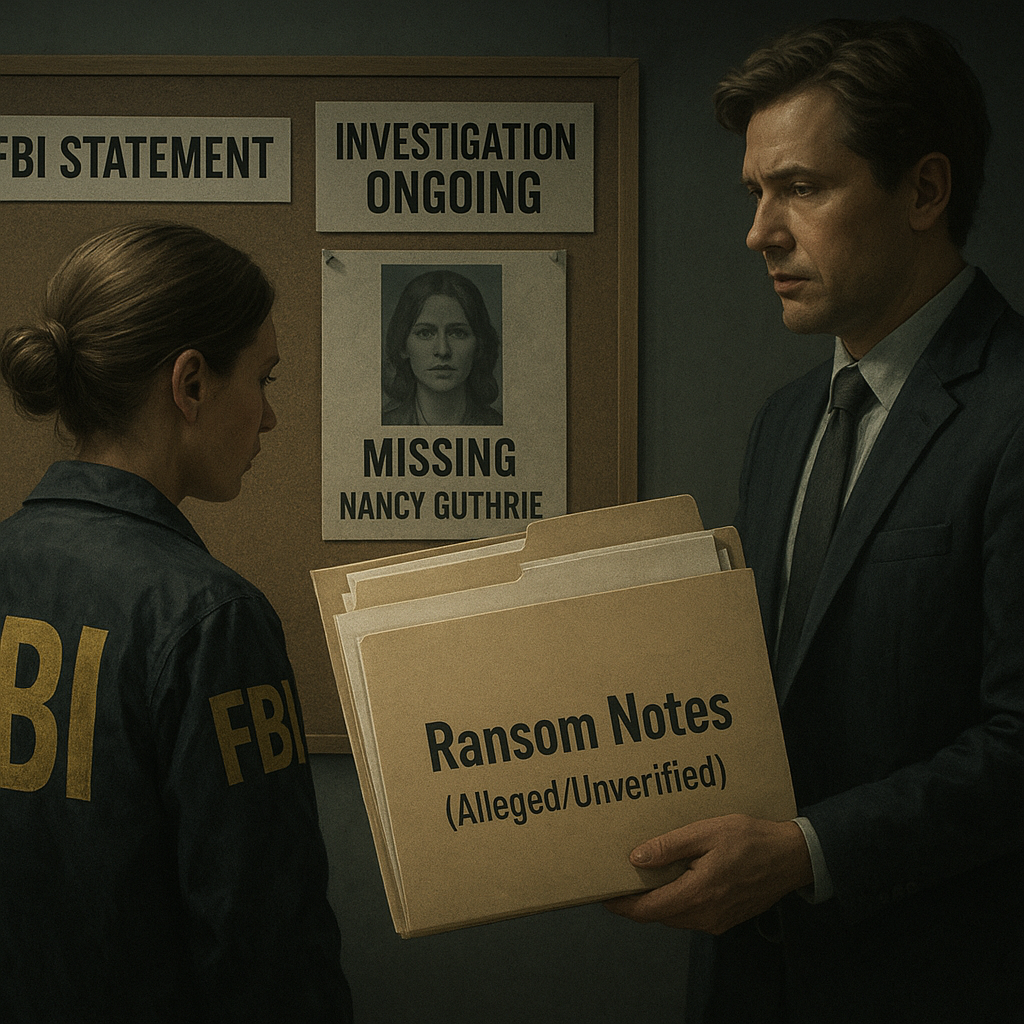
The FBI said Wednesday that some ransom notes connected to the disappearance of Nancy Guthrie have been "deemed to be extortion attempts without legitimacy," while other demands "may potentially be legitimate and are still being investigated as such." The statement is a notable signal in a case marked by uncertainty, mixed messages, and the practical difficulty investigators face when criminal actors exploit a missing-person investigation for fraud or leverage.
Key Takeaways:- The FBI says at least some of the ransom notes appear fraudulent.
- Other demands are still being checked for authenticity.
- Mixed ransom claims can complicate missing-person investigations.
- The case shows how law enforcement sorts credible leads from noise.
What happened
According to the FBI statement, the agency has received or reviewed multiple ransom-related demands in connection with Guthrie's disappearance. Some have been rejected as illegitimate extortion attempts, meaning investigators do not believe those communications are tied to a genuine kidnapping or release demand. Other messages, however, have not been ruled out. They remain under active review, and the Bureau is treating them as potentially authentic until investigators can verify otherwise.
That split is important. In high-profile missing-person cases, especially those involving possible abduction, ransom notes can come from several sources at once: people trying to scam families, opportunists chasing publicity, hoaxers, or someone with direct knowledge of the disappearance. Sorting those apart is slow work. It often requires tracing phone numbers, email headers, digital routing, handwriting, payment instructions, and contact patterns, then comparing them with known facts in the case.
The FBI did not say which specific communications were false and which were still being checked. That cautious approach is typical. Publicly identifying too much can tip off a suspect, complicate an investigation, or contaminate future interviews. Still, the agency’s statement gives the public a limited but meaningful window into where the case stands: investigators are dealing with both suspected fraud and unresolved leads.
In disappearance cases, every message can set off a chain reaction. Families may be asked for money, a phone call may be demanded, or a deadline may be set. Even a forged ransom note can cause real harm. It can drain resources, raise false hopes, and force police to spend time verifying claims that were never legitimate in the first place. In a case like this, the line between a real demand and a fabricated one can determine how quickly investigators focus their resources.
Legal context and charges or proceedings
Ransom demands tied to a disappearance can implicate a range of criminal statutes, depending on the facts. If someone knowingly sends a false extortion message, that conduct can lead to federal or state charges for extortion, threats, mail fraud, wire fraud, or related offenses. If the demand is genuine and tied to an abduction, the case can expand into kidnapping, hostage-taking, interstate communications threats, conspiracy, or obstruction-related charges. The exact charges depend on where the conduct occurred, whether lines crossed state borders, and what evidence ties the sender to the underlying disappearance.
For investigators, the first legal question is not just whether a note exists, but whether it can be authenticated. That means more than checking the words on the page. It involves identifying the sender, the medium, the route, and the intent. A real demand often contains details that only the perpetrator would know. A fake one usually fails on those points, though not always immediately. Hoaxers can copy public information, and real offenders can hide behind intermediaries.
The FBI’s language reflects that legal uncertainty. The phrase “deemed to be extortion attempts without legitimacy” suggests investigators have already ruled out some communications based on the available evidence. The phrase “may potentially be legitimate” signals the opposite: there is enough to keep digging, but not enough to confirm authenticity. In a criminal case, that distinction matters because probable cause, charging decisions, and search warrants all depend on evidence that can stand up in court.
This is also where federal investigative authority can become central. The FBI often enters disappearance cases when interstate communications, ransom demands, kidnapping allegations, or digital evidence cross jurisdictional lines. Even when a local agency leads the case, federal agents may help with forensics, communications tracing, victim recovery resources, and coordination with prosecutors. For a broader look at how major cases move between agencies and courts, see our coverage of major criminal investigations, federal court proceedings, and law enforcement response.
There is also a practical legal issue involving the family or any intermediaries receiving the demands. In genuine kidnapping scenarios, law enforcement may ask recipients not to pay, not to negotiate alone, and not to reveal investigative steps. In fraudulent extortion attempts, those same communications can become evidence of a separate crime. If the sender claims to hold the missing person but cannot prove it, the message may still be treated as a serious threat because the law punishes attempts to obtain money by coercion or false pretense.
The agency has not publicly disclosed whether any arrests have been made or whether search warrants have been executed in relation to the ransom notes. That silence does not mean inactivity. It may mean investigators are preserving evidence, cross-checking digital trails, or waiting for corroboration before moving forward. In cases with possible kidnapping or extortion, premature action can alert a suspect and reduce the chance of recovery.
Law enforcement or court response
The FBI statement is a law-enforcement response, but it also carries an implicit message to the public: not every claim in a missing-person case should be taken at face value. That is especially true when criminals exploit the news cycle. Families in crisis can become targets for fake pleas, scam calls, and bogus offers of help. Investigators often have to shield them from that noise while preserving every lead that might matter.
A careful response usually involves several parallel tracks. Agents verify the origin of each note. Analysts compare language across messages. Digital forensics teams trace devices and IP addresses. Behavioral analysts look for patterns in timing, word choice, and demands. And investigators on the ground continue the more traditional work of interviewing witnesses, reviewing surveillance, and searching the areas most likely connected to the disappearance.
The response from prosecutors, if and when charges are brought, would depend on the evidence package built by investigators. In federal cases, prosecutors typically need to show that the suspect knowingly transmitted a threat or demand, intended to obtain something of value or compel action, and used a covered communication channel or crossed a jurisdictional threshold. If the underlying disappearance is criminal, the government may also pursue broader charges tied to kidnapping or obstruction.
If the case enters court, pretrial motions could become important quickly. Defense lawyers may challenge whether the messages were authentic, whether the searches that produced evidence were lawful, or whether investigators improperly linked separate communications to the same person. A judge may need to decide what statements can be admitted, what forensic methods were reliable, and whether the government’s evidence connects the sender to the alleged extortion.
That is why investigators are usually careful in public statements. They do not want to promise more than they can prove. In a case like this, the difference between “we are investigating” and “we have confirmed” is not semantics. It can be the difference between a lead that survives cross-examination and one that collapses in court.

Community and policy implications
Cases involving ransom notes and disappearances raise hard questions beyond one family or one suspect. They show how vulnerable missing-person investigations are to manipulation. A single fake demand can trigger media speculation, online rumor, and public pressure that may not help the search. The result is often confusion. The public wants certainty. Investigators can rarely give it.
There is also the issue of trust. When the FBI says some notes are illegitimate, that can reassure the public that the agency is not chasing every tip blindly. At the same time, it can create unease. If some notes are fake, who sent them? Why? Were they opportunistic scams, or are they meant to distract investigators from a real abduction? The answer matters for public safety because hoaxes can divert resources from actual emergencies.
From a policy standpoint, the case illustrates why agencies invest in multi-agency task forces and digital forensics. Modern extortion is often hybrid in nature: part old-fashioned coercion, part online fraud, part identity deception. A person can send a message from a disposable account, route calls through multiple services, and leave few traces. That means law enforcement needs both traditional homicide-and-missing-person expertise and cyber-investigative capacity.
There are broader civil liberties concerns too. Serious cases can justify aggressive tracing, but those tools must still be used within constitutional limits. Phone records, account data, and location information can all reveal intimate details about innocent people as well as suspects. When investigations expand quickly, oversight matters. So does specificity. Courts generally expect warrants to identify the evidence sought and the reasons for it.
For communities, the best response is measured patience, not speculation. Missing-person cases generate huge online attention, and that attention can be both helpful and harmful. It can spread awareness, but it can also create rumor markets where unverified claims travel faster than official updates. Families deserve better than that. So do investigators.
Public safety agencies can take several lessons from cases like Guthrie’s. First, they should communicate clearly about what is known and what is not. Second, they should warn families about scams and fake ransom communications. Third, they should coordinate early with prosecutors and digital analysts so that if a real extortion plot emerges, evidence is preserved from the start. Those are not flashy steps. They are the steps that often matter most.
For readers following similar cases, our related reporting on missing-person investigations, criminal extortion cases, and digital evidence in court offers more context on how these cases develop and why seemingly small details can become decisive.
Frequently Asked Questions
What did the FBI say about the ransom notes?
The FBI said some of the ransom notes in Nancy Guthrie’s disappearance were “deemed to be extortion attempts without legitimacy,” while other demands may still be legitimate and are being investigated.
Does that mean some notes are fake?
Yes. The statement indicates investigators believe at least some of the communications are not genuine ransom demands and instead appear to be fraudulent extortion attempts.
Are any charges filed?
The FBI statement did not announce any arrests or charges. Based on the wording, the investigation appears to be ongoing.
Why would investigators keep looking at questionable demands?
Because in disappearance cases, not every message can be dismissed immediately. Some communications may turn out to be genuine, and investigators need to verify each one before ruling it out.
What crimes could be involved if the notes are real?
Depending on the facts, possible offenses could include kidnapping, extortion, threats, wire fraud, or related federal and state crimes.
How do police verify ransom notes?
They may examine handwriting, digital metadata, call records, payment instructions, language patterns, and whether the sender knew details not publicly available.
What should families do if they receive a ransom demand?
Law enforcement generally advises families to contact investigators immediately, preserve the message, and avoid acting alone or paying money without police guidance.
Final thought
The FBI’s statement does not resolve Nancy Guthrie’s disappearance, but it does clarify the shape of the investigation. Some messages are being treated as scams. Others remain open questions. That mix is common in high-stakes missing-person cases, and it is one reason these investigations can be so difficult to explain in public. The work is slow, exacting, and often invisible until investigators can prove what is real.