Jacob Allen Morley, a 28-year-old Tennessee inmate convicted of murder and other crimes, was taken into custody near Kansas City, Missouri, more than a week...
Escaped Tennessee Murder Convict Jacob Allen Morley Captured in Missouri
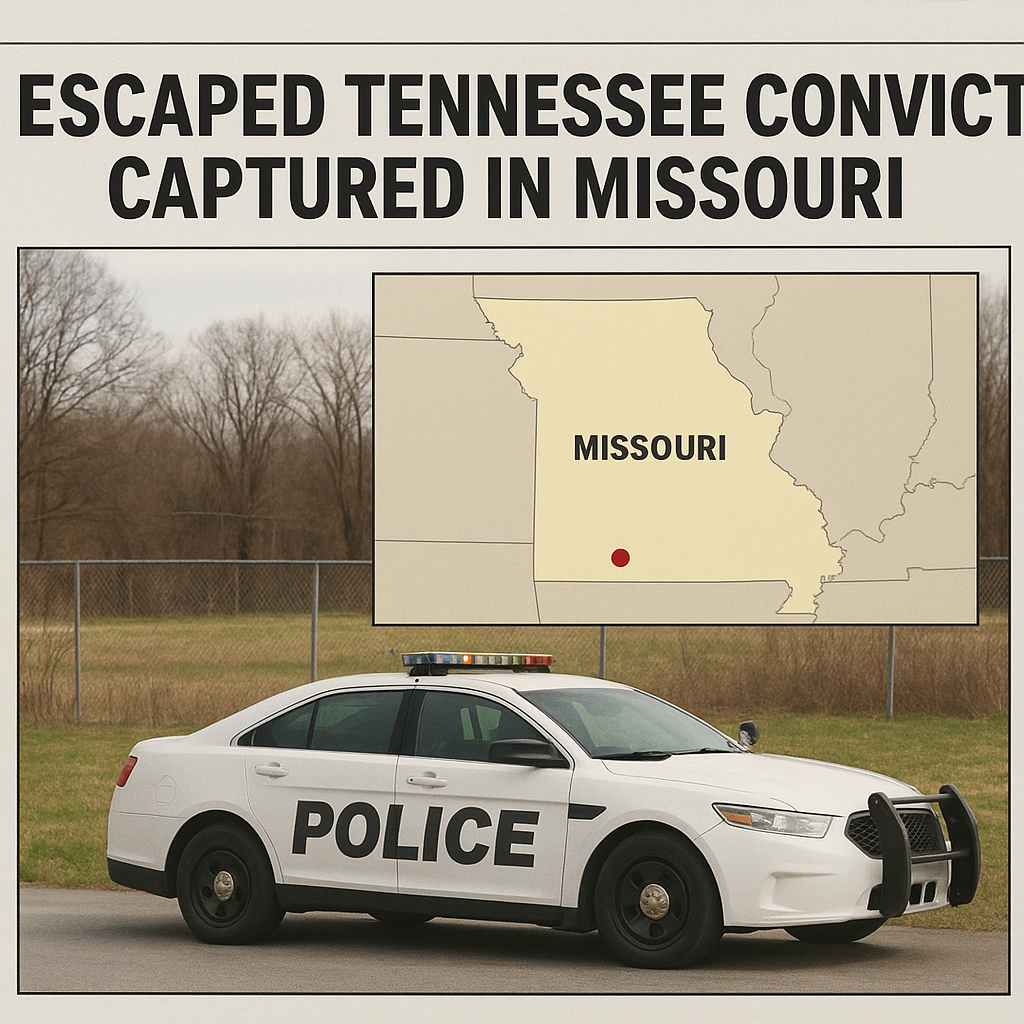
Jacob Allen Morley, a 28-year-old Tennessee inmate convicted of murder and other crimes, was taken into custody near Kansas City, Missouri, more than a week after escaping from the Northwest Correctional Complex, authorities said Tuesday. The Missouri State Highway Patrol said a trooper confronted Morley after his car became stuck off the roadway near Independence; the arrest was reported as occurring without incident.
What happened
The Tennessee Bureau of Investigation announced that Morley was in custody Tuesday near Kansas City. The capture ended a search that began after prison officials discovered he was missing late on Oct. 25. The Northwest Correctional Complex is in Tiptonville, a town of about 3,500 people roughly 100 miles north of Memphis.
According to a statement from the Tennessee Department of Correction, staff discovered Morley was missing at about 11:30 p.m. Security video showed that he had breached a perimeter fence. The department did not describe how he got through the barrier, whether an alarm sounded, or how long it took staff to confirm he was gone. No further details about the escape route or any possible assistance were included in the statements summarized by authorities.
The department added Morley to Tennessee’s Most Wanted list and said he should be considered dangerous. That warning was part of the public notice during the search. It is separate from the specific account of Tuesday’s arrest, which Missouri authorities described as ending without incident.
The Missouri State Highway Patrol said it received information from the TBI at about 9:30 a.m. Tuesday that Morley might be traveling west on Interstate 70 near Independence. The patrol said Flock Safety cameras located the vehicle. Its statement did not identify the vehicle’s owner, describe the camera data used to locate it, or say whether the system relied on a license plate, another identifier, or a combination of information.
Officers from multiple agencies moved into the area because authorities believed Morley might be armed with multiple weapons, according to the patrol. A police helicopter then spotted his car and followed it. The public account does not identify all the agencies involved or explain what information led investigators to believe weapons were present.
The patrol said the car attempted to leave the roadway and became stuck. A state trooper confronted Morley and took him into custody without incident. Police placed the arrest at about 11:34 a.m. The statements do not report shots fired, injuries, a pursuit-related crash, or weapons found at the scene. They also do not say whether the vehicle was searched or provide details about any property recovered.
Authorities had previously said Morley stole a truck after escaping and that it was later found abandoned in Illinois. The announcement of his arrest described him in a different car near Independence. Officials have not publicly explained how he traveled between states, whether the truck was the only vehicle involved, or when he changed vehicles. Those gaps matter: the available account establishes a broad timeline, not a complete reconstruction of his movements.
Morley was convicted in 2025 of murder, abuse of a corpse, tampering with evidence and aggravated burglary in the 2022 killing of his co-worker, Cody Birchfield, 34. Those convictions are documented in court records shared by the Carter County Clerk’s Office in Tennessee. The information released about the escape and capture does not describe the circumstances of Birchfield’s death, the evidence presented at trial, or the sentence imposed on Morley.
Birchfield’s sister, Carrie Norman, described Morley as a very dangerous man in an interview with NBC News. She said she feared he would kill someone if he obtained a weapon. Her comments reflected the family’s concern during the search. The Missouri patrol’s statement, meanwhile, said officers believed Morley could have multiple weapons but did not report that any were found or used during the arrest.
Legal context and proceedings
Morley’s murder conviction and the prison escape are separate legal matters. The convictions relate to Birchfield’s 2022 killing; the escape concerns his departure from a state correctional facility. A person’s existing conviction does not, by itself, establish that prosecutors have filed a new escape charge. The public statements about the capture did not announce a new charge or provide a court docket number for an escape case.
Tennessee law generally classifies escape from a penal institution as a Class E felony. The statute also provides for a consecutive sentence in circumstances where a person escapes while serving a sentence for a felony. The specific statute is available through this Tennessee escape law reference. Whether prosecutors will charge Morley under that provision, which facts they would allege, and how any new sentence might relate to his existing sentence were not reported in the capture announcement.
The distinction between conviction, sentence and custody is important here. Court documents cited by the Carter County Clerk’s Office establish the listed convictions, but the information available about the arrest does not state the length or terms of Morley’s sentence. It also does not establish whether he had an appeal pending, whether any other court matter was active, or what custody classification he had at the prison. Those details should not be inferred from the fact of his escape.
Because Morley was found in Missouri after escaping from a Tennessee facility, his return involves coordination across state lines. Federal law sets out a process for one state to seek the return of a person accused or convicted there who is found in another state. The process can include a governor’s requisition and an arrest under the receiving state’s authority; formal extradition can also be waived. The federal statute is set out at 18 U.S.C. § 3182.
The announcement does not say whether Missouri authorities have begun formal extradition proceedings, whether Morley waived them, or when he would be returned to Tennessee. Nor does it report whether he faced any separate Missouri charge. Being taken into custody in Missouri is not, on its own, proof that a particular transfer procedure has been completed. Until officials or court records clarify the next steps, the timing and legal route of his return remain unknown.
A return to Tennessee would also be distinct from any decision about additional prosecution. Tennessee authorities could assess whether to bring an escape case, while prison officials could conduct an administrative review under their own procedures. The available statements do not say whether either process has started. They also do not disclose whether a prosecutor has reviewed the evidence concerning the fence breach, the stolen truck, or the interstate search.
The absence of those details is not evidence that no review is underway. It means only that the public record described in the announcements focuses on the capture. In a case involving an escape from custody, basic follow-up information would ordinarily include the person’s present custodial location, whether an escape charge has been filed, and the expected process for returning the person to the state where the original sentence is being served. None of those details was included in the reported statements.
Law enforcement and court response
The recovery operation involved a sequence of actions described by the Missouri State Highway Patrol: information from the TBI, camera identification of a vehicle, a helicopter’s visual tracking, and a trooper’s face-to-face confrontation after the car became stuck. The agency said officers from multiple agencies moved into the area because of the perceived weapons risk. This account makes clear that the arrest was not attributed to a single tool or agency alone.
The TBI’s role, as described by Missouri authorities, was to provide information that Morley might be traveling west on I-70 near Independence. The highway patrol’s statement says Flock Safety cameras located the vehicle, but does not explain whether those cameras generated the initial lead or helped confirm a vehicle already identified by investigators. It also does not give a precise location, the number of cameras involved, or the duration of any tracking.
Those limits are relevant to public understanding of surveillance technology. The statement identifies a camera system but does not specify what data was captured, how long it was retained, whether a person or vehicle was identified by a plate, or which agencies could access the information. Without those details, it would be premature to describe the system as having identified Morley personally or to attribute the arrest to camera technology alone.
The helicopter and trooper’s actions also appear in the patrol’s account as distinct steps. The helicopter spotted the car and followed it; the car then tried to travel off the roadway and became stuck; a trooper confronted Morley and took him into custody. The patrol did not say that the helicopter directed the car off the road or that officers used force. It described the arrest as without incident.
Tennessee’s correction department has not, in the statements summarized here, provided a detailed account of the prison’s security response or the steps taken after Morley was found missing. It is not reported whether the department has opened a formal review, examined fence conditions, assessed staffing or alarm procedures, or identified any policy changes. No cause for the breach beyond the video showing a perimeter fence was given.
The Tennessee Department of Correction’s news page, the Tennessee Bureau of Investigation’s news page, and the Missouri State Highway Patrol’s news releases are the official channels through which agencies publish updates. Any later account of a charge, transfer or prison review would need to be assessed against those statements and relevant court records rather than assumed from the arrest alone.
Community and policy implications
The escape began at a prison in a small northwest Tennessee town and ended more than a week later in the Kansas City area. The movement across state lines illustrates why public notices and coordination among agencies can matter in a search. But the known facts do not establish how Morley reached Missouri, whether authorities received public tips, or whether any particular surveillance tool was decisive. The public account supports a timeline; it does not answer every question about the search.
For residents near Tiptonville, the department’s warning that Morley should be considered dangerous was a significant public-safety message. The available report does not say whether the prison or local officials issued specific shelter instructions, closed roads, or reported encounters with Morley during the days he was missing. It also does not describe any injuries or additional crimes during the search. Those details should remain unasserted unless officials provide them.
The arrest announcement also highlights a practical tension in public safety reporting. Officials had reason to treat the search cautiously: the department’s warning and the patrol’s statement both described a potential weapons risk. At the same time, the reported arrest ended without incident. Accurate accounts should preserve both facts, rather than turning a risk assessment into a claim that weapons were used or that a confrontation produced injuries.
For the victim’s family, the capture ends the immediate uncertainty about Morley’s whereabouts, but it does not resolve questions about the murder case or the sentence. Norman’s comments to NBC News expressed fear that her brother’s killer could harm someone if armed. No additional comment from the family was included in the report of the arrest, and there is no basis to assume how relatives view the next legal steps.
The escape also raises questions for corrections officials that cannot be answered from a brief arrest statement. A fence breach is a concrete failure point, but a public review would need to establish how it occurred, whether security systems detected it, how staff responded, and whether any conditions at the facility contributed. The statements do not provide those findings. Until a review is released, it would be speculative to attribute the escape to a staffing shortage, equipment failure, or deliberate assistance.
Any review would be more useful if it separated the physical breach from the later search. The prison’s security response concerns detection and containment; the interstate operation concerns locating and safely arresting a person after escape. They involve different agencies and different information. In this case, authorities have described parts of the search in Missouri, but have not publicly explained the facility’s internal response in comparable detail.
The camera component presents a separate accountability issue. A public explanation could clarify what information officers received, how the vehicle was matched to the search, which agencies accessed the data and how long records were retained. The patrol’s statement does not answer those questions. Those omissions do not show misuse; they identify what is still unknown about the technology’s role and the safeguards surrounding it.
The case also shows why an arrest should not be treated as the end of legal reporting. The next verifiable developments may include a Tennessee escape charge, Missouri custody proceedings, a transfer, or an official prison review. None was confirmed in the statements about Morley’s capture. Until there is a filing or agency update, reports should distinguish the established facts from possible next steps and avoid presenting routine legal possibilities as decisions already made.

Frequently Asked Questions
Where was Jacob Allen Morley captured?
The Tennessee Bureau of Investigation said Morley was captured near Kansas City. The Missouri State Highway Patrol said officers located his vehicle near Independence, Missouri, after receiving information that it might be traveling west on Interstate 70.
When did Morley escape?
Authorities said Morley escaped on Oct. 25 from the Northwest Correctional Complex in Tiptonville, Tennessee. The correctional department said staff discovered he was missing at about 11:30 p.m. and that security video showed he had breached a perimeter fence.
What was Morley convicted of?
Court documents shared by the Carter County Clerk’s Office show that Morley was convicted in 2025 of murder, abuse of a corpse, tampering with evidence and aggravated burglary in the 2022 killing of his co-worker Cody Birchfield, 34.
Were weapons found, or was anyone hurt during the arrest?
The highway patrol said officers believed Morley might be armed with multiple weapons and described the arrest as without incident. The reported statements do not say whether weapons were recovered, and they do not report injuries.
Has Morley been charged with escape or returned to Tennessee?
The capture announcement did not report a new escape charge or say when Morley would be returned to Tennessee. The next legal steps, including any extradition process or waiver, were not publicly detailed in the information available.
Morley’s capture resolves the immediate search, but not the unanswered questions about how he breached the prison perimeter, how the interstate search unfolded, or what legal steps will follow. The next account from correctional officials, investigators or the courts will determine whether those questions receive a public answer.