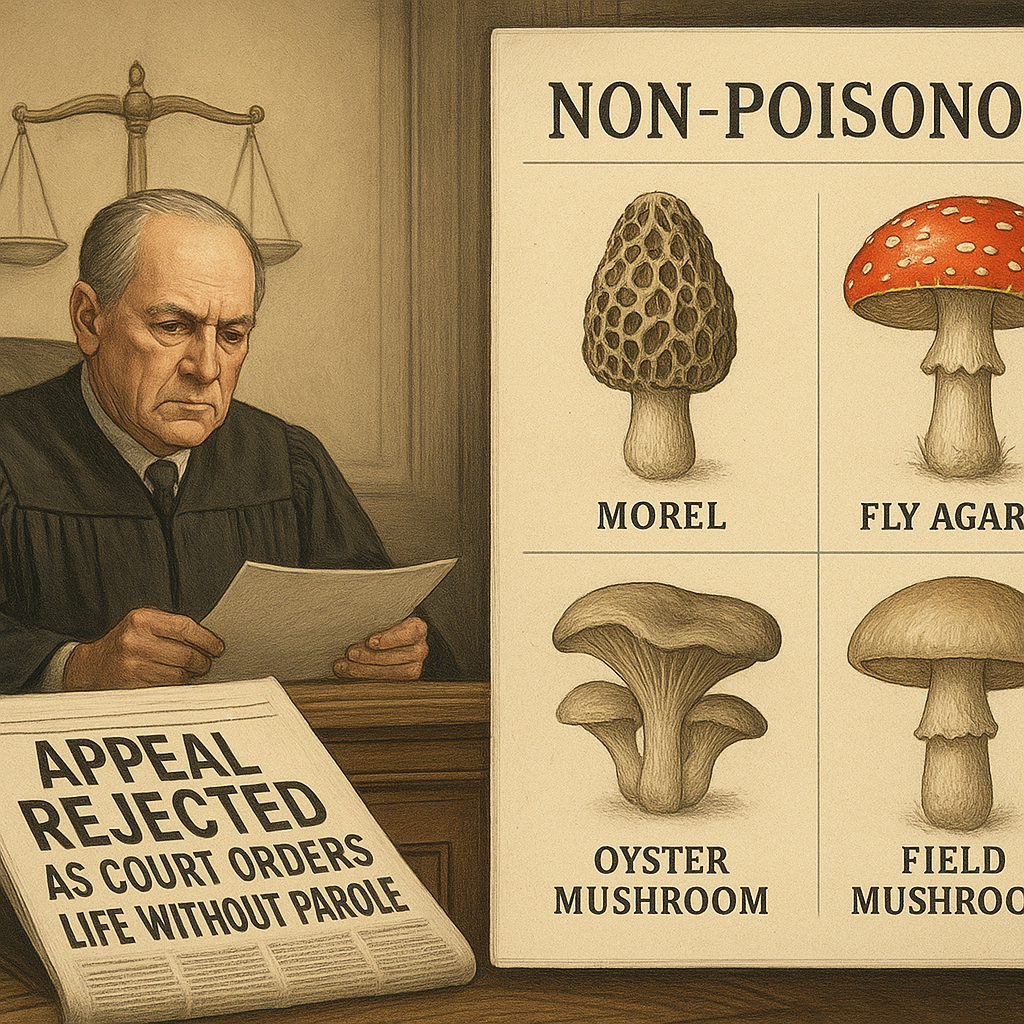
Erin Patterson Appeal Rejected as Court Orders Life Without Parole
An appeals court in Victoria has rejected Erin Patterson’s challenge to her convictions for murdering three relatives and attempting to murder a fourth, while granting prosecutors’ appeal against her sentence. The court said the case involved “such shocking criminality” that it was inappropriate to set a non-parole period, leaving Patterson with no prospect of release through parole.
What happened
Patterson’s convictions followed a family lunch she hosted at her rural home in Leongatha, in the Australian state of Victoria, in July 2023. The people who became ill were her estranged husband’s parents, Don and Gail Patterson; Gail’s sister, Heather Wilkinson; and Heather’s husband, Ian Wilkinson.
Don and Gail Patterson and Heather Wilkinson died within days of the meal. Ian Wilkinson survived after spending weeks in hospital. The jury convicted Erin Patterson of murdering the three people who died and attempting to murder Ian.
The fatal meal became the centre of a widely followed criminal case. Prosecutors said the relatives were poisoned with death cap mushrooms served in beef Wellington. Patterson maintained that she had added the mushrooms accidentally. The appeal court has now dismissed her challenge to the convictions, leaving the jury’s verdicts in place.

The court’s ruling also changes the practical meaning of the sentence. At her earlier sentencing, Patterson received three life sentences for murder and a 25-year sentence for attempted murder, with a 33-year non-parole period. Under that arrangement, she could have been considered for release after serving the minimum term. The appeal judges have removed that possibility by declining to set any non-parole period.
That is a consequential distinction. A life sentence does not always mean that a prisoner can never be released: the sentencing court may set a minimum period that must be served before parole can be considered. Here, the Court of Appeal concluded that the offending was so serious that no such period should be fixed. The decision does not shorten or replace the convictions. It makes the punishment more restrictive by ruling out parole eligibility.
The judges described the conduct in unusually strong terms. Justice Stephen McLeish, speaking for the three-member panel, said the offending was “extraordinarily cold and calculated” and should be condemned “in the strongest terms.” After what he described as anxious consideration, he said the court had concluded that the case involved “such shocking criminality that it is inappropriate to fix a nonparole period.”
The description reflects the court’s assessment of the seriousness of the crimes and the appropriate punishment. It is not a separate finding beyond the convictions. Nor does it change the standard of proof or the jury’s role. The appeal court considered the legal challenges before it and left the convictions intact while accepting the prosecution’s argument about sentence.
Legal context and charges or proceedings
The proceedings involved two distinct appeals. Patterson challenged the convictions; prosecutors challenged the leniency of the non-parole period. The judges dismissed her challenge and upheld the prosecution’s sentencing appeal. The result therefore resolved both issues in the prosecution’s favour.
The earlier sentence had combined life imprisonment for each of the three murders with a separate 25-year term for the attempted murder of Ian Wilkinson. The 33-year non-parole period had set the point at which Patterson could first seek consideration for release. The Court of Appeal’s order removes that threshold. She will remain imprisoned for life without an opportunity to apply for parole under the sentence described in the ruling.
Parole eligibility is not the same as guaranteed release. Where a non-parole period exists, it marks the minimum time a prisoner must serve before a parole authority can consider release. The authority may still refuse release. Without a non-parole period, there is no ordinary parole eligibility date to reach. The practical effect in Patterson’s case is that she is to spend the rest of her life in prison, unless a later legal process changes the outcome.
Patterson’s remaining appeal route is an application to Australia’s High Court. The court’s public information explains its role as the country’s final court of appeal. A potential application is not the same as an appeal being accepted or a conviction being overturned: a party must first obtain permission to proceed. The reported account says Patterson can apply to challenge both the convictions and the sentence, but does not report that she has filed such an application or that the High Court has agreed to hear one.
The Court of Appeal’s ruling also places Patterson in a rare category. She is only the second woman in Australia to be imprisoned for life without the possibility of parole, according to the reported account. The first was Katherine Knight, sentenced in New South Wales in 2001 for murdering her partner, John Price, the previous year. The comparison is limited to the rarity of the sentence; the cases involved different crimes and legal proceedings.
This is a sentence outcome, not a new trial. The appeal judges did not order a retrial or set aside the jury’s verdicts. Their decision means the earlier convictions continue to stand, while the punishment is altered so that Patterson has no non-parole period.
Law enforcement or court response
The ruling followed prosecutors’ argument at an appeal hearing in August that Patterson should never become eligible for parole. The three judges accepted that position. They also rejected Patterson’s appeal against her convictions, leaving the verdicts for murder and attempted murder undisturbed.
The decision illustrates the separate tasks performed by a trial jury and an appellate court. The jury considered the evidence at trial and returned the convictions. The Court of Appeal later examined the challenges brought by Patterson and prosecutors. Its ruling does not provide a new account of every trial exhibit or witness; the reported details establish the outcome and the court’s stated reasons for removing parole eligibility.
The judges’ choice of language matters because it explains why they considered an ordinary minimum term inadequate. McLeish said the conduct was cold and calculated and that its criminality was so shocking that setting a non-parole period would be inappropriate. The court’s unanimous position, delivered on behalf of all three judges, leaves no dissenting view identified in the reported account.
That does not mean the case is necessarily beyond all further legal review. Patterson can ask the High Court to consider an appeal, but the account does not establish whether she will do so or what grounds such an application would raise. Until a later court changes the result, the appeal ruling governs her sentence and convictions.
The Victorian Court of Appeal is part of the state’s Supreme Court structure. The Supreme Court of Victoria provides information about its courts and appeal work, while the High Court of Australia explains its role as the nation’s final appellate court. Those institutional roles help distinguish the state appeal now decided from any possible final application in Canberra.
Community and policy implications
The deaths and the survival of Ian Wilkinson gave the case a profound effect on the victims’ family and community. The reported account does not detail how relatives responded to the appeal ruling, so their views should not be assumed. What is clear is that the court’s decision settles the immediate appeal and makes the sentence substantially harsher by removing the prospect of parole.
The case also drew exceptional attention beyond Victoria. The deaths followed a family meal, and the unusual method alleged by prosecutors brought intense public interest. The case has since inspired podcasts, books and screen adaptations. This week, actor Melanie Lynskey announced she would play Patterson in a six-episode series for Paramount+, and would also serve as an executive producer. The production is described as dramatizing the 97 days from the fatal lunch until Patterson’s arrest.
That attention presents a familiar challenge in high-profile criminal cases: public retellings may reach audiences long after a courtroom has established the legal record. A dramatization is not a substitute for the trial or appeal decisions. The facts of conviction and sentence remain matters for the courts, and the reported appeal ruling should be distinguished from fictionalized treatment of events.
The mushroom-poisoning context is also a public-safety concern, though the court case is not evidence that every mushroom poisoning is deliberate. Death cap mushrooms can cause fatal poisoning. The BBC has reported that death caps account for 90% of lethal mushroom poisonings globally. The account also points to a 2020 cluster of poisonings in Victoria, where one person died and seven others were hospitalized, and to a 2022 incident in Massachusetts in which doctors saved a mother and son who nearly died.
Those examples underline the danger of misidentifying or consuming poisonous mushrooms, but they do not establish details about Patterson’s state of mind. That question was addressed through the criminal trial and appeal, where Patterson’s position was that she added the mushrooms by accident and the jury convicted her. Public-health warnings about toxic fungi and legal findings about a particular defendant are related only in subject matter; one should not be used as proof of the other.
The sentence also invites wider discussion about life imprisonment without parole, particularly because the reported account identifies Patterson as only the second Australian woman to receive it. The ruling is a case-specific judgment, not a change to sentencing law for all future cases. Its significance lies in the appellate court’s conclusion that the particular crimes warranted no parole eligibility, and in the rarity of that outcome for a woman in Australia.
For the victims’ relatives, the decision closes the current appeal process in Victoria but cannot undo the deaths or Ian Wilkinson’s long hospitalization. For the justice system, it confirms the jury’s verdicts and establishes the final sentence unless a further appeal succeeds. The High Court remains a possible route, but the reported information provides no indication that the court has taken up the case.
Frequently Asked Questions
What did the Court of Appeal decide?
The three judges dismissed Erin Patterson’s appeal against her convictions and upheld prosecutors’ challenge to her non-parole period. The result is life imprisonment without parole eligibility.
Who died after the July 2023 meal?
Don Patterson, Gail Patterson and Heather Wilkinson died within days of the lunch. Heather’s husband, Ian Wilkinson, survived after spending weeks in hospital. Patterson was convicted of attempting to murder him.
What was Erin Patterson’s earlier sentence?
She received three life sentences for murder and 25 years for attempted murder. The earlier sentence included a 33-year non-parole period. The Court of Appeal has now ruled that no non-parole period should be fixed.
Can Patterson appeal again?
She can apply to Australia’s High Court, her last appeal option. The reported account does not say that she has filed an application or that the High Court has agreed to hear one.
What was Patterson’s explanation for the mushrooms?
Patterson maintained that she added death cap mushrooms to the beef Wellington dishes accidentally. The jury convicted her of three murders and one attempted murder, and the Court of Appeal dismissed her challenge to those convictions.
Final thought
The appeal ruling leaves the convictions intact and replaces a sentence with a possible parole date with life imprisonment without parole eligibility. Its defining point is the court’s conclusion that the seriousness of these crimes made a non-parole period inappropriate. Any further change now depends on whether the High Court grants Patterson permission to appeal.