Law enforcement officials and medical personnel returned to the witness stand on Day 6 of Lindsay Clancy’s murder trial, offering testimony that prosecutors...
Day 6 of the Lindsay Clancy Trial: Law Enforcement and Medical Testimony Put the Case in Focus
Law enforcement officials and medical personnel returned to the witness stand on Day 6 of Lindsay Clancy’s murder trial, offering testimony that prosecutors and defense lawyers are expected to use to frame one of the most closely watched criminal cases in Massachusetts. The proceedings, covered by CBS News reporter Shanelle Kaul, centered on the events leading up to the deaths of Clancy’s three children and the competing questions that will shape the trial: what happened, what Clancy understood at the time, and how the law should treat claims tied to mental health and postpartum illness.
Key Takeaways- Day 6 focused on testimony from police and medical witnesses.
- The case turns on both the facts of the killings and Clancy’s mental state.
- Prosecutors and defense attorneys are building sharply different narratives.
- The trial raises broader questions about mental health evidence in homicide cases.
- The outcome could influence public debate on postpartum psychiatric crises and criminal responsibility.
What happened
The murder trial of Lindsay Clancy has drawn intense public attention because of the scale of the loss and the legal issues at stake. Prosecutors allege that Clancy killed her three children in January 2023 at the family’s home in Duxbury, Massachusetts. The deaths stunned the community and triggered a fast-moving investigation by local police, state authorities, and medical professionals who were asked to assess Clancy’s condition in the hours after the killings.
By the sixth day of testimony, the courtroom had moved beyond the initial shock and into the evidentiary details that jurors will need to sort out. Law enforcement witnesses described the scene, the response to the emergency, and the investigative steps taken after officers arrived. Medical personnel, meanwhile, testified about Clancy’s physical and mental condition, helping establish the timeline of her treatment and the questions surrounding her state of mind.
The case has become one of the most closely followed criminal proceedings in the state in years, not only because of the tragic facts but because it sits at the intersection of criminal law, mental health, and postpartum psychiatric illness. The central issue is not simply whether the children died at Clancy’s hands; it is whether the evidence supports criminal responsibility in the way prosecutors argue, or whether the defense can persuade jurors that a severe mental health crisis altered her ability to understand or control her actions.
In cases like this, testimony from police officers and medical staff can carry unusual weight. Officers can establish the physical evidence, the sequence of events, and the condition of the scene. Medical witnesses can explain hospital observations, diagnoses, medications, and any signs of psychosis or other psychiatric impairment. Together, those accounts often become the backbone of the factual record. In a case with high public emotion, they can also help calm speculation by grounding the trial in evidence rather than reaction.
The testimony on Day 6 followed earlier proceedings that have already exposed the difficult terrain ahead for both sides. Prosecutors need to show that Clancy acted with intent and should be held accountable under the law. The defense is expected to emphasize medical records, expert opinions, and any evidence that she was experiencing a severe mental disturbance around the time of the killings. That distinction may determine not only the verdict but also how the public remembers the case.
The stakes extend well beyond this one courtroom. Families, clinicians, and criminal justice observers have been watching to see how the legal system handles allegations tied to postpartum mental illness. The trial has become a test of how seriously courts take psychiatric evidence in violent felony cases and whether existing legal standards are adequate when a defendant’s mental state is central to the defense.
For readers following the case, related criminal justice coverage often helps place these proceedings in context. See also coverage of courtroom testimony in homicide cases, criminal cases involving mental health defenses, and law enforcement investigations into domestic tragedies.
Legal context and charges or proceedings
At the center of the case are homicide charges brought after the deaths of Clancy’s three children. The legal framework is straightforward in one sense: prosecutors must prove the charged offenses beyond a reasonable doubt. But the defense has signaled that the central factual dispute is not limited to the act itself. It also involves Clancy’s mental condition and whether she was capable of forming the intent required for the prosecution’s theory.
Mental health defenses in homicide cases can take several forms, depending on the jurisdiction and the facts. A defendant may argue that a mental disease or defect prevented criminal responsibility, or that the evidence undercuts the prosecution’s showing of intent, premeditation, or malice. In some cases, the defense does not seek to deny the act, but rather to explain it through a psychiatric crisis. That does not automatically lead to acquittal, and it does not erase the criminal allegations. It does, however, change the jury’s task.
Massachusetts law, like that of many states, allows psychiatric evidence under certain circumstances, but it is not a free pass. Courts generally require that the evidence be relevant, reliable, and tied to the legal elements in dispute. Jurors are then asked to consider competing expert interpretations, sometimes in the face of tragic facts that are emotionally hard to separate from legal standards.
The Clancy trial also highlights the difficult line between public understanding and legal proof. News coverage often focuses on whether postpartum depression or psychosis was mentioned in the case. The law, however, asks more precise questions. Was there a diagnosable mental illness? Did it affect her ability to understand the nature of the act? Was she legally sane under the standards the jury must apply? Those are not abstract questions. They are often the decisive ones.
Evidence from Day 6 appears intended to answer those questions from multiple directions. Police testimony can support the prosecution’s timeline and physical narrative, while medical personnel may give the defense room to argue that Clancy’s condition was clinically serious and perhaps visible to others before the killings. If jurors accept that a psychiatric emergency was underway, they may view the case differently than if they believe the evidence points to calculated violence.
The procedural posture of the trial matters as well. Because the case is being tried before a jury, much depends on how witnesses present themselves and how the lawyers frame the same facts. A police officer’s description of a scene can sound clinical and matter-of-fact, yet it may carry emotional force because of what happened there. A doctor’s recitation of symptoms and treatment may sound neutral, but it can be central to whether the defense can create reasonable doubt or support a lesser legal conclusion.
This is the sort of criminal case in which the legal context cannot be separated from the human story. But the court must still decide it using the rules of evidence, the burden of proof, and the standards that govern homicide trials. That is what makes the proceedings so closely watched by lawyers, mental health advocates, and victims’ rights groups alike.
Readers interested in the broader legal issues can also review state homicide procedure, psychiatric evidence in criminal trials, and criminal responsibility standards.
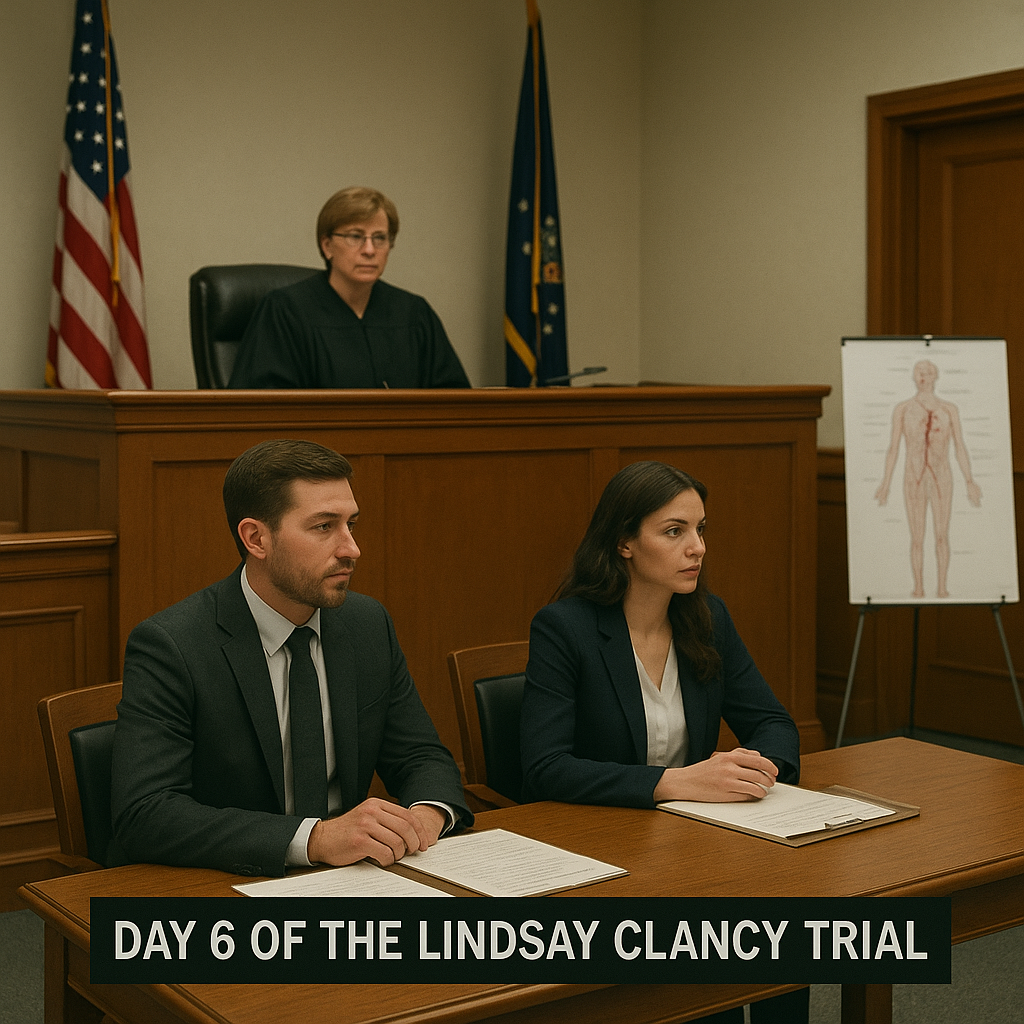
Law enforcement or court response
The response from law enforcement in the Clancy case began with the emergency call and the rapid arrival of officers and medical responders. In cases involving child deaths, police generally have to do two things at once: protect any surviving victims or witnesses and preserve evidence that may later be used in court. That means photographing the scene, documenting injuries, collecting statements, and maintaining a careful chain of custody for physical evidence.
Day 6 testimony from law enforcement officials likely aimed to show how the investigation developed and what officers observed when they arrived. In a murder trial, those details matter because they can support or undermine both the timeline and the defense theory. If officers encountered signs consistent with a crisis, that may support the defense’s portrayal of the defendant’s mental state. If they found evidence suggesting planning or concealment, that strengthens the prosecution.
Medical testimony is just as important. Emergency room personnel, psychiatrists, and other clinicians can describe what they saw in the defendant’s condition after the incident. They may testify about medications, prior treatment, observations of psychosis, or statements made during treatment. Depending on the scope of their testimony, they can either corroborate a mental health defense or complicate it.
Courts often have to manage these cases carefully because they bring together two sources of authority that juries naturally trust: law enforcement and medicine. When both sides call experts, the judge must ensure the evidence stays within the proper bounds. That can mean limiting repeated testimony, ruling on objections about relevance, or instructing jurors on how to weigh expert opinions.
The public response has also been shaped by the way the case has been reported. As with many high-profile child homicide prosecutions, the details are painful enough that coverage must be handled with care. The legal system’s job is not to soften those facts, but it is to test them methodically. Testimony from police and clinicians helps the jury do that.
The case also reflects how modern homicide trials increasingly depend on a mix of traditional witness testimony and specialized records. Body-camera footage, hospital charts, text messages, medication histories, and prior mental health evaluations can all become pivotal. The result is a trial that is part police investigation, part medical review, and part legal argument over culpability.
If you follow this type of reporting, related coverage of police investigative practices, trial evidence and expert witnesses, and mental health response systems may provide useful background.

Community and policy implications
Even though the trial is focused on one family and one defendant, the implications reach far beyond the courtroom. The deaths of three children in a case connected to alleged postpartum psychiatric illness have raised questions about how families, doctors, and public health systems identify risk before a crisis turns deadly.
One major policy question is whether mental health systems are equipped to recognize severe postpartum illness early enough. Some patients receive close follow-up after giving birth, but others fall through the cracks. If symptoms progress rapidly, families may not know where to turn. Clinicians may see warning signs but not have enough time or resources to intervene. Those gaps do not excuse violent crime. But they do matter if the goal is prevention.
Another issue is how criminal courts should handle postpartum mental health evidence. The public often hears shorthand explanations that blur important distinctions between depression, anxiety, psychosis, and other conditions. In reality, these are not interchangeable diagnoses. Postpartum psychosis, for example, is a rare but serious psychiatric emergency that can involve hallucinations, delusions, and disorganized thinking. If the defense can show that such a condition was present, the legal analysis may shift.
At the same time, prosecutors and victims’ advocates will argue that the law cannot be allowed to collapse in the face of sympathy. A tragic diagnosis is not the same thing as legal innocence. The jury still has to decide whether the prosecution proved the elements of the charges and whether any defense established a lawful basis for a different verdict.
The trial also speaks to a larger issue in criminal justice policy: how much weight courts should give to emerging science and expert medicine. Judges routinely face cases where psychiatric knowledge has advanced faster than legal doctrine. That tension is especially visible here. The law asks a narrow set of questions about intent and responsibility, while medicine may describe a far more complicated picture of crisis, impairment, and recovery.
Community reaction in cases like this often reflects a struggle to reconcile grief with explanation. Neighbors and readers want answers. Families of the victims want accountability. Mental health advocates want accuracy and careful language. Those goals are not always compatible. The trial forces the legal system to hold them all in view at once.
Policy makers may also look at whether postpartum mental health screening, postpartum home visits, crisis intervention, and family support services need strengthening. That conversation is not new, but a high-profile case can give it momentum. The challenge is turning public attention into practical reforms that reach parents before symptoms become dangerous.
There is also a broader justice-system lesson about the role of media coverage. When a case becomes a national story, public opinion can harden before the evidence is fully presented. Courts are designed to resist that pressure, but they do not operate in a vacuum. Careful reporting matters because it can distinguish legal fact from rumor and keep the focus on what the evidence actually shows.
For more context on these issues, see coverage of postpartum mental health policy, crisis intervention in families, and justice system responses to mental illness.
Frequently Asked Questions
What happened on Day 6 of the Lindsay Clancy trial?
Law enforcement officials and medical personnel testified, adding detail to the prosecution and defense narratives about the killings and Clancy’s condition at the time.
What is the case about?
Clancy is charged in connection with the deaths of her three children in Massachusetts. The trial is focused on the facts of the killings and her mental state.
Why is mental health such a major issue in the case?
The defense has indicated that psychiatric evidence, including postpartum-related illness, may be central to Clancy’s responsibility and intent.
What can police testimony prove in a homicide trial?
Police witnesses can describe the scene, the response, the physical evidence, and the early steps of the investigation.
Why are medical witnesses important?
They can explain diagnoses, symptoms, treatment, and any observations that bear on the defendant’s mental condition.
Does a mental illness defense automatically lead to acquittal?
No. The jury must still apply the law and decide whether the defense evidence changes the legal outcome.
The Clancy trial remains a difficult and closely watched case because it asks the legal system to do two things at once: account for a devastating loss of life and evaluate evidence of mental illness with care and discipline. That is never easy. But it is exactly the kind of work criminal courts are built to do.