Billy Evans says he knew cameras were recording in the shower but did not consent to having his naked body shown to the public in the documentary <em>You Can...
Billy Evans Says He Did Not Consent to Shower Footage in Elizabeth Holmes Documentary
Billy Evans says he knew cameras were recording in the shower but did not consent to having his naked body shown to the public in the documentary You Can See Everything. The film’s production company, A24, responded that everything filmed was recorded with the couple’s consent, leaving an important question unresolved in the public account: what, exactly, did that consent cover?
Key Takeaways- Evans told CBS Sunday Morning the shower scene’s public release was an uncomfortable surprise, despite his awareness that cameras were filming.
- A24 said everything filmed was captured with consent; the interview did not report the terms of any release or agreement.
- The documentary revisits Elizabeth Holmes’s public life, but Evans’s account of filming is separate from Holmes’s criminal case.
- Holmes was convicted of defrauding investors and sentenced to more than 11 years in federal prison. The interview reports no criminal charge or court finding concerning Evans or the shower footage.
What happened
Evans, 34, gave CBS Sunday Morning what the program described as his first television interview. He spoke about You Can See Everything, a documentary by Lance Oppenheim and Nathan Fielder. The filmmakers spent 34 days with Evans and Holmes, including time in their home in the weeks before Holmes reported to prison in 2023.
The film makes Evans a prominent and often unsettling figure. In the interview, he rejected the portrayal of himself as a controlling man who uses his wife, saying that description was not who he is. He also said he loves the film, even though he would have preferred not to be presented as a villain. The edit, he acknowledged, was not his to control.
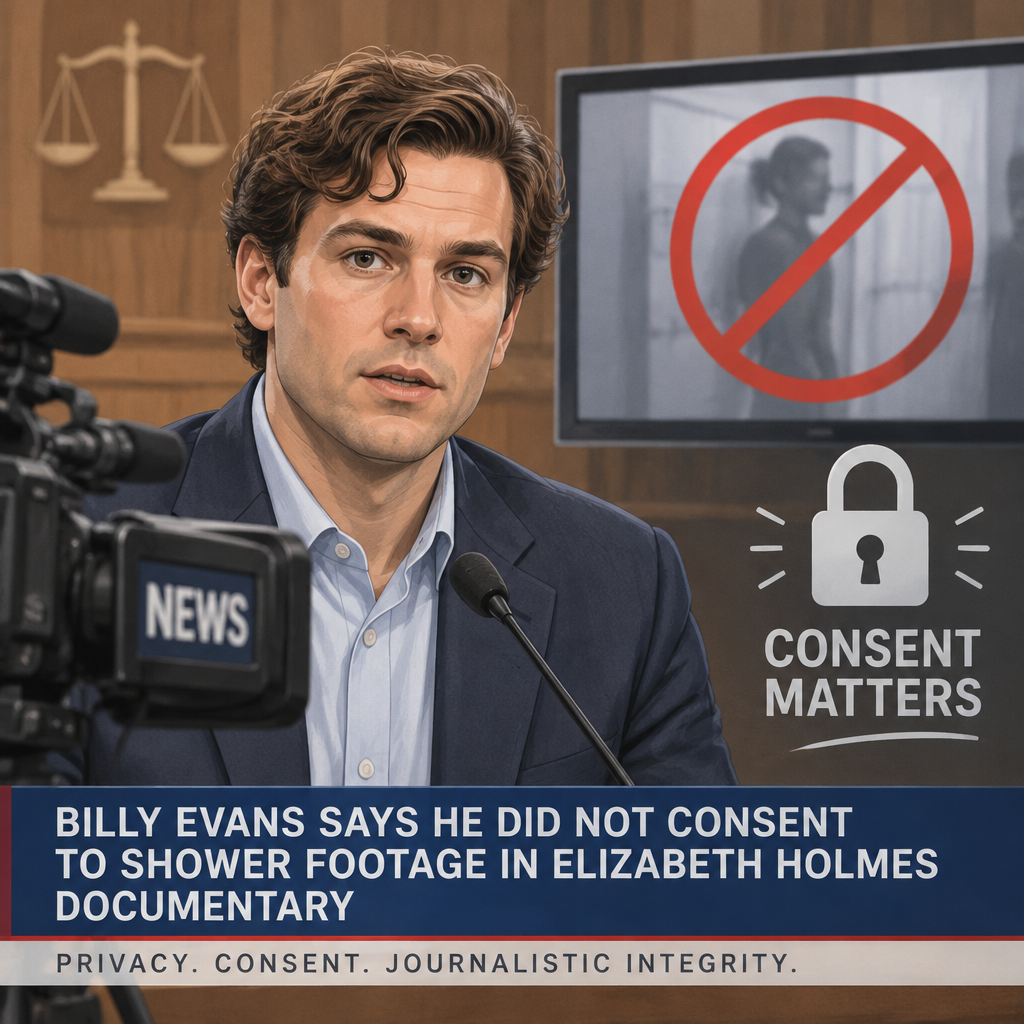
The most concrete dispute he described concerned a shower scene. Evans told CBS he knew the filmmakers were recording while he showered, but said he had not agreed to have his full body shown to viewers. He said he was as surprised as the rest of the public when the footage appeared, and described the experience as awkward and uncomfortable, particularly because people connected to his children could see it.
Those two parts of his account matter. Awareness that a camera is operating is not necessarily the same thing as agreement to publish every image it captures. At the same time, A24’s statement that everything filmed was recorded with consent is a direct response from the production company. The interview does not include a copy of a participant release, an account of negotiations over the scene, or a more detailed explanation from A24 about what it meant by consent.
Evans said filming could run for as long as 16 hours a day. He described requests and incidents he regarded as inappropriate or awkward, but did not detail them, saying he would rather spare viewers the specifics. The account therefore raises questions without establishing what the filmmakers asked for beyond what Evans chose to discuss.
He also explained why he agreed to participate at all. Evans said he takes risks that may be too large, including inviting Fielder into his home and trusting the filmmakers with the right to portray him. His stated aim was to help viewers see Holmes as he knows her. When he watches the documentary, he said, he sees the person he loves.
The interview also places his decision against the intense public attention surrounding Holmes. In 2014, Forbes described her as the youngest self-made female billionaire. By the time Evans met her in 2017, Theranos and its claims about blood testing were under serious scrutiny. Evans said he had seen Holmes’s office earlier that week but did not know who she was when they first met.
Legal context and charges or proceedings
The shower-footage dispute is not part of the criminal case against Holmes. The distinction is important: a documentary can revisit a person’s criminal history while also raising separate questions about the filming and publication of footage of other people. Nothing in the CBS interview indicates that Evans was accused of participating in Theranos’s fraud, or that a court has ruled on his account of the documentary.
Holmes’s case arose from Theranos’s claims to investors about its blood-testing technology and business. In March 2018, the Securities and Exchange Commission announced civil fraud charges against Holmes and former Theranos president Ramesh “Sunny” Balwani. The SEC’s account described alleged misrepresentations about the company’s technology, financial condition and business performance. The agency’s civil case and the later criminal prosecution were separate proceedings.
A federal jury in California returned its verdict against Holmes in January 2022. It found her guilty of one count of conspiracy to defraud investors and three wire-fraud counts involving investors. Jurors acquitted her on patient-related counts and could not reach verdicts on three other counts. Those distinctions matter: the verdict was not a finding that every claim made about Theranos was proved, nor was it a conviction on the patient-related charges.
In November 2022, a federal judge sentenced Holmes to 11 years and three months in prison. She reported to prison in 2023. The U.S. Department of Justice described the sentence as punishment for defrauding investors. Holmes’s convictions and sentence are the established court outcomes; the interview with Evans does not change them or offer new evidence about the trial.

The footage question involves a different set of possible legal issues. In the United States, laws concerning recording, privacy, publicity and publication differ by state and can turn on the facts and the agreements involved. A person’s awareness that a camera is present may be relevant, but it does not, by itself, tell the public what a signed release permitted, whether a particular image was covered, or what the parties understood about distribution.
The interview does not report where a relevant agreement was signed, what its language said, whether Evans signed a separate release, or whether he challenged the scene through a legal claim. It also does not report a court ruling, regulator inquiry or police investigation about the footage. Without those facts, it would be premature to declare that the scene was either lawful or unlawful, or that either side’s public statement resolves the disagreement.
A legal challenge, if one were brought, could require examination of the agreement, communications about the filming, the footage itself and the production’s decisions about editing and release. Depending on the applicable law and claims, issues might include privacy, the scope of consent or whether a portrayal created a legally actionable false impression. Those are general possibilities, not allegations that Evans has made in court.
Nor does a subject’s unhappiness with an edit automatically establish a legal violation. Documentarians generally make editorial choices, and films about matters of public interest can receive legal protection. But editorial freedom does not make every recording or disclosure immune from challenge. The facts and the governing law would matter, and no outcome should be assumed from the interview alone.
Law enforcement or court response
The public response described in the interview came from Evans and A24, not from law enforcement or a court. Evans offered his account of what he knew while filming and what he says he did not agree to have shown. A24’s statement was broader: everything filmed, the company said, was filmed with the couple’s consent. Neither statement, as reported, lays out the full terms of any agreement.
That leaves a factual gap, not a verdict. The company’s statement does not specify whether it is referring to consent to record, consent to edit, consent to distribute, or all of those stages. Evans’s comments likewise do not explain the precise assurances he says were made or identify the paperwork he signed. The interview reports no public release document that would allow viewers to compare the accounts with the written terms.
The criminal proceedings against Holmes followed a very different process. Prosecutors presented evidence to a jury, and the jury returned count-by-count decisions. The Justice Department’s account of the verdict records the convictions, acquittals and unresolved counts. The sentencing announcement records the prison term. Those official documents concern Holmes’s investor-fraud case, not the documentary’s filming practices.
The SEC’s civil action is another source of context, but it should not be mistaken for a finding about the shower scene or Evans. The agency’s 2018 announcement sets out the regulator’s allegations concerning Theranos. The later criminal verdict established Holmes’s guilt on specific investor-related counts after trial. Keeping those proceedings separate helps prevent the film’s dramatic presentation from blurring legal outcomes with opinions about a spouse or a documentary subject.
No law-enforcement response to the shower footage is reported in the interview. Nor is there a report that Evans has filed suit. That absence does not prove that no private dispute exists; it means the CBS account does not establish one. If a case were filed, the documents and claims in that proceeding—not the film’s editing alone—would show what legal arguments were actually made.
Community and policy implications
The dispute has implications beyond one scene because documentary production often relies on prolonged access to private spaces. People may agree to be filmed while believing that the production relationship will operate according to assurances that are difficult for viewers to see later. Once a film is edited and released, participants may have little practical control over the final version, even if they were present for filming.
That power over the finished work is part of the bargain of documentary filmmaking. Directors and editors shape a story from hours of footage; participants do not necessarily have final-cut approval. Evans appears to understand that imbalance: he said he did not control the edit and did not present his criticism as a reason to reject the whole film. He said he loves it, while also describing a moment that he found painful and exposing.
Consent, however, is not a single, self-explanatory word. It can refer to allowing a camera into a room, agreeing to be recorded, signing a release, or authorizing particular uses of the resulting images. Those permissions may be combined in one document or discussed separately. The terms of the agreement in this case are not reported, so the public cannot know how clearly it addressed nudity, intimate settings, editing or distribution.
Productions can reduce conflict by making expectations explicit before filming begins. A written explanation can distinguish permission to record from permission to publish, identify whether sensitive settings are off limits, and state who can be contacted when a participant objects to a proposed scene. Clear boundaries do not guarantee agreement over every edit, but they can make consent more informed and the limits easier to understand.
The question is especially sensitive when a participant’s children, relatives, co-workers or educators may later encounter intimate footage. Evans said the scene’s circulation made him uncomfortable partly because people connected to his children could see it. That is a personal consequence he described, not proof of a separate legal violation. Still, it illustrates how a film made about adults can affect people who did not choose to become part of its public story.
There is also a public-interest question. Holmes’s rise and conviction are subjects of legitimate reporting and documentary scrutiny. The SEC’s allegations and the jury’s verdict concern the conduct of a company and its founder, matters with consequences for investors and public trust. But intimate footage of a partner is not automatically necessary to explain financial fraud. Editors and producers have to weigh what a scene contributes against the privacy costs of showing it.
Audiences can make a similar distinction. A film’s portrayal of Evans may be powerful, but an edit is not a judicial finding about his character. The documentary presents a selected narrative; the interview presents Evans’s response; A24 offers a different statement about consent. Viewers can assess those accounts without treating any one of them as a substitute for a court’s evaluation of evidence.
Frequently Asked Questions
Did Billy Evans know cameras were filming in the shower?
Evans told CBS that he knew the filmmakers were recording while he showered. He said he did not consent to having his naked body shown to viewers and was surprised by the footage’s release.
What did A24 say about consent?
A24 said, “Everything that was filmed was filmed with their consent.” The interview did not report the terms of a release or clarify how the company applied that statement to the shower scene’s publication.
Was Billy Evans charged in the Theranos case?
The interview does not report that Evans was charged. Holmes’s federal convictions were for investor-related conspiracy and wire fraud. The documentary dispute is separate from those criminal proceedings.
What was Elizabeth Holmes convicted of?
A federal jury convicted Holmes in 2022 of one conspiracy count and three wire-fraud counts related to investors. It acquitted her on patient-related counts and did not reach verdicts on three other counts. She was sentenced to 11 years and three months in prison.
Has a court ruled on the shower footage?
No such ruling is reported in the CBS interview. The account does not report a lawsuit or law-enforcement investigation concerning the scene.
A film can document a criminal case and still leave difficult questions about the people who opened their home to the cameras. Evans’s interview does not settle the disagreement over consent, and A24’s response does not disclose the agreement’s terms. For now, the clearest account is also the narrowest: Evans says he knew filming was happening, but says he did not agree to the public exposure of his body. Whether that distinction has a legal consequence is not established by the interview.