Army Plans to Detonate 68 Drums of Unstable Lead Azide at Iowa Ammunition Plant
The Army plans to detonate 68 drums of deteriorating lead azide at the Iowa Army Ammunition Plant near Middletown at 9 a.m. local time Wednesday, officials said Tuesday. They described the explosive as unstable and warned that waiting could lead to an uncontrolled blast. The planned detonation is also expected to release a plume of lead dust, prompting officials to urge people in its immediate path to evacuate.
What happened
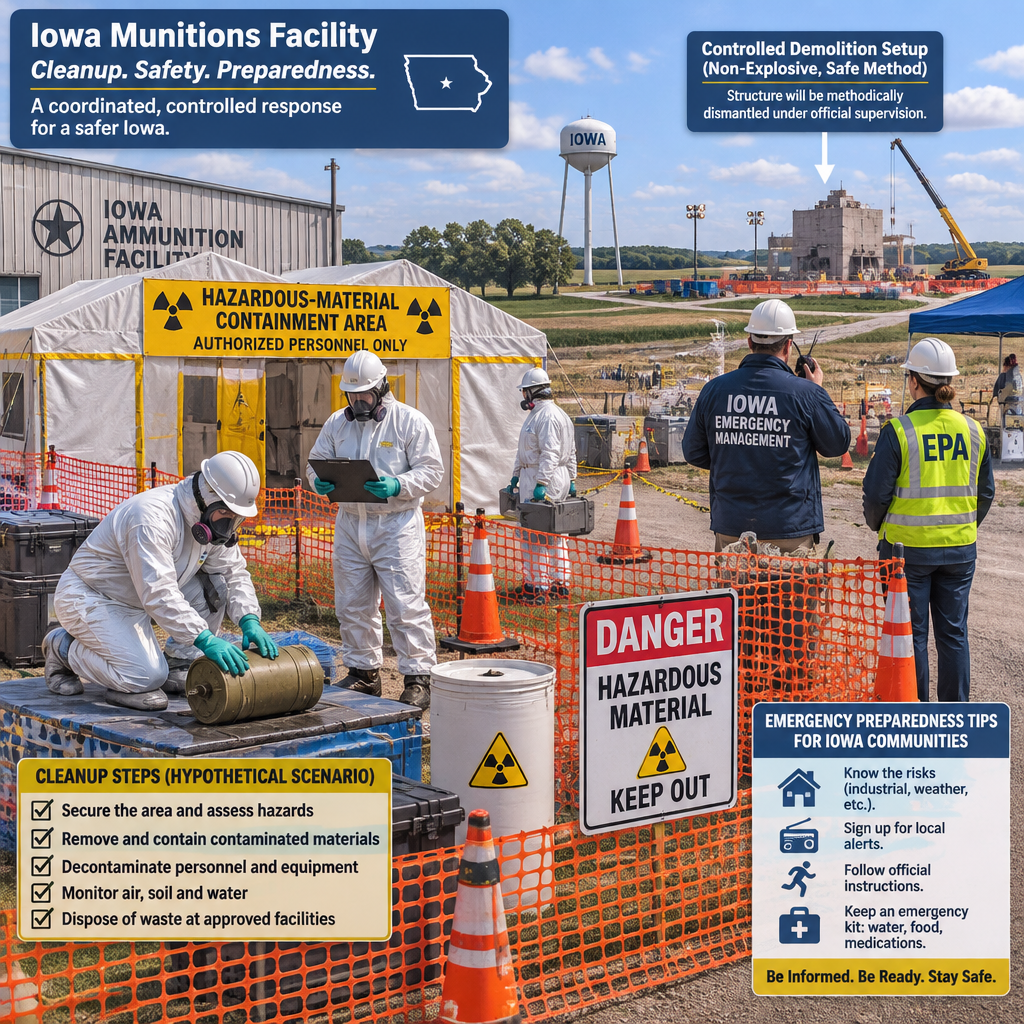
The Army says it will carry out the detonation at the Iowa Army Ammunition Plant, a federal military facility in Middletown in southeastern Iowa. The material involved is lead azide, a toxic explosive compound once used in making bombs. Officials said 68 drums of the chemical have deteriorated and become increasingly dangerous.
The Army’s explanation centers on what it calls recrystallization. Officials said the chemical has changed in a way that makes it highly unstable. They also said cold weather adds to the risk of a spontaneous explosion. The announcement did not state the drums’ total weight, how long they have been stored, or the results of any recent testing. Those details matter to public understanding, but the immediate case made by the Army is that handling the containers could itself set off an explosion.
At Tuesday’s news conference, officials from the Army, the Environmental Protection Agency, the Bureau of Alcohol, Tobacco, Firearms and Explosives and other federal agencies said they had considered alternatives. They concluded that none was safe. Even moving or opening the drums, they said, could trigger a blast.
Acting Army Secretary Adam Telle said officials had hoped to avoid a high-order detonation because it carries risks. “However, we were never able to find a viable alternative,” he said. The Army’s position is that a controlled detonation now presents less danger than leaving the material in place until it explodes on its own.
ATF Director Robert Cekada described the risk of waiting in stark terms: “It’s just a matter of time when we have an uncontrolled detonation. It’s not a matter if, it’s a matter of when, and that would not be a great place for us to be.” His statement expresses the agency’s assessment; officials did not publicly provide a probability, timeline or technical report quantifying the likelihood of an accidental blast.
The plan is expected to send a plume of lead dust across Iowa and possibly into neighboring states. Officials said the weather forecast for Wednesday morning is favorable for protecting public health and safety. Telle called the forecasted patterns “ideal.” The briefing details did not specify wind direction, projected plume boundaries, expected lead concentrations or the locations where air and soil would be sampled.
Those gaps should not be mistaken for proof that the plume will affect every community equally—or that no community will be affected. Wind, particle size and other conditions influence where dust travels and settles. The event had not yet taken place at the time of the announcement, so the plume remained a forecast rather than a measured release.
Legal context and proceedings
A federal appeals court gave the Army the green light to proceed on Monday, according to the account of the ruling. The announcement did not identify the court, the case number, the parties or the reasoning behind the decision. Without those details, it is not possible to describe the ruling’s exact scope or any conditions attached to it.
The court’s action is a significant procedural step: it allows the Army to carry out a plan that had faced a legal challenge. It does not, by itself, establish that the detonation is risk-free, that people have already been exposed, or that the predicted plume will follow a particular route. Those questions depend on the operation and on monitoring after the blast.
This is a court dispute over a proposed public-safety operation, not a criminal prosecution. No criminal charges or individual defendants were reported. The central issue described by officials is whether the Army can proceed with an explosive disposal plan in light of the danger they say the stored material poses and the risks associated with detonation.
The distinction matters. A court’s permission to proceed does not replace the responsibility to explain safety decisions to the public. Residents need to know what the order permits, what precautions agencies will take and how officials will respond if monitoring finds contamination beyond the predicted area. The public details of the ruling were not provided at Tuesday’s briefing, leaving those legal questions difficult to assess independently.
Nor does the decision settle the longer-term questions raised by the incident: how the drums became unstable, how the hazard was managed before officials considered it urgent, and who will pay for testing or cleanup if lead dust is detected. Those questions may be addressed through agency records, later court filings or environmental reviews, but the announcement did not answer them.
Law enforcement and court response
The Army presented the detonation as a response to an imminent explosives hazard. Its officials said that moving the drums or opening them could provoke an explosion, and that alternative ways of neutralizing the material had been examined but ruled out. The explanation offered at the briefing was categorical: officials said they found no safe option other than detonation.
That assessment deserves clear public documentation. A summary of the alternatives considered, the reasons each was rejected and the technical basis for the timing would help residents and independent experts understand why the government views the operation as necessary. Officials said the weather window is favorable, but did not detail the criteria used to select Wednesday morning or what would happen if conditions changed.
The presence of multiple federal agencies at the news conference showed that the response involves more than explosives disposal. The Army is responsible for the facility and the planned operation. EPA officials were among those at the briefing, while HHS preparedness official Sean Kaufman addressed health risks. ATF’s director described the danger officials see in delaying. Their participation does not, on its own, explain each agency’s specific operational role or amount to a guarantee that no harm will occur.
Officials said extensive safety precautions were being taken. They also urged people in the immediate path of the expected plume to evacuate. The briefing account did not provide a map of that path, a radius, a list of affected towns or a single public-facing boundary residents could use to determine whether they are included. When evacuation advice is tied to a forecast zone, a map and repeated updates are essential: people should not have to infer their risk from a general description.
The timing of public notices is also important. Residents told officials they were distressed and confused and did not feel they had enough time to prepare. A warning can be technically accurate yet difficult to act on if it does not say who should leave, when they should leave, where they should go and how they will learn that conditions have changed. Those practical details are part of emergency communication, not an optional addition to it.
The information available before the planned blast did not include a detailed monitoring plan. Public confidence will depend in part on whether agencies disclose where samples are collected, what they measure, how results are interpreted and when results will be released. A clear distinction between forecast modeling and measured conditions can prevent uncertainty from being mistaken either for reassurance or for evidence of widespread contamination.
Community and policy implications
The most urgent concern is the health of people who may be near the projected plume. Officials specifically warned that children and pregnant people face heightened risks from lead exposure. Kaufman, a principal deputy assistant secretary for preparedness and response at HHS, also singled out people with chronic disease. “If they are women who are pregnant, children under the age of 6 or children in general, and individuals who may have chronic disease, you definitely want to be out of that area,” he said. “I would evacuate that area.”
Lead can harm the nervous system, and young children are particularly vulnerable. The CDC says no safe blood lead level has been identified for children. The risks vary with the amount and duration of exposure, among other factors; the announcement did not provide an estimate of anyone’s likely dose. General health information from the EPA, the CDC and the Agency for Toxic Substances and Disease Registry can explain lead’s health effects, but it cannot establish what any person near this operation has inhaled or ingested.
A forecast of lead dust does not mean each location will receive the same amount, or that exposure has already been confirmed. It does mean that local residents need specific, timely instructions. Officials should make clear which areas are in the expected path, whether people outside that area should take any action, and which sources will provide reliable updates. Residents should follow instructions from local emergency managers and public health agencies rather than relying on guesses about wind or on unverified social media posts.
The information people need does not end when the detonation is over. Agencies should explain how they will check air and settled dust, how long sampling will continue, and whether homes, schools, farms or other sites will be considered if results warrant it. They should publish sampling locations and results promptly, describe any limits of the tests and explain what steps follow a concerning reading. Those are questions for officials to answer; the announcement did not establish that contamination has been found or specify what cleanup would be required.
Local schools, health providers and community organizations may also need clear advice that matches official evacuation boundaries. Families need to know whether school operations will change and where to seek guidance about health concerns. If any testing or medical follow-up is recommended, residents should be told who qualifies, where to go and whether the service is available without charge. None of those arrangements was detailed in the briefing account.
There is a broader policy issue behind the immediate emergency. When a hazardous military material becomes unstable, the public needs a transparent account of how it was stored, when the danger was recognized and what options were reviewed. The Army’s explanation that moving the drums could be dangerous may explain why routine handling is off the table. It does not answer how agencies will prevent similar situations, or how the public will be notified when an explosive hazard threatens a civilian area.
The case also tests whether emergency decisions can be communicated in a way that supports informed action. Officials have to balance the danger of an uncontrolled explosion against the potential consequences of a planned release. A credible explanation should acknowledge both risks, state what is known and unknown, and provide updates as forecasts are replaced by measurements. Calling conditions ideal may describe the best available timing; it should not be confused with a promise that there will be no exposure.
For residents, trust will turn on what happens next: whether the evacuation advice is precise, whether the operation proceeds under the stated conditions, and whether environmental data are released in an understandable form. If agencies find lead outside the predicted area, the public will need to know what that means and what response follows. If they do not, the monitoring record should still be made public so the conclusion can be evaluated rather than simply asserted.
Frequently Asked Questions
What is lead azide?
Lead azide is a toxic explosive compound. Officials said the 68 drums at the Iowa Army Ammunition Plant have deteriorated and undergone recrystallization, making them highly unstable. The briefing did not give the total quantity by weight or provide a detailed technical assessment.
Why does the Army say it has to detonate the drums?
The Army says the material could explode spontaneously and that cold weather increases the risk. Officials said moving or opening the drums could also set off an explosion, and that they found no safe alternative to detonation. That is the government’s stated assessment; officials did not release a probability or timeline for an accidental blast at the briefing.
Where is the plume expected to travel?
Officials said the detonation is expected to send lead dust across Iowa and likely into neighboring states. The precise route, boundaries and expected concentrations were not reported in the announcement. People should use evacuation boundaries and directions issued by local emergency officials, not attempt to estimate the plume themselves.
Who did officials urge to leave?
Officials recommended evacuation for anyone in the immediate path of the expected plume. They especially urged pregnant people, children and people with chronic health conditions to leave the affected area if possible. The announcement did not specify an evacuation radius or provide a map of the zone.
Has lead exposure been confirmed?
The Tuesday briefing described a planned detonation and an expected plume. It did not report that the detonation had occurred or that monitoring had confirmed exposure. Measurements after the operation would be needed to establish where lead dust traveled and in what amounts.
The Army says it faces a choice between a planned blast and the possibility of an uncontrolled one. That claim makes the case for urgent action, but it also raises the bar for public explanation. Residents need precise evacuation information before the operation and transparent monitoring afterward. The court’s permission to proceed resolves an immediate legal obstacle; it does not end the government’s responsibility to show what happened and what it means for people living nearby.