After Karen Read’s Acquittal, O’Keefe’s Friends Describe Life Under Suspicion
A new Netflix documentary gives friends and relatives of John O’Keefe a chance to describe the fear and strain they say followed the accusations surrounding his 2022 death in Canton, Massachusetts. More than a year after Karen Read was acquitted of murder and manslaughter, one witness, Colin Albert, says he worries every day that someone may attack him. The case’s criminal verdicts are settled; the public argument over what happened, and who has been believed, is not.
What happened
O’Keefe was a Boston police officer whose death became the subject of two closely watched criminal trials. On the morning of Jan. 29, 2022, he was found unresponsive in the snow outside the Canton home of Brian Albert, a Boston police officer and O’Keefe’s friend. The case drew attention well beyond Massachusetts as prosecutors and Read’s defense offered sharply different accounts of how he came to be there.
Read was O’Keefe’s girlfriend at the time. Prosecutors said the two had been drinking and that Read struck him with her SUV before leaving him in the snow. They pursued charges that included second-degree murder, manslaughter while operating under the influence of alcohol, and leaving the scene of bodily injury and death. Read pleaded not guilty.
Her lawyers presented a different theory. They suggested that O’Keefe may have been attacked inside Brian Albert’s home and that Read had been framed as part of a cover-up. That was the defense’s account, not a finding made by a court. The trial’s central conflict was therefore not only about what the prosecution could prove, but about whether jurors accepted its account beyond a reasonable doubt.
Brian Albert rejected the suggestion that O’Keefe entered his home that night. In the Netflix documentary, he said there were many people in the house and that anyone entering through either door would have been seen in the kitchen. “John O’Keefe never came into my house,” he said. His statement reflects his account of the night; the documentary itself does not resolve the dispute.
Colin Albert, Brian Albert’s nephew, was another prominent figure in the prosecution’s case. He describes the personal impact of becoming a focus of suspicion. “I am scared every single day about somebody coming up to me, whether they try to attack me, whether they try to do something horrible,” he says in the film. He adds that he is scared every day of his life.
The account makes clear how far the case’s public consequences extend beyond a courtroom. The Albert family members were not merely mentioned in competing legal theories; they became people whose conduct and credibility were scrutinized by trial observers and online audiences. The documentary presents their descriptions of that experience, while the underlying allegations remain distinct from the criminal charges that were decided against Read.
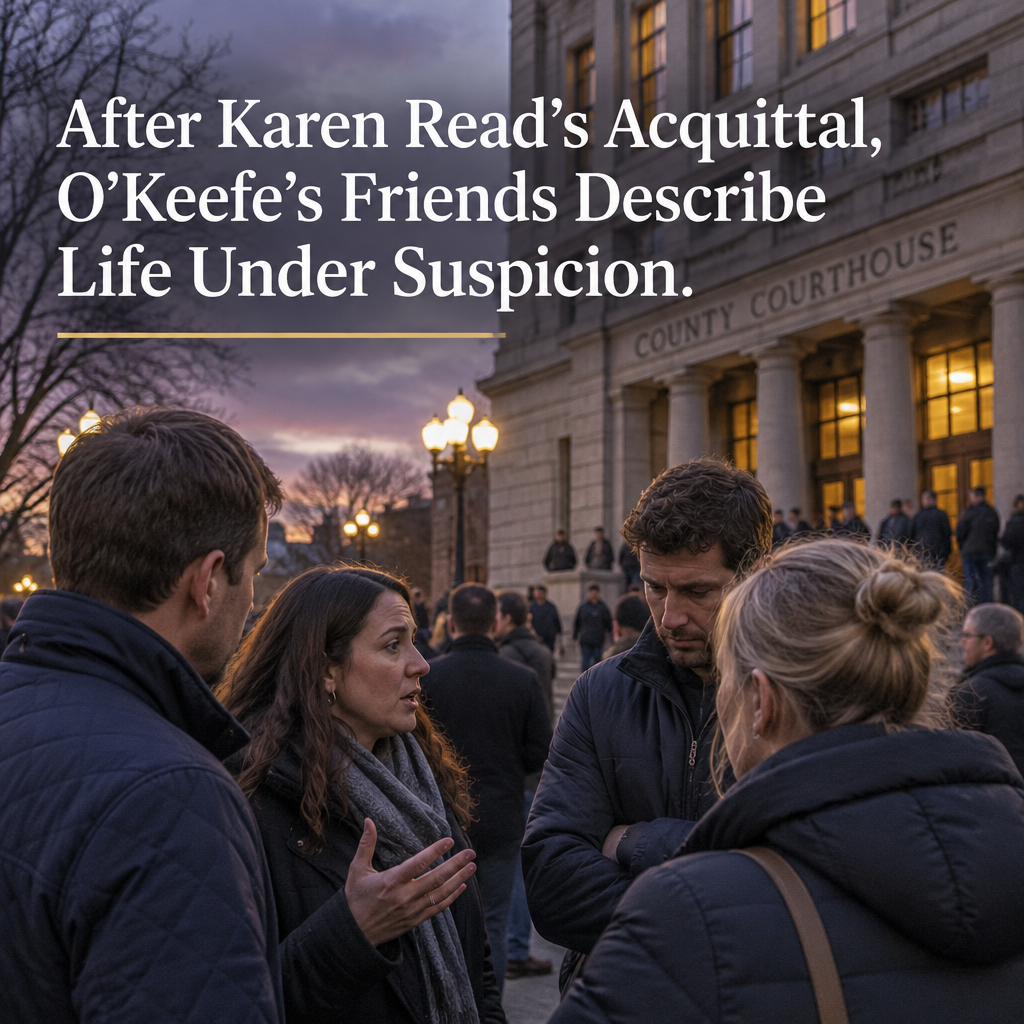
The first trial took place in 2024 and ended without a verdict. A hung jury means jurors did not reach the agreement needed to return a verdict on the charges; it is not a finding of guilt or innocence. Read was tried again in 2025. The second trial, held in June, attracted crowds to the Dedham courthouse, including supporters wearing pink, a color associated with Read. The attention turned a local prosecution into a national spectacle.

The second jury acquitted Read of the charges tied to O’Keefe’s death, including murder and manslaughter. It found her guilty only of driving under the influence. A judge sentenced her to one year of probation. The documentary is set after that result and gives O’Keefe’s friends and family members space to describe what they believe has been lost in the argument over Read’s culpability.
Read did not participate in the film. In a 2024 ABC News interview before her retrial, she was asked whether she had tried to “tap” O’Keefe with her vehicle while intoxicated and emotional, without intending to kill him. She rejected that description. “To tap him with my 6,000-pound, full-size SUV and hit John’s body with my car — no,” she said. That response is part of her public account, not a substitute for the verdict returned at trial.
Jen McCabe, another friend of O’Keefe and a key prosecution witness, says in the documentary that the victim and his family have been forgotten. “People should remember John, and the amazing guy he was, and not Karen Read,” she says. Her comment points to a recurring concern among O’Keefe’s supporters: that an intense argument about Read has eclipsed the life and death at the center of the case.
The film’s format matters. Viewers hear from people who agreed to appear, including witnesses whose names were already prominent in the prosecution’s case. Read did not appear, and a documentary is not a retrial or an independent determination of disputed facts. Its interviews can convey fear, grief, and frustration; they cannot alter the jury’s verdict or establish that a proposed account of the death is true.
Legal context and charges or proceedings
The distinction between the two trials and the final verdict is important. The first proceeding ended in a hung jury, so it produced no verdict on the charges. A retrial followed. In June 2025, jurors found Read not guilty of the offenses linked to O’Keefe’s death and guilty of driving under the influence. The reported sentence was one year of probation.
An acquittal means the jury did not find the defendant guilty of the charged offense under the legal standard it was required to apply. In a criminal case, the prosecution bears the burden of proving guilt beyond a reasonable doubt. A not-guilty verdict is not the same as a judicial finding that every part of the defense’s account happened. In this case, the verdict does not by itself establish that O’Keefe was attacked inside the home or that anyone took part in a cover-up.
The distinction cuts both ways. The accusations directed at Brian Albert, Colin Albert, or other people in public discussion should not be treated as proven simply because they were raised as part of the defense theory. The documentary’s interviews do not supply a court ruling on those claims. The criminal proceeding concerned whether Read was guilty of the offenses charged against her, not whether every allegation made during the public dispute was true.
Read’s conviction for driving under the influence is also separate from the acquittals. The jury returned a guilty verdict on that offense and not-guilty verdicts on the charges related to O’Keefe’s death. Reporting should preserve both parts of the outcome rather than describing the case as either a complete conviction or a complete exoneration. The judge imposed a year of probation; further details of the probation conditions are not reported here.
The verdicts also explain why the earlier hung jury should not be presented as a result in Read’s favor or against her. It signaled that the first jury could not reach a decision, not that it had determined the facts. The second jury then reached verdicts on the charges before it. Those outcomes, rather than the reaction of courthouse crowds or arguments made in the documentary, define the criminal case’s reported result.
Read’s absence from the film has a separate significance. Her public statement in 2024 offered a response to one question about the prosecution’s theory, but it was not testimony in the documentary. Nor should her absence be interpreted as evidence for or against her. The film records the perspectives of its participants; it does not present a full evidentiary record, and it does not replace the trial process.
The available account does not report a new criminal charge against the Albert family members or a new court proceeding arising from the documentary. It is therefore important not to turn expressions of fear or anger into claims that a specific person committed a crime. Where the documentary records a participant’s belief or recollection, it should be described as that person’s account unless independently established by the court record.
Law enforcement or court response
The prosecution’s case placed Read’s conduct and the circumstances of O’Keefe’s death before two juries. The defense challenged that account and advanced a theory that other people were involved. The outcome in 2025 shows that the jury did not convict Read of murder, manslaughter, or leaving the scene, while it did convict her of driving under the influence. The reported facts do not provide a basis for claiming that the court endorsed either side’s broader public narrative in full.
The trial took place in Dedham, Massachusetts. Crowds gathered outside the courthouse in support of Read, and the proceedings received extensive public attention. A visible show of support can be a form of public expression, but it is not evidence and does not determine a jury’s decision. The same is true of hostile commentary or confident claims shared outside court: the law requires the charges to be decided on the evidence and legal instructions presented to jurors.
The testimony of witnesses such as Colin Albert and Jen McCabe formed part of the prosecution’s case, according to the reported account. Their post-trial reflections add information about how they say the public controversy affected them, but they are not new trial testimony. Brian Albert’s statements in the documentary are similarly his own account of the home and the night. A fair report distinguishes those personal statements from findings reached by the jury.
No new law-enforcement investigation or court action is identified in the documentary account described here. That absence should be stated plainly. It would be inaccurate to imply that the film reopened the case, that authorities announced a new inquiry, or that a court has resolved the conflicting accounts since the 2025 verdict.
For readers seeking broader procedural background, the Massachusetts court system describes the state’s courts, while the Associated Press Karen Read coverage page collects reporting on the case. These resources can help separate procedural developments from commentary and personal accounts. The documentary should be read with the same distinction in mind.
Community and policy implications
The Albert family’s account raises a question that often follows a nationally watched prosecution: what happens to witnesses and people named in competing theories after the trial ends? Colin Albert says he fears being approached or attacked. His words establish that he describes living with fear. They do not, on their own, identify a specific threat or document an attack, and no such details are reported here.
That distinction should not minimize the concern. Public accusations can carry consequences even when no criminal charge is brought against the person accused and even after a jury has returned its verdict. Online discussion can make a witness’s identity and personal life a subject of ongoing scrutiny. But public concern about those consequences must not become a reason to silence legitimate criticism, prevent reporting, or treat every disagreement as harassment. The facts of any specific threat require evidence and careful attribution.
The case also illustrates the limits of a verdict as an answer to public conflict. A jury decides the charges in front of it under the applicable law. It does not decide what every viewer should believe about each person who testified, nor does it resolve every suspicion expressed outside court. After a high-profile verdict, legal closure and social consensus are different things. The law can settle a defendant’s criminal liability while community members continue to disagree about the evidence.
The documentary’s choice to center O’Keefe’s friends and relatives shifts attention toward the people who say they have lived with suspicion. But their experience does not erase the need to remember O’Keefe as an individual. McCabe’s appeal to remember him speaks to the risk that a victim’s life can be reduced to a symbol in a public dispute. News coverage and documentaries can resist that reduction by identifying him as a Boston police officer and a person whose death affected family and friends, without using grief to settle contested facts.
The case also demonstrates why precise language matters in reporting. “Acquitted” is not interchangeable with “the defense theory was proven.” “Convicted of driving under the influence” should not be confused with a conviction for causing O’Keefe’s death. “A witness says she is afraid” should not be converted into a claim that a particular person made a threat. These distinctions protect the public’s understanding of the record and the reputations of people who remain part of the story.
Documentaries can contribute to public understanding by recording voices that may not have been heard widely during a trial. They can also narrow the frame, because participants speak from their own memories and interests and because not everyone involved chooses to appear. Read’s decision not to participate means viewers do not hear her directly in this film, though she has spoken publicly elsewhere. That fact is relevant to how the film is understood, but it does not establish that the documentary is inaccurate or that her account is correct.
For people who followed the trial, the courthouse crowds and national coverage may have made the case feel like a contest between camps. Criminal proceedings are not popularity contests. Public support cannot replace proof, and criticism of a verdict cannot turn into proof of guilt. The same standard should apply when a new documentary prompts another wave of discussion: identify what the jury decided, attribute each participant’s claims, and avoid presenting allegations as established facts.
The Norfolk District Attorney’s Office is the county prosecutor’s office, and the Netflix Tudum site provides the streaming service’s official entertainment coverage. Neither type of resource should be mistaken for a neutral substitute for the full trial record. Together with court documents and careful reporting, they can help readers distinguish the film’s presentation from the legal outcome.
Frequently Asked Questions
What happened to John O’Keefe?
O’Keefe, a Boston police officer, was found unresponsive in the snow outside Brian Albert’s home in Canton on the morning of Jan. 29, 2022. Prosecutors said Karen Read struck him with her SUV after a night of drinking and left him there. Read’s lawyers argued she was framed and suggested he may have been attacked inside the home.
Was Karen Read convicted of murder?
No. After a first trial ended with a hung jury in 2024, a second jury in June 2025 acquitted Read of second-degree murder, manslaughter while operating under the influence, and leaving the scene of bodily injury and death. The jury convicted her only of driving under the influence.
What sentence did Read receive?
A judge sentenced Read to one year of probation after her driving-under-the-influence conviction. Other details of the probation conditions are not reported in the account summarized here.
Did the jury find that O’Keefe was attacked inside the home?
No such finding is reported. Read’s lawyers raised that possibility as part of their defense theory. The acquittals mean the jury did not find Read guilty of the charges; they do not establish that the alternative theory was true.
Did Karen Read appear in the Netflix documentary?
No. Read did not participate in “The Trials of Karen Read.” She spoke about the case in an ABC News interview in 2024, before her retrial, and rejected the suggestion that she had intentionally tapped O’Keefe with her SUV.
The verdicts settle the charges that jurors considered, not every public argument about the people involved. As the documentary brings O’Keefe’s friends and family back into view, the most responsible account keeps three things in focus: what the court decided, what each person says, and what remains unproven.